 tradivior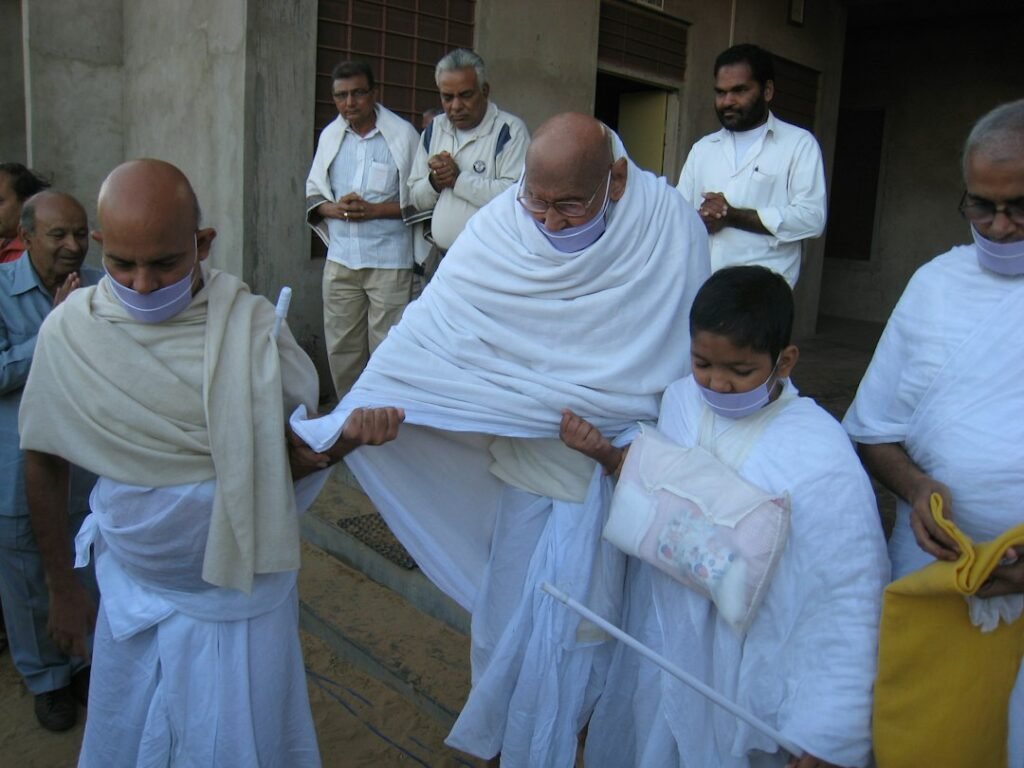
In this investigation
A Jain mendicant walking with a soft broom can look, from a distance, as if they are simply cleaning the path. That is not what the broom is for. Its purpose is ethical: to move small living beings away from places where the monk or nun might otherwise crush them while walking, sitting or lying down.
The broom—known by names such as rajoharana, ogha or picchi depending on tradition—is one of the most distinctive material expressions of Jain ahimsa. It turns non-violence from an abstract principle into a minute discipline of bodily movement.
Ahimsa is the key, not hygiene
Modern observers sometimes reinterpret Jain ground-sweeping as ancient sanitation, environmentalism or even microbial awareness. The historical tradition is much clearer: the concern is harm to living beings.
Classical and monastic sources describe careful sweeping before sitting, lying down or moving through places where small creatures may be present. The aim is not to disinfect the ground but to reduce injury caused by one’s own body.
Why the smallest life matters
Jain ethics extends moral concern far beyond large animals. Living beings are understood across multiple forms and sensory capacities, and the ideal of non-harm reaches into ordinary acts such as walking, eating, drinking and breathing.
This makes the broom intelligible within Jain cosmology and ethics. The practitioner does not need modern entomology to know that small creatures can be crushed underfoot. Careful observation is sufficient.
The broom is one of very few possessions
Jain monasticism places strong restrictions on possessions. The fact that a broom is among the few permitted implements shows how central non-harm is to daily practice.
Different Jain traditions use different materials. Svetambara mendicants may carry a soft woollen or thread broom, while Digambara monks are associated with the picchi made from naturally shed peacock feathers. The material itself is chosen to reduce harm.
Sweeping is not done like ordinary cleaning
The action is gentle. The purpose is to move living beings, not scrub the surface. A harsh sweeping motion that injured insects would defeat the ethical aim.
This distinction matters because the same object category—a broom—can serve entirely different functions. Domestic cleaning removes dirt. Jain monastic sweeping manages the practitioner’s relationship to vulnerable life.
Walking itself becomes morally significant
Most people treat walking as ethically neutral unless they intentionally harm someone. Jain asceticism makes movement morally visible. Where you step, how quickly you move and whether you inspect the ground can all become part of disciplined conduct.
This is a striking example of how religion can slow ordinary action. The body must continually notice its effects on the environment.
The rainy season reveals the same logic
Jain mendicants traditionally reduce travel during the monsoon season, when small forms of life are especially abundant. The rainy-season retreat is another expression of the same ethical concern: movement can unintentionally destroy life.
This does not mean Jain monks discovered modern ecology in the scientific sense. It means close observation of seasonal life informed an already existing ethic of non-harm.
Did Jain monks understand microorganisms?
Claims that Jainism anticipated microbiology are often overstated. Jain traditions certainly conceptualized extremely small living beings and extended moral concern to forms of life invisible or barely visible to ordinary perception. But those concepts belong to a religious cosmology, not to experimental microbiology.
Modern microbiology identifies organisms through microscopy, culture, molecular methods and reproducible classification. A philosophical belief in subtle life is not equivalent to discovering bacteria.
Yet the practical effect can be real
Gently moving visible insects from a place before sitting can indeed reduce the chance of crushing them. No speculative science is required. The mechanism is direct and observable.
Where the creatures are too small to detect, effectiveness becomes less certain. The ethical intention can be strong even when the practical prevention of all harm is impossible.
Ahimsa is about responsibility, not perfect harmlessness
Living inevitably causes some harm. Walking compresses soil. Eating destroys organisms. Breathing affects microbes. Jain ascetic discipline responds by minimizing intentional and avoidable harm as far as practicable within its religious framework.
The broom therefore represents vigilance rather than a claim that the practitioner has become harmless in an absolute physical sense.
Why the practice looks ecological today
Modern environmental movements find Jain ahimsa attractive because it extends moral concern beyond humans. Contemporary Jain thinkers have therefore connected non-violence, non-possession and restraint with ecological ethics.
Oxford scholarship on Jainism and ecology notes that environmental interpretation is largely modern. Classical Jain practice was primarily oriented toward reducing harm and karmic burden, not managing ecosystems as modern conservation science understands them.
This distinction does not make modern ecological readings illegitimate
Traditions can generate new ethical applications. A principle developed in one context can be extended to another. Jain non-harm can meaningfully inspire animal welfare or environmental concern today.
The historical mistake would be to claim that ancient monks carried brooms because they were practicing biodiversity conservation in the modern technical sense.
Attention itself is being trained
The practical requirement to inspect the ground changes attention. A mendicant must notice small life that most pedestrians ignore. This can cultivate a distinctive perceptual habit: the environment is scanned for vulnerable beings rather than treated as empty space.
Modern psychology would describe this as attentional training shaped by moral goals. The person learns to see what the ethical system teaches them to value.
The broom makes ethics visible to others
A carried rajoharana or picchi is also a social signal. It immediately identifies the renouncer and communicates commitment to ahimsa.
This does not reduce the practice to signalling. But public visibility helps communities recognize and reproduce ideals. An object can be both genuinely functional and symbolically powerful.
Why sweeping every step is not universal Jain practice
Popular summaries sometimes imply that every Jain monk sweeps continuously before every footfall. Actual practices differ by sect, context and action. Sweeping before sitting or lying is well documented, and some traditions use longer-handled implements when walking.
This variation matters because caricature can turn an exacting ethical discipline into an exotic spectacle.
The mouth-cloth belongs to the same ethical world
Some Jain mendicants use a muhpatti, a cloth associated with reducing harm to small airborne life and maintaining discipline around speech and breath. Like the broom, it reveals how deeply non-harm penetrates ordinary bodily functions.
Again, this should not be confused with modern respirators or infection-control masks. Similar-looking objects can arise from very different purposes.
Could the practice reduce insect deaths?
For visible insects in the immediate path or seating area, yes, plausibly and directly. Moving an insect before placing body weight on it reduces the chance of crushing it.
Quantifying the effect across daily monastic life would require observational research. The mechanism is straightforward, but the total ecological impact is unknown.
What science cannot infer from compassion
The fact that a practice incidentally protects small organisms does not prove that Jain cosmology accurately anticipated modern biology in all respects. Ethical insight and scientific description are different achievements.
Tradivior’s task is to preserve both: acknowledge the extraordinary scope of Jain concern for life without turning it into a false claim of ancient laboratory science.
The history is visible in art as well as texts
Early Jain artistic representations from Mathura show ascetics carrying whisk-like implements associated with non-harm. This matters because material evidence supports the textual tradition: the broom was not invented recently to dramatize ahimsa for modern audiences.
When literary rules and visual representation converge, historical confidence strengthens. The implement was part of recognizable monastic identity.
Why naturally shed materials matter
For Digambara picchi made from peacock feathers, the preference for naturally shed feathers is itself ethically significant. Obtaining the implement should not require harming the animal whose material is used.
This extends ahimsa upstream into manufacture. An object designed to prevent harm would contradict its purpose if its production required violence.
Non-harm is broader than animal welfare
Modern animal welfare often focuses on sentient animals capable of pain. Jain ethics extends concern to a much wider field of life. That difference is philosophical and should not be erased by translating Jainism directly into contemporary welfare language.
The comparison can still be fruitful. Jain practice demonstrates what happens when an ethic of restraint is applied to ordinary movement with unusual consistency.
Why the practice slows the body
Careful sweeping before sitting or moving prevents impulsive action. The practitioner must pause, inspect and then act. This makes ethical awareness temporal: non-harm requires time.
From a behavioural perspective, the broom inserts a cue between intention and movement. Such cues can interrupt automatic behaviour and make a moral goal more salient.
The broom as a constant reminder
Because the implement is carried visibly, it is not only used when danger appears. Its presence continually reminds the mendicant of the vow. In this sense, the object is both tool and mnemonic.
Psychologists would recognize this as environmental cueing: an external object keeps a behavioural commitment accessible. The religious explanation remains ahimsa; the cognitive mechanism helps explain persistence.
Could such vigilance become psychologically costly?
Extreme concern about causing harm could resemble anxiety or compulsive checking if removed from religious context. But clinical labels should not be imposed simply because behaviour is repetitive or highly cautious.
Diagnosis depends on distress, impairment, loss of control and cultural context. A disciplined monastic practice chosen within a coherent ethical system is not equivalent to obsessive-compulsive disorder.
Jain ecology: continuity and reinterpretation
Modern Jain environmentalism often draws legitimately from ahimsa and aparigraha, or non-possession. Yet historical scholarship cautions that classical ascetic rules were primarily concerned with spiritual liberation and karmic non-harm, not ecosystem management.
This distinction lets contemporary Jains build ecological ethics honestly: as a new application of old principles rather than a claim that ancient monks already practiced modern conservation biology.
Why this is a stronger story than “ancient microbiology”
The pseudoscientific version says Jain monks somehow knew about bacteria before microscopes. The historical version is more impressive: they extended moral concern so far that ordinary movement was reorganized around the possibility of harming tiny beings.
Ethical imagination, close observation and disciplined restraint are genuine achievements. They do not become more valuable by being mislabeled as laboratory science.
Why meticulous non-harm can alter ordinary perception
A person trained to scan the ground for tiny life does not inhabit the same perceptual world as someone who treats the path as empty background. Ethical instruction changes what becomes noticeable.
This matters beyond Jainism. Attention is selective. Humans notice what goals teach them to notice. Jain ascetic discipline makes small forms of life morally salient, so perception itself becomes part of ethical practice.
Why restraint is a technology of behaviour
The broom does not create non-violence by itself. It supports a behavioural system in which the practitioner pauses before acting. That pause is important because many harms are not deliberate; they arise from automatic movement.
In modern behavioural language, the broom functions as a cue that interrupts habit and reactivates a moral rule. This is a plausible psychological mechanism that fits the practice without pretending ancient mendicants used behaviourist theory.
Why the practice is ethically demanding
Ahimsa at this level requires constant inconvenience. Walking more slowly, inspecting a seat, restricting travel in the rains and carrying specialized implements all impose costs. The willingness to accept those costs demonstrates that non-harm is not merely rhetorical.
This is one reason the practice remains compelling today. It asks a question modern life often avoids: how much inconvenience are we willing to accept in order to reduce harm to other beings?
The modern lesson is ethical, not microbiological
The most defensible modern relevance lies in attentiveness, restraint and moral expansion. Jain monastic practice shows how a community can design daily routines around minimizing unintended harm.
That lesson survives perfectly well without claiming that Jain texts secretly contained modern microbiology or ecology. The tradition’s actual achievement is already substantial.
The practice also demonstrates an important distinction between moral intention and measurable outcome. A monk may fail to prevent every accidental death, yet the ritual still changes behaviour toward greater caution. Ethics often works by reducing avoidable harm rather than eliminating all harm.
That makes the broom a rare case where original purpose and practical mechanism align unusually well: the stated aim is to avoid harming small beings, and gently moving visible creatures directly serves that aim.
Why this matters beyond monastic life
Most people will never adopt Jain ascetic discipline, but the practice poses a broader ethical challenge: ordinary actions have consequences for forms of life we rarely notice. The broom makes those consequences visible.
Modern environmental ethics often asks how to reduce large-scale harm through policy and technology. Jain practice begins at the scale of the individual step. The scales are different, but the moral question is related: how much attention are we willing to devote to harms that are easy to ignore?
That alignment between explicit purpose and practical effect is unusual among traditions examined here. Jain ground-sweeping does not need a speculative modern mechanism: its stated ethical goal and observable action already match.
That practical clarity is precisely why the practice deserves to be understood on its own terms rather than inflated into a claim of ancient laboratory science.
What survives scrutiny?
The Jain broom is a historically authentic tool for reducing avoidable harm to small living beings. Its practical logic is direct: look carefully, move vulnerable life, then sit or walk.
The practice also trains attention and visibly embodies ahimsa. What does not survive scrutiny is the claim that it proves ancient knowledge of microbiology or was originally designed as environmental conservation science.
The Tradivior Evidence Profile
Historical Authenticity — Strong. Jain monastic brooms and their non-harm function are well documented in textual, artistic and ethnographic sources.
Original-Purpose Evidence — Strong. Avoiding injury to living beings under the discipline of ahimsa is explicit.
Scientific Mechanism — Strong for visible-life avoidance. Moving an organism before stepping or sitting directly reduces crushing risk.
Experimental Evidence — Limited. The mechanism is obvious, but systematic quantitative studies of prevented harm are scarce.
Cross-Cultural Evidence — Limited to Moderate. Many traditions value non-harm, but Jain ascetic micro-care is unusually rigorous.
Modern Relevance — Strong ethically, context-specific practically. The practice remains central to Jain mendicant identity and informs modern environmental reflection.
The Tradivior Conclusion
Evidence Supported—with historical qualifications. Jain mendicants use soft brooms to reduce avoidable harm to small living beings. The practical mechanism is real and the historical purpose is explicit. What should be rejected is the retrospective claim that the practice demonstrates modern microbiology or that ancient Jain ascetics were environmental scientists in today’s sense. The deeper achievement is ethical: ahimsa is carried down to the scale of where one places a foot.
Sources and further reading
- Deo SB. History of Jaina Monachism from Inscriptions and Literature.
- Dundas P. The Jains.
- Jaini PS. Scholarship on Jain monastic practice and purification.
- Oxford Handbook scholarship on Jainism and ecology.
- Ethnographic scholarship on Jain asceticism and non-harm.
Continue exploring
Partially Supported
Why Do Religious Processions Take Sacred Things Into the Street?
Religious processions move sacred presence, symbols and communities through public space. They can expand shared identity through coordinated movement and visibility, but the same public occupation can mark boundaries and…
Primarily Symbolic/Cultural
Why Is Diwali Built Around Light?
Diwali’s lamps are historically and religiously meaningful symbols whose interpretations vary across Hindu, Jain, Sikh and regional traditions. Light makes sacred time visible and transforms homes and streets; modern science…

Primarily Symbolic/Cultural
Why Do Religions Regulate Meat?
Religions regulate meat because killing animals, blood, purity, sacrifice and communal identity carry unusually high moral weight. Some rules may have ecological or safety consequences, but Jewish, Islamic, Hindu, Jain,…

Partially Supported
Why Did Religions Across the World Practice Fasting?
Why did fasting emerge across Judaism, Christianity, Islam, Hinduism, Jainism and Buddhism? The evidence points to multiple religious purposes—not one hidden metabolic origin—while modern science confirms that different fasting protocols…
Picked for your curiosity
Enable JavaScript to build a reading profile and see recommendations.