 tradivior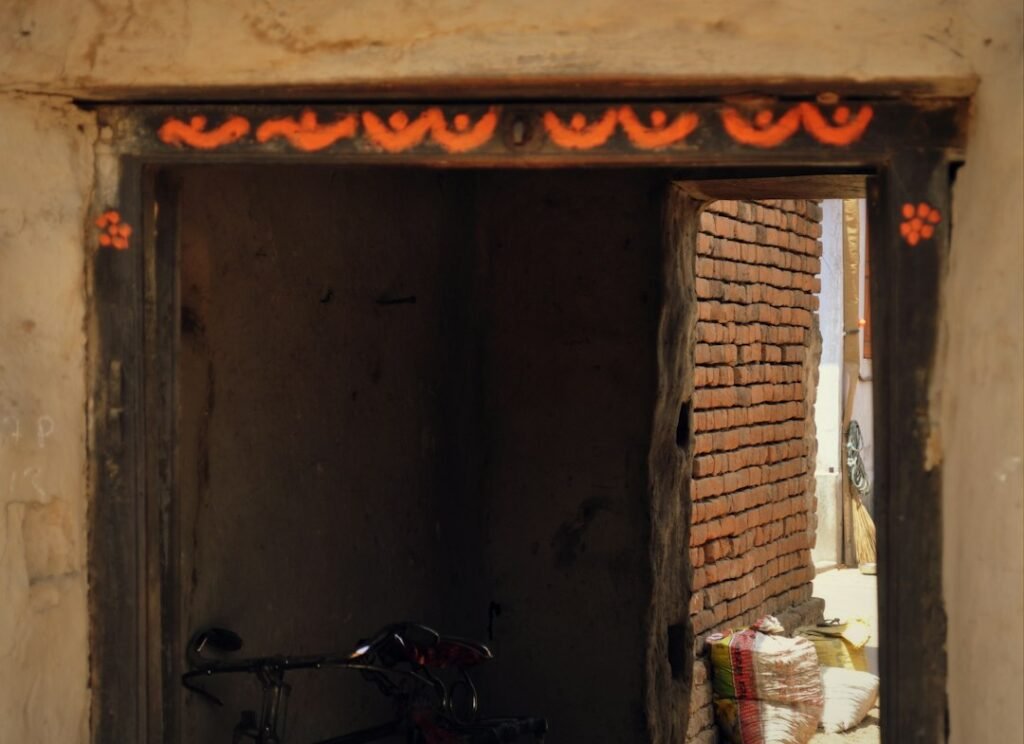
In this investigation
An Indian doorway decorated with leaves, flowers, beads or embroidered cloth immediately announces that the threshold matters. During weddings, Diwali, Gudi Padwa, Navratri, house-warming ceremonies and other auspicious occasions, many families hang a toran or bandhanwar above the entrance.
The practice is often accompanied by modern explanations that sound scientific: mango leaves supposedly absorb harmful gases, marigolds repel insects, green leaves purify the air and the arrangement protects the household from microbes. Some of those plants do contain biologically active compounds. But there is a large gap between laboratory extracts and a few fresh leaves hanging above a door.
The stronger historical explanation begins with the threshold itself. A decorated entrance signals welcome, auspiciousness, ritual readiness and a change from ordinary time to special time. The materials can change while that social function survives.
A toran is first a threshold marker
The Sanskrit word toraṇa has a long architectural history as a gateway or ornamental entrance. Monumental stone toranas at sites such as Sanchi demonstrate how strongly South Asian visual culture could invest gateways with symbolic importance.
The household hanging called a toran is not simply a miniature copy of a Buddhist stone gateway, and the exact historical relationship between architectural and domestic forms should not be overstated. What they share is a broader idea: entrances can be marked, beautified and made ceremonially significant.
THE THRESHOLD PRINCIPLE
A toran tells a visitor that the space beyond the doorway is prepared, welcoming and ritually meaningful. Its first function is communicative before any biological claim is considered.
Fresh greenery is an obvious material for marking auspiciousness
Leaves are abundant, renewable and visually associated with living vegetation. Fresh green material signals vitality in a way that dried wood or bare stone does not.
Mango leaves are especially familiar in South Asian ritual contexts and also appear with water pots and other ceremonial arrangements. Their ritual use therefore extends beyond door decoration.
The leap from “a culturally valued living leaf” to “an ancient air-purification device” is a modern reinterpretation unless direct historical evidence demonstrates otherwise.
The doorway is where welcome becomes visible
Decorating an interior room is mainly for people already inside. Decorating the entrance communicates before a visitor crosses the threshold. It announces festival, wedding, hospitality or ritual preparation to neighbours and guests.
Design resources documenting toran craft in Gujarat and Maharashtra emphasize precisely this welcoming function. The hanging is the first ornament encountered by a guest and can display local embroidery, mirrors, beads, leaf forms and community aesthetics.
Toran craft reveals that tradition is not one fixed object
Modern torans may be made from mango leaves, flowers, fabric, wool, beads, mirrors, plastic or mixed materials. Regional craft traditions give them distinctive shapes and motifs.
This diversity matters because the durable tradition is the decorated threshold, not one mandatory biological material. A fabric toran cannot plausibly work through leaf phytochemistry, yet it still performs the cultural function perfectly well.
Marigold provides a powerful example of a tradition absorbing a newcomer
Orange and yellow marigolds are now so closely associated with Indian festivals that they can appear timeless. Botanically, however, the commonly cultivated Tagetes marigolds are native to the Americas.
Agricultural and botanical sources describe Tagetes erecta as Mexican/Central American in origin and document its spread through Europe after the sixteenth-century Spanish encounter with the Americas. Indian horticultural literature records introduction through Portuguese networks in the early-modern period.
That means an ancient Indian toran tradition cannot have depended on American Tagetes marigolds from its beginning. The flower became integrated into an existing cultural system later.
THE HISTORICAL LESSON
A living tradition can be genuinely old even when some of its most iconic modern ingredients are relatively recent additions. Continuity does not require material immobility.
Why marigold adapted so well to Indian ritual life
Marigolds are intensely coloured, produce abundant flowers, hold up reasonably well as garlands and are widely cultivable. Those practical characteristics make them excellent ceremonial flowers.
Their orange and yellow tones also fit existing auspicious visual palettes. A plant does not need to be indigenous to become culturally important. Adoption can be rapid when a new material works well inside an established ritual grammar.
Do marigolds repel insects?
There is real scientific evidence that compounds from some Tagetes species have insecticidal or repellent activity. Modern reviews describe essential oils and thiophenes with effects against particular insects, ticks, nematodes and other pests under experimental conditions.
That evidence does not directly establish that a household garland of fresh flowers hung above a doorway meaningfully repels mosquitoes from a room. Laboratory extracts and essential oils concentrate compounds far beyond what may be released from decorative flowers in ordinary use.
The correct conclusion is therefore “biologically plausible compounds exist,” not “the toran was designed as an ancient insect-control technology.”
Fresh flowers may influence smell and sensory atmosphere
Aromatic flowers and leaves release volatile compounds. Even without medicinal effects, their smell can change the immediate sensory character of an entrance.
Scent, colour and freshness create an obvious psychological signal that a space has been prepared. That sensory effect is direct and does not require exaggerated claims about sterilizing the air.
Mango leaves contain active phytochemicals—but extraction matters
Research on Mangifera indica leaves identifies compounds including mangiferin, phenolic acids, flavonoids, tannins and terpenes. Laboratory extracts have shown antimicrobial, antioxidant and other biological activities.
But extracting compounds with water, ethanol or other solvents and applying them at measured concentrations is not equivalent to hanging intact leaves in air. Evidence for a mango-leaf extract cannot automatically be converted into evidence that a doorway toran disinfects a house.
The popular “mango leaves absorb carbon dioxide” explanation is weak
Living leaves perform photosynthesis when attached to a functioning plant and supplied with light, water and active tissues. Detached leaves do not become high-capacity carbon-dioxide filters simply because they are hung above a doorway.
Even if some photosynthetic activity briefly continues after cutting, the gas exchange of a handful of leaves would be trivial compared with normal household ventilation and human respiration. There is no good evidence that torans materially regulate room carbon dioxide.
This is a clear example of a modern scientific-sounding explanation being attached retrospectively to a symbolic practice.
“Air purification” is too vague to count as a scientific claim
Air can contain carbon dioxide, volatile chemicals, particulate matter, allergens and microbes. A claim that something “purifies air” is meaningless unless it identifies which contaminant is reduced, by how much, under what conditions and with what measurement.
No strong evidence demonstrates that ordinary mango-leaf or marigold torans function as meaningful household air-cleaning systems.
Symbolic protection can be socially real without being a physical barrier
Families may describe a toran as keeping away negativity, attracting prosperity or welcoming Lakshmi. Science cannot measure “auspiciousness” in the same way it measures particulate matter.
These symbolic interpretations operate within religious and cultural systems. Their significance lies in what the threshold represents, not necessarily in a hidden biochemical mechanism.
The entrance is a natural place for protective symbolism
Doorways are vulnerable boundaries because people, goods and unknown influences cross through them. Cultures worldwide decorate, bless, guard or mark entrances with signs, charms, inscriptions, plants or images.
The toran belongs to this broader human pattern of threshold symbolism. It is positioned exactly where the domestic world meets the outside world.
Ephemeral decoration fits festivals particularly well
Fresh leaves and flowers decay. That apparent weakness is also a ritual strength. They make a festival visibly temporary.
The household is renewed for a wedding or sacred day, the decoration remains fresh for a limited period, and then ordinary time returns. Perishable material can therefore mark ceremonial time more effectively than permanent ornament.
Making the toran can be part of the ritual
Traditions are not only objects; they are actions. Selecting leaves, buying flowers, tying strings and decorating the doorway create shared preparation before guests arrive or worship begins.
The labour itself can reinforce family participation and memory. A ready-made plastic toran preserves the visual symbol while changing that participatory dimension.
Craft torans preserve local identity even when fresh plants disappear
Embroidered and beadwork torans in Gujarat, Kutch, Saurashtra and Maharashtra demonstrate how doorway decoration became a craft surface carrying local motifs and techniques.
Peacocks, floral forms, mirrors, geometric patterns and deity imagery can transform the toran into a statement of regional aesthetic identity as much as ritual purity.
A scientific origin story is unnecessary
Modern defenders of tradition sometimes assume that a custom becomes more respectable if it was secretly invented for mosquito control, oxygen production or antimicrobial air purification.
The toran does not need that rescue. A welcoming threshold marker used to beautify sacred occasions is already a coherent cultural practice.
If some plant materials also release useful volatiles, that can be an incidental benefit rather than the hidden reason the tradition exists.
Tradition evolves by substitution
Fresh mango leaves may be unavailable in an apartment city. Marigolds may be expensive. Families may substitute artificial leaves, fabric or beadwork.
If the custom remains recognizable after the biological material disappears, that is strong evidence that its core function is symbolic, aesthetic and social rather than chemical.
What survives scrutiny?
- Decorating thresholds with torans is a well-established South Asian living tradition associated with auspicious occasions and welcome.
- The Sanskrit term toraṇa has an ancient architectural gateway history, although domestic hanging torans should not simply be equated with monumental stone gateways.
- Mango leaves have long ritual associations and remain a common fresh material for doorway decoration.
- Modern torans also use fabric, beads, embroidery, mirrors and synthetic materials, showing that the tradition is not dependent on one plant.
- Tagetes marigolds are native to the Americas and reached India in the early-modern period, so marigold torans cannot be an unchanged ancient Indian material tradition.
- Marigold essential oils and extracts can have insect-repellent or insecticidal effects under experimental conditions.
- Mango-leaf extracts contain bioactive phytochemicals and show laboratory antimicrobial activity.
- Neither body of evidence proves that fresh doorway garlands provide meaningful household pest control or air sterilization.
- Claims that a few detached mango leaves materially absorb household carbon dioxide or “purify oxygen” are not supported by good evidence.
- The strongest explanation is threshold symbolism: welcome, auspiciousness, celebration, ritual preparation and local identity.
The Tradivior Evidence Profile
Historical Authenticity — Strong. Torans and decorated thresholds are established South Asian traditions, with regional craft forms and ritual use documented across living communities.
Original-Purpose Evidence — Moderate to Strong. Welcome, auspiciousness, sacred occasion and prosperity symbolism are well documented; universal claims about one original purpose are difficult because forms vary regionally.
Scientific Mechanism — Limited. Some toran plants contain volatile or bioactive compounds, but realistic doorway exposure is very different from laboratory extracts and essential oils.
Experimental Evidence — Limited. Evidence exists for biological activity of marigold and mango-leaf preparations, not for household torans as clinically or environmentally meaningful air-cleaning or insect-control devices.
Cross-Cultural Evidence — Moderate. Threshold decoration and protective entrance symbolism are globally common, while the toran is a specifically South Asian form with substantial regional diversity.
Modern Relevance — Strong. Torans continue to function effectively as symbols of welcome, festival, identity and household preparation even when made from non-plant materials.
The Tradivior Conclusion
Primarily Symbolic/Cultural. Torans survive scrutiny most strongly as threshold symbols that announce welcome, auspiciousness and ritual readiness. Fresh mango leaves and marigolds can contribute colour, scent and living material, and both plants contain compounds with real biological activity. But modern claims that a doorway toran materially purifies household air, removes carbon dioxide or functions as a scientifically designed insect barrier are not supported by direct evidence. The history of marigold is especially revealing: an American flower introduced in the early-modern period became so successfully integrated into Indian ritual life that it now feels ancient. That is not a weakness in the tradition. It is evidence of how living traditions adapt.
Continue investigating
- Why Do People Remove Shoes Before Entering a Home?
- Why Do Indian Homes Create Rangoli at the Entrance?
- Why Do Traditions Decorate Sacred Spaces With Flowers?
Sources and further reading
- D’Source, National Institute of Design. “Toran Making.” Documentation of toran craft, doorway use and regional decorative traditions in Gujarat.
- D’Source, National Institute of Design. “Traditional Toran from Kolhapur.” Documentation of regional toran practice in western Maharashtra.
- Tingsanchali C. “Early Makara Torana in Indian Art.” Damrong Journal of the Faculty of Archaeology. Study of the architectural torana motif.
- Kew Science. Tagetes erecta / Mexican marigold: native range in Mexico and Central America and global introduction.
- Indian horticultural literature on marigold origin and introduction into India through Portuguese networks in the sixteenth century.
- Verma N, Aggarwal N, Sood P. “Exploring the phytochemistry and biological potential of Tagetes minuta (L.): A comprehensive review.” South African Journal of Botany. 2024;168:175–195.
- “Insecticidal activity of marigold Tagetes patula plants and foliar extracts against the hemipteran pests.” 2020; PMCID: PMC7237031.
- Mehmood H, Mehmood J, Zulfiqar N. “Exploring the phytochemistry and pharmacology of Mangifera indica L. leaves: A review.” International Journal of Plant Based Pharmaceuticals. 2024;4(1):9–18.
- “Mango (Mangifera indica L.) Leaves: Nutritional Composition, Phytochemical Profile, and Health-Promoting Bioactivities.” Antioxidants. 2021;10(2):299.
- “Utilisation of Mangifera indica plant extracts and parts in antimicrobial formulations and as a pharmaceutical excipient: a review.” Future Journal of Pharmaceutical Sciences. 2023.
Continue exploring
Partially Supported
Why Do Humans Repeat Rituals?
Rituals repeat because fixed sequences create predictability, memory, identity and coordination. Experiments suggest ritualized repetition can regulate anxiety and social connection, while mantra repetition shows small benefits for psychological distress;…
Partially Supported
Why Do Religious Processions Take Sacred Things Into the Street?
Religious processions move sacred presence, symbols and communities through public space. They can expand shared identity through coordinated movement and visibility, but the same public occupation can mark boundaries and…

Primarily Symbolic/Cultural
Why Do Humans Make Offerings to the Sacred?
Offerings make relationships with gods, ancestors and sacred powers materially visible. Gifts can express reciprocity, devotion, gratitude, sacrifice and group commitment; costly-signalling models illuminate some public effects but cannot substitute…
Primarily Symbolic/Cultural
Why Is Diwali Built Around Light?
Diwali’s lamps are historically and religiously meaningful symbols whose interpretations vary across Hindu, Jain, Sikh and regional traditions. Light makes sacred time visible and transforms homes and streets; modern science…
Picked for your curiosity
Enable JavaScript to build a reading profile and see recommendations.