 tradivior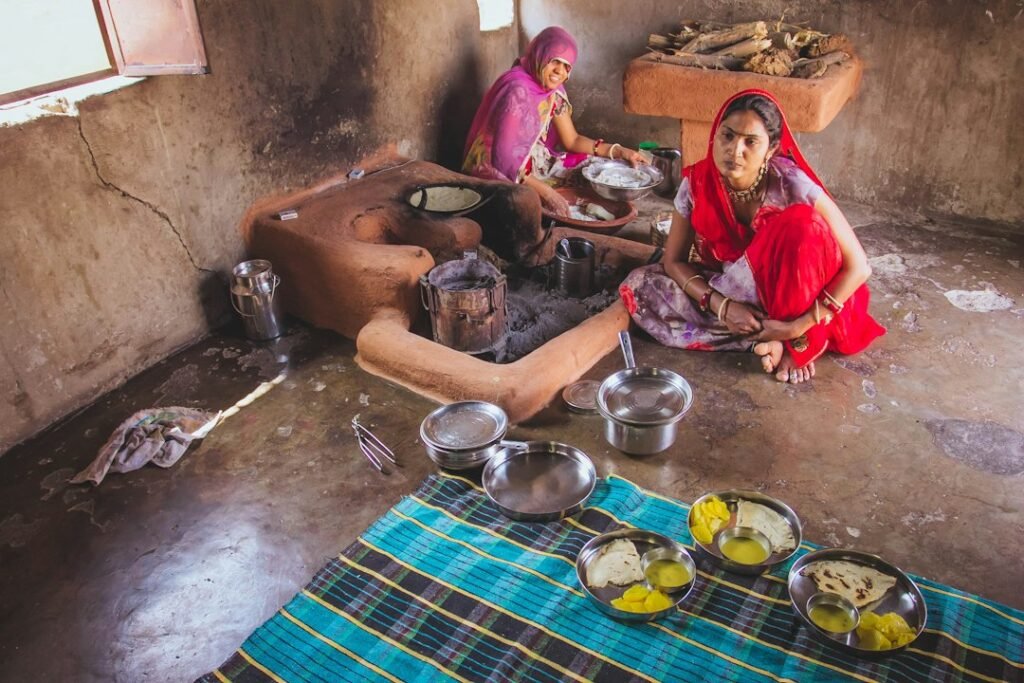
In this investigation
In many Indian homes, the kitchen was never simply a room containing a stove. It could be a protected zone with rules about who entered, who cooked, what utensils touched which foods, where water was stored, where people sat to eat, when the space was washed, and what happened after birth, death, menstruation, illness or ritual observance.
Modern explanations often convert these rules into a neat hygiene story: kitchens were separated because ancient Indians understood germs. That claim captures only part of the picture. Separation can certainly reduce dirt, animals, smoke and accidental contamination. But historical and ethnographic evidence also shows that Indian food spaces carried ideas of ritual purity, caste hierarchy, commensality, gendered domestic responsibility and sacred offering. These meanings cannot be reduced to microbiology.
The more accurate question is not “Was the traditional Indian kitchen scientific or superstitious?” It is: what problems did spatial separation actually solve, and which social values did it enforce?
There was never one traditional Indian kitchen
India’s domestic architecture varies enormously by climate, region, religion, caste, class, household size and period. A Tamil courtyard house, a Maharashtrian wada, a Bengali household, a Rajasthani haveli, a Bohra dwelling in Gujarat and a Himalayan home could organize food, water and eating in very different ways.
Any claim that “Indians traditionally kept the kitchen in this exact location” should therefore be treated cautiously. What recurs is not one national floor plan, but the idea that cooking and eating are socially important activities whose spaces often receive special rules.
THE FIRST CORRECTION
Traditional Indian domestic space is regionally diverse. The useful comparison is between recurring principles—cleanliness, fire control, water access, privacy, purity, commensality and household hierarchy—not one supposed ancient blueprint.
The kitchen was often a controlled threshold between raw and cooked
Cooking transforms ingredients materially, but in many South Asian traditions it also transforms their social status. Raw grain that can be transported or handled relatively freely may become cooked food whose acceptability depends on who prepared it, what water was used, which utensils touched it and to whom it is served.
That makes the kitchen a threshold. Outside it are raw ingredients, fuel, market purchases and visitors. Inside it, food becomes part of the household body and, in some traditions, may become fit for ritual offering. Controlling access to that space therefore had social and religious consequences beyond ordinary tidiness.
Purity and cleanliness overlapped—but were not the same concept
A washed utensil can be physically clean yet ritually unacceptable in a particular tradition. Conversely, an object treated as ritually pure is not automatically sterile. Historical purity systems classify substances, persons and situations through religious and social rules, not laboratory microbiology.
This distinction matters because modern retellings often convert ritual purity into hidden germ theory. There were genuine cleaning practices, but the reasons given historically could involve auspiciousness, caste, bodily states, deity worship or rules of touch. Scientific hygiene and ritual purity sometimes produce similar behaviour without being the same explanation.
Daily cleaning had obvious practical value
Traditional kitchens using solid fuel, open vessels, stored grains and frequent floor-level work were exposed to soot, ash, food scraps, insects, rodents and moisture. Regular sweeping, washing and organized storage therefore had practical benefits independent of ritual theory.
Colonial-era Hindi cookbooks studied by historians repeatedly emphasized cleaning the kitchen, washing utensils, organizing stores and preparing the cook’s body and clothing before food preparation. These texts mixed older purity ideas with emerging domestic-science and hygiene language, showing how categories could merge over time.
Separating cooking from traffic reduces contamination opportunities
A cooking space that is not also the main passageway keeps outdoor dirt, footwear, animals and unrelated household activity away from food preparation. Separating storage protects grain from water and heat. Keeping washing activity organized prevents wastewater from spreading through dry food zones.
These are ordinary environmental-control benefits. They do not require an ancient theory of bacteria to be discovered. Generations can learn empirically that some arrangements keep food cleaner, reduce pests and make work easier.
Fire itself encouraged spatial specialization
Traditional cooking fires generate heat, smoke, sparks and ash. Before modern gas lines and exhaust fans, managing combustion was a major architectural issue. Kitchens needed fuel storage, ventilation and surfaces that could tolerate heat.
Separating sleeping areas from heavy smoke and flame had obvious advantages. In many courtyard houses, semi-open spaces also allowed food preparation to move with season, light, ventilation and household activity rather than remain fixed inside a sealed room.
Courtyard houses show that cooking zones could be flexible rather than rigid
Architectural studies of Tamil courtyard houses show kitchens positioned near internal courtyards, with adjacent spaces used for preparation, washing, drying food, dining or family activity depending on time of day. Bohra houses in Gujarat likewise used the courtyard as an organizing core, with kitchens, water places and stores connected to it.
This evidence complicates the image of a permanently sealed sacred kitchen. Households often used a gradient of spaces: dedicated cooking area, preparation area, water zone, courtyard, dining zone and formal reception rooms. Boundaries could be real without being absolute.
Water was one of the most socially sensitive household resources
Water is essential for cooking, drinking, washing hands, cleaning utensils and ritual purification. In societies where caste rules governed commensality and touch, water could become socially charged because contamination was understood not only materially but ritually.
Separate vessels, protected water storage and rules about who could draw or serve water therefore had more than one function. They could prevent ordinary dirt and mixing, but they could also reproduce hierarchy by restricting who was considered an acceptable handler.
Cooked food could carry the social identity of the cook
Anthropological work on caste and food shows that who cooks for whom has historically mattered deeply in many communities. Acceptance of food could depend on caste status, perceived purity, type of food and relationship between giver and receiver.
This is why a “pure kitchen” cannot be discussed only as a sanitation strategy. Purity rules were also mechanisms of social exclusion. They could determine who entered, whose touch invalidated food and whose labour remained invisible or stigmatized.
THE HISTORICAL LIMIT
Some kitchen boundaries reduced ordinary contamination. Others enforced caste and status boundaries. The same rule could do both. Calling every purity restriction “ancient hygiene” hides the social hierarchy encoded in food practice.
Commensality determines who may become socially close
Eating together is one of the strongest signals of social acceptance. Refusing to accept food from a person can communicate distance more powerfully than words. Across Indian history, caste rules often governed inter-dining and the exchange of cooked food.
The dining zone therefore mattered because food consumption was social classification in action. Who sat together, who served, who ate first and whose leftovers could be touched were historically meaningful questions in many households.
Purity rules could turn domestic architecture into social hierarchy
A house is not socially neutral. Entrances, courtyards, kitchens, prayer rooms and service areas regulate movement. When only some people are permitted into the cooking zone, architecture helps enforce the rule.
This is one reason food hierarchy can persist without constant verbal instruction. The layout itself teaches who belongs where.
The kitchen was also a gendered workplace
Idealized household traditions often made women responsible for maintaining culinary order, purity, timing and hospitality. Colonial-era cookbooks in North India helped construct the ideal middle-class Hindu housewife as the guardian of a clean, organized and morally disciplined kitchen.
This domestic authority could be real while remaining unequal. Skill, knowledge and control over food gave women influence inside the household, but the same system could confine labour, assign disproportionate responsibility and link a woman’s moral worth to domestic performance.
Rules around menstruation reveal why hygiene-only explanations fail
In some communities, menstruating women were or remain restricted from kitchens, prayer spaces or food preparation. These practices vary enormously and are actively contested.
Whatever modern health arguments are later attached to such rules, they cannot be explained primarily as food-safety measures. Menstruation itself does not make a person microbiologically unsafe to cook. The restrictions belong mainly to culturally specific purity systems and gender norms.
Birth and death could temporarily reorganize household food rules
Many Hindu communities historically observe periods of ritual impurity associated with birth or death. During these periods, ordinary cooking, worship or food exchange may be altered.
Again, the social logic is not reducible to contamination control. A birth or death changes the ritual status of the household. Food rules make that invisible transition tangible in everyday life.
Sacred offering raises the standard of separation
Food intended for a deity is often prepared under stricter rules than ordinary meals. Ingredients, utensils, bodily cleanliness and tasting practices can be regulated because the food is not yet simply household food; it is an offering.
After offering, prasāda may circulate back to worshippers with transformed religious status. Anthropological work in Chhattisgarh and elsewhere shows how food exchange with deities can create a ritual zone of purity and a hierarchical relationship between divine recipient and human participants.
Separate utensils can solve practical and symbolic problems simultaneously
Households may reserve vessels for milk, ritual food, meat, guests or particular cooking processes. Materially, separation can prevent flavour transfer, allergen mixing or residue. Symbolically, it can maintain dietary boundaries.
The danger is retrospective simplification. If one utensil is separated for a ritual reason and another for practical cooking performance, a modern observer should not force both into the same explanation.
Vegetarian and non-vegetarian zones can reflect identity as much as sanitation
Some households maintain separate cookware or preparation areas for vegetarian and non-vegetarian foods. Modern kitchens sometimes retain the practice even when strict ritual rules have weakened.
The separation can prevent unwanted mixing, which is practically useful for dietary preference. But historically, vegetarianism in parts of India has also been linked to caste status, religious identity and claims of purity. The boundary can therefore express morality and social belonging, not simply food safety.
Colonial modernity did not simply replace tradition—it reworked it
Early twentieth-century Hindi cookbooks show household reformers mixing Ayurvedic language, Hindu purity ideals, colonial domestic science, nationalism and modern hygiene. Clean kitchens became evidence of bodily discipline and even civilizational strength.
This matters because practices presented today as timeless may have been reorganized relatively recently. Modern domesticity often takes older rules and gives them new scientific, nationalist or middle-class explanations.
The colonial kitchen became a political space
Historians of Bengal and North India show that cooking and domestic food practice became linked with cultural nationalism. The household kitchen could represent moral order against colonial stereotypes, while the idealized “Indian” diet was selectively reconstructed.
This process demonstrates why claims about “our ancestors always did this for scientific reasons” deserve scrutiny. Traditions are continuously re-described in response to new political worlds.
Caste exclusion cannot be rescued by calling it hygiene
Modern scholarship continues to document how food practices reproduce caste boundaries in homes, restaurants, schools and public institutions. Who cooks and who eats together remain politically charged questions.
There is no scientific basis for treating a person’s caste as a contamination risk. Where kitchen purity rules exclude people because of inherited status, the mechanism is social hierarchy, not microbiological protection.
Dalit and anti-caste movements have challenged food hierarchy directly
Food has also been a site of resistance. Anti-caste thinkers and movements challenged restrictions on commensality, water access and dietary legitimacy. Public eating, shared meals and assertion of stigmatized foods can function as political acts.
This is important for any modern evaluation of kitchen tradition. A practice may be historically authentic and socially harmful at the same time. Tradivior’s task is not to preserve hierarchy simply because it is old.
Modern food safety supports zoning—but by different criteria
Contemporary food-safety systems also separate activities. Raw meat is kept away from ready-to-eat food. Handwashing areas are maintained. Waste is separated from food storage. Clean utensils are protected from dirty ones.
This creates a superficial resemblance to traditional purity zones. But modern safety rules are based on measurable hazards such as pathogens, allergens, chemicals and temperature control. The criterion is contamination risk, not caste, auspiciousness or ritual status.
Some traditional habits survive very well under modern evidence
Removing outdoor footwear from food-preparation areas, cleaning surfaces, protecting drinking water, separating waste, keeping animals away from stored food and organizing raw versus cooked ingredients are all sensible practices under modern hygiene.
The reason they survive scrutiny is that their practical effects can be measured—not because every traditional explanation must therefore have been scientific.
Other rules survive mainly as identity and ritual
Separate utensils for sacred offerings, rules about tasting before worship, particular directions for a cooking hearth or restrictions linked to ritual states may remain deeply meaningful without having a demonstrated food-safety advantage.
Symbolic does not mean worthless. Ritual organization can maintain identity, memory and a sense of sacred order. The problem begins only when symbolic rules are falsely advertised as universal medical facts.
Modern apartments are transforming the old spatial logic
Urban apartments compress cooking, dining and living into smaller footprints. Gas and induction replace smoky hearths. Refrigerators alter storage. Domestic help, restaurant delivery and shared workplaces change who handles food.
Yet many families preserve parts of the older logic: footwear remains outside, prayer food receives separate treatment, kitchens may still be restricted during rituals, and vegetarian/non-vegetarian utensils may remain distinct. Tradition adapts to architecture rather than disappearing.
Regional architecture proves that function and meaning were intertwined
Courtyard houses are especially revealing because one layout can solve climatic, social and ritual problems at once. The courtyard brings light and ventilation, supports drying and washing, allows supervision of children, provides semi-private family space and helps separate formal visitors from domestic work.
The kitchen’s relationship to the courtyard therefore cannot be reduced to one motive. Architecture often succeeds precisely because one spatial arrangement satisfies several needs simultaneously.
The most durable insight is controlled flow
Traditional kitchen zoning controls flows: people, water, smoke, ingredients, utensils, waste and social interaction. Modern kitchens do the same with different technologies.
The useful inheritance is not a rigid map of pure and impure persons. It is the design principle that food preparation benefits from deliberate boundaries between clean and dirty processes, storage and waste, public traffic and controlled preparation.
Tradition becomes harmful when symbolic hierarchy masquerades as contamination science
A rule such as “wash hands before cooking” can be defended by measurable hygiene. A rule such as “food becomes unsafe because a person of a particular caste touched it” cannot. Both may historically appear within one purity system, but modern evidence separates them.
This is precisely why Tradivior uses multidimensional evidence rather than asking whether a tradition is simply “scientific.” A practice can contain sound environmental design and unjust social hierarchy at the same time.
What survives scrutiny?
- Indian kitchen layouts and rules varied greatly by region, religion, caste, class and period; there was no single universal traditional design.
- Separating cooking, storage, washing and heavy household traffic can reduce dirt, smoke, pests and practical contamination.
- Courtyard houses often organized kitchens, water, food preparation and dining through flexible zones rather than rigidly isolated rooms.
- Ritual purity and physical cleanliness overlap in some behaviours but are conceptually different.
- Historical food rules often governed who could cook, serve, share water or eat together.
- Caste-based kitchen restrictions functioned as social hierarchy and exclusion, not evidence-based contamination control.
- Gendered kitchen responsibility could provide domestic authority while also concentrating unpaid labour and moral expectations on women.
- Sacred-food preparation and separate ritual utensils remain understandable as religious practices without needing biomedical justification.
- Modern food safety supports separation by measurable hazard—raw versus cooked food, waste, allergens, pathogens—not inherited social status.
- The strongest surviving design principle is controlled flow of people, water, ingredients, utensils, smoke and waste.
The Tradivior Evidence Profile
Historical Authenticity — Strong. Specialized kitchens, food purity rules, commensality restrictions and domestic zoning are well documented in multiple Indian regions and historical periods.
Original-Purpose Evidence — Strong. Historical sources and ethnography show intertwined purposes: ritual purity, caste regulation, sacred offering, household order, cleanliness, gendered domesticity and practical food preparation.
Scientific Mechanism — Moderate. Spatial separation can reduce ordinary contamination, smoke exposure, pests and workflow conflicts. These mechanisms do not explain caste or ritual purity rules as a whole.
Experimental Evidence — Moderate. Modern food-safety and environmental-design principles support process separation, though direct experiments on specific historical Indian kitchen rules are limited.
Cross-Cultural Evidence — Strong. Many societies separate food preparation, waste, sacred food, raw materials and dining, although caste-based purity rules are historically specific in form.
Modern Relevance — Strong. Kitchen zoning remains useful when organized around hygiene, workflow, ventilation and dietary needs; inherited exclusion based on caste or bodily status should not be treated as scientific necessity.
The Tradivior Conclusion
Historically Practical—but socially mixed. Traditional Indian kitchen zoning often solved real household problems: controlling smoke, organizing water and storage, protecting food preparation and separating clean from dirty processes. Those functions survive modern scrutiny. But purity rules also encoded caste hierarchy, gender expectations and ritual classifications that cannot be justified by germ theory. The tradition should therefore be neither romanticized as hidden ancient food science nor dismissed as meaningless taboo. Its architecture often combined practical intelligence with social boundaries that modern evidence and ethics require us to separate.
Continue investigating
- Why Did Courtyard Houses Appear Across Hot Climates?
- Why Did Indians Traditionally Eat With Their Hands?
- Why Do People Sweep and Wash the Entrance Each Morning?
Sources and further reading
- “Kitchen Hinduism: Food politics and Hindi cookbooks in colonial North India.” Modern Asian Studies. Cambridge University Press, 2024.
- “Nation on a Platter: the Culture and Politics of Food and Cuisine in Colonial Bengal.” Modern Asian Studies. 2010;44(1):81–98.
- Babb LA. “The Food of the Gods in Chhattisgarh: Some Structural Features of Hindu Ritual.” Southwestern Journal of Anthropology. 1970;26(3):287–304.
- Iversen V, Raghavendra PS. “What the signboard hides: Food, caste and employability in small South Indian eating places.” 2006.
- Sethi PR. “Caste on the Menu, Caste on Your Plate: Food, Purity and the Silent Divide in India’s Historical, Legal and Cultural Landscapes.” 2025.
- Säävälä M. “Auspicious Hindu houses. The new middle classes in Hyderabad, India.” Social Anthropology. 2003.
- Architectural research on traditional Bohra dwellings of Gujarat and their relationship between courtyard, kitchen, water place and dining functions.
- Vedhajanani B, Rose AL. “Contextual Comparison of Courtyard Houses in Tamil Nadu.” Indian Journal of Science and Technology. 2016;9(5).
- Recent architectural studies of vernacular courtyard houses in Kumbakonam, Tamil Nadu, documenting cooking, washing, dining and seasonal use of adjacent spaces.
- Ambedkar BR. Annihilation of Caste. 1936, and later scholarship on caste, commensality and food politics.
Continue exploring

Partially Supported
Why Do Humans Repeat Rituals?
Rituals repeat because fixed sequences create predictability, memory, identity and coordination. Experiments suggest ritualized repetition can regulate anxiety and social connection, while mantra repetition shows small benefits for psychological distress;…
Partially Supported
Why Do Religious Processions Take Sacred Things Into the Street?
Religious processions move sacred presence, symbols and communities through public space. They can expand shared identity through coordinated movement and visibility, but the same public occupation can mark boundaries and…

Primarily Symbolic/Cultural
Why Do Humans Make Offerings to the Sacred?
Offerings make relationships with gods, ancestors and sacred powers materially visible. Gifts can express reciprocity, devotion, gratitude, sacrifice and group commitment; costly-signalling models illuminate some public effects but cannot substitute…
Primarily Symbolic/Cultural
Why Is Diwali Built Around Light?
Diwali’s lamps are historically and religiously meaningful symbols whose interpretations vary across Hindu, Jain, Sikh and regional traditions. Light makes sacred time visible and transforms homes and streets; modern science…
Picked for your curiosity
Enable JavaScript to build a reading profile and see recommendations.