 tradivior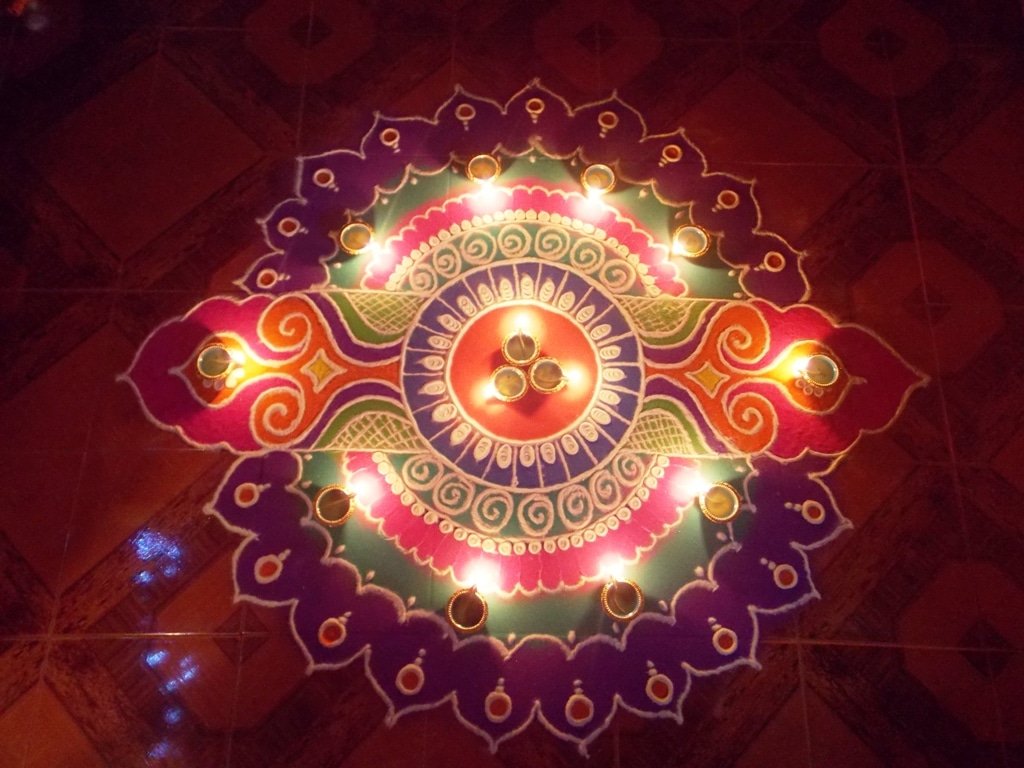
In this investigation
At the threshold of millions of Indian homes, art is made where it is expected to disappear. A pattern is drawn at dawn. Feet cross it. Wind disturbs it. Rain dissolves it. By the next day, it is drawn again.
Depending on region and language, these threshold designs may be called kolam, rangoli, muggu, alpana, mandana, aripana and other names. Their materials, geometry, colours and occasions vary. Some are daily. Others appear mainly at festivals, weddings or religious events. Some are made from rice flour, some from chalk or stone powder, some from coloured powders or flower petals.
Modern explanations often attach a single hidden scientific purpose: feeding ants, repelling insects, stimulating the brain, encoding sacred geometry or balancing environmental energy. The historical record is more interesting. Threshold art combines auspiciousness, hospitality, gendered skill, artistic inheritance, daily discipline and community identity. Measurable cognitive effects are plausible, but no one universal scientific origin explains the tradition.
Rangoli and kolam are related traditions, not one identical practice
“Rangoli” is often used in English as a broad umbrella term, but regional traditions have distinct forms. Tamil kolam frequently uses dot grids and continuous looping lines. Bengali alpana is traditionally painted more freely with rice paste. Rajasthani mandana has its own motifs and surfaces. Telugu muggu traditions include elaborate dot-based patterns.
Collapsing them into one national art form erases regional histories. Tradivior therefore treats the shared threshold function as a point of comparison rather than evidence of one single origin.
THE FIRST CORRECTION
India has a family of threshold-design traditions. Their names, materials, motifs and ritual meanings differ by region and community.
Kolam is a daily practice of disappearance and renewal
Ethnographic and cognitive research on Tamil kolam describes a routine in which women prepare a dot grid at the household threshold and draw looping patterns around it. Through the day, the design is worn away by traffic and weather. The next morning, another appears.
This ephemerality is central. A kolam is not primarily an object designed to survive. The practice is the repetition of making.
The threshold gives the design social visibility
A picture inside a private room is mostly seen by household members. A design at the doorway is seen by neighbours, visitors and passers-by. It therefore communicates something about the household to the social world.
Skill, care and regularity become visible. A well-made threshold can signal domestic order, festive readiness and hospitality before a visitor crosses the door.
Auspiciousness is historically more central than modern “energy” claims
In many communities, threshold designs mark the home as auspicious and ready for positive presence. They may be enlarged or elaborated for festivals and special ritual occasions.
Anthropological work on Tamil households notes that kolams are not necessarily sacred objects in themselves, yet their absence during periods of ritual pollution such as recent death can make them signs of domestic auspiciousness.
This differs from claims that the geometry physically alters invisible energy. “Auspicious” is a cultural and religious category; converting it into an unmeasured electromagnetic mechanism is a modern reinterpretation.
Women have historically been the main transmitters of kolam knowledge
Research describes kolam as a predominantly female practice transmitted through families and communities. Girls learn by watching, copying, practising and eventually improvising.
Competence can become part of domestic and cultural identity. The skill is therefore artistic knowledge, embodied memory and social training at the same time.
Gendered skill can be empowering and burdensome at once
Women may take pride in design fluency and use kolam as creative expression. Community movements have even mobilized the practice as evidence of women’s knowledge and capacity.
But a valued skill can also become an obligation. If a woman’s domestic respectability is judged through daily threshold maintenance, artistic recognition coexists with gendered labour expectations.
The dot grid creates a constrained creative system
Many pulli kolams begin with a grid of points. The artist must then route lines around or through this structure according to learned conventions. Some designs require a single continuous loop; others use multiple loops or symmetries.
This is why kolam attracts mathematicians and cognitive scientists. The tradition creates complex forms from simple local rules.
Complexity can be generated without formal mathematical notation
A skilled artist does not need graph theory terminology to produce a pattern that a mathematician can later describe using graph-theoretic or algorithmic concepts.
This distinction is crucial. A tradition can embody mathematically interesting structure without its historical practitioners having formulated the modern mathematical theory used to analyse it.
THE MATHEMATICS DISTINCTION
Kolam can be analysed mathematically today. That does not prove it was invented to encode modern mathematics.
Practice clearly trains visuospatial skill
Drawing around a dot grid requires tracking distance, direction, symmetry and local constraints while controlling hand movement. Repeated practice therefore exercises visuospatial working memory and geometric representation.
General cognitive research shows that geometry depends on visual-spatial abilities and that humans possess basic geometric intuitions even without formal schooling. Kolam offers a culturally embedded environment in which those capacities are repeatedly trained.
But there is little evidence that kolam uniquely enhances intelligence
It is reasonable to say that practising complex geometric drawing develops the skills needed to perform complex geometric drawing. It is a much stronger claim to say that daily kolam broadly increases IQ, prevents dementia or mathematically rewires the brain in a unique way.
Those broader health and cognitive claims require direct controlled evidence that is currently limited.
Regular geometric forms are cognitively salient
Humans are sensitive to symmetry, repetition, angle and shape regularity. Recent neuroscience and cognitive research continues to identify specialized processing for structured geometric forms.
This helps explain why geometric designs can be visually satisfying and memorable without requiring claims about mystical frequencies.
The rice-flour explanation is partly true and often overstated
Traditional kolam may use rice flour, and small animals or insects can consume edible material placed on the ground. This has encouraged the popular explanation that kolam was invented specifically to feed ants and express ecological generosity.
That interpretation is culturally meaningful in some contemporary accounts, but it should not be treated as the single demonstrated historical origin of all kolam. Materials vary, and chalk or stone powder are also widely used.
Feeding small creatures can be an ethical interpretation without being the sole origin
Indian religious traditions include strong ideas of generosity toward living beings. A household may sincerely understand edible kolam material as sharing food with ants or birds.
That ethical meaning deserves respect. Historical causation requires more evidence than present-day interpretation.
Kolam does not function as a reliable insect-control barrier
Some modern claims say rice flour attracts ants away from the house, while others say specific powders repel insects. These explanations often contradict one another.
There is no strong general evidence that ordinary threshold designs form an effective pest-control system. Pest management depends on species, food availability, moisture, cracks, sanitation and specific chemical repellents—not geometric appearance alone.
Threshold placement is practical because the audience is already there
The threshold is where private domestic identity meets public life. It is therefore an ideal location for a visual sign of welcome, ritual status or festival participation.
No hidden environmental mechanism is required to explain the location. The social boundary itself makes the doorway meaningful.
Repeated erasure prevents the artwork from becoming purely possessive
A permanent artwork can become property. An ephemeral design emphasizes performance and renewal. The artist expects people to walk over it.
This can reinforce a different relationship to artistic labour: the value lies in knowing how to recreate the form, not preserving one physical object forever.
Community copying functions as a distributed design library
Kolam patterns circulate through observation, notebooks, competitions, schools and now digital media. Designs can be copied and modified without the modern assumption that each motif belongs exclusively to one creator.
This allows collective variation. A tradition can remain recognizable while continuously generating new forms.
Festivals expand the visual vocabulary
Daily patterns may be relatively simple because they must be completed quickly. Festivals create time and social incentive for larger, coloured and more elaborate designs.
The shift demonstrates how one practice moves between routine domestic maintenance and public celebration.
Rangoli can mark temporary sacred space
Some designs accompany lamps, offerings, weddings or deity worship. Their placement helps define where a ritual begins and visually separates ordinary floor from ceremonial space.
This spatial function is symbolic but powerful. Humans routinely use lines, borders and decoration to make an otherwise ordinary location feel set apart.
Symmetry does not prove cosmic-energy engineering
Symmetry is attractive, easy to recognize and useful for generating complex designs. It appears widely in art across cultures.
Claims that symmetric rangoli designs scientifically “balance electromagnetic energy” require measurable definitions and experimental evidence. At present, the aesthetic and cognitive explanations are much stronger.
Daily drawing can become meditative without being identical to meditation
Repetitive skilled activity can absorb attention and reduce awareness of unrelated concerns. Artists often report flow-like states during drawing, weaving, music or craft.
Kolam may provide this kind of attentional absorption for experienced practitioners. But a daily household task should not automatically be reclassified as an ancient mindfulness intervention unless practitioners themselves described it that way.
Embodied memory may be more important than verbal rules
Skilled artists can execute patterns rapidly because repeated movements become procedural knowledge. The hand “knows” sequences that may be difficult to describe verbally.
This is common in craft traditions. Knowledge survives because bodies reproduce it, not because every rule is written down.
Kolam demonstrates that sophisticated knowledge need not be elite knowledge
Formal mathematical history often focuses on texts written by specialist scholars. Kolam reminds us that complex spatial knowledge can also live in everyday domestic practice, transmitted among people whose expertise may not enter canonical intellectual histories.
Recognizing this does not require claiming that household artists secretly invented modern graph theory. Their expertise is impressive on its own terms.
Modern commercial rangoli changes materials and meaning
Plastic stencils, synthetic colours, stickers and ready-made designs reduce the skill and time required. Social media allows enormous pattern libraries to circulate instantly.
This does not necessarily destroy the tradition. It changes which part of the practice is emphasized—from procedural drawing skill toward visual display or festival participation.
The ecological cost of modern materials can contradict the old aesthetic
Natural powders and rice flour degrade quickly. Plastic glitter, synthetic microbeads or non-biodegradable decorations can persist in the environment.
A living tradition can therefore become less environmentally benign even while appearing more colourful. Material choice matters more than nostalgic assumptions.
The strongest scientific story is about cognition and skill, not hidden physics
Repeated geometric drawing plausibly exercises visuospatial working memory, motor control, symmetry detection and procedural learning. Those are ordinary cognitive mechanisms supported by broader research.
There is no need to invent unmeasured energy fields to make the practice interesting. Kolam is already a sophisticated example of culturally transmitted geometric craft.
What survives scrutiny?
- India contains multiple regional threshold-design traditions rather than one uniform rangoli practice.
- Tamil kolam is a well-documented daily women’s art built around repeated renewal at the household threshold.
- Threshold designs function as signs of auspiciousness, hospitality, domestic order and festival participation.
- Kolam transmits skilled geometric knowledge through observation and embodied practice.
- Dot-grid designs can be analysed with modern mathematics, but this does not prove they were historically invented to encode those theories.
- Repeated drawing plausibly trains visuospatial and motor skills, though broad claims of unique cognitive enhancement remain unproven.
- Rice flour can feed small organisms, but this is not established as the single historical origin of kolam.
- Ordinary rangoli or kolam patterns are not demonstrated universal pest-control systems.
- Claims about electromagnetic or “energy-balancing” effects lack strong scientific evidence.
- The strongest modern interpretation is living geometric craft with social, ritual and cognitive value.
The Tradivior Evidence Profile
Historical Authenticity — Strong. Rangoli, kolam and related threshold traditions are widely documented across Indian regions and remain living practices.
Original-Purpose Evidence — Strong. Auspiciousness, hospitality, household identity, ritual marking, artistic skill and gendered cultural transmission are well-supported functions.
Scientific Mechanism — Moderate. Geometric drawing clearly recruits visuospatial working memory, pattern recognition, motor control and procedural learning, but many popular ecological and energy claims are weakly specified.
Experimental Evidence — Limited to Moderate. General geometry and visuospatial research supports plausible cognitive effects; direct controlled research on long-term kolam practice remains limited.
Cross-Cultural Evidence — Strong. Threshold decoration and ephemeral geometric art appear widely, though Indian traditions have distinctive regional forms and meanings.
Modern Relevance — Strong. Kolam and rangoli remain vibrant forms of cultural education, domestic identity, festival participation and artistic practice.
The Tradivior Conclusion
Primarily Symbolic/Cultural—with real cognitive skill. Rangoli and kolam survive scrutiny as sophisticated living traditions of threshold art, auspiciousness, hospitality and embodied geometric knowledge. Repeated practice clearly demands visual-spatial control and procedural skill, and edible materials may also carry ethical meanings about sharing with other creatures. But stronger modern claims—that the designs were created as insect-control devices, encode advanced mathematical science or physically balance invisible environmental energies—are not historically or experimentally established. Their cultural and cognitive value does not need those claims.
Continue investigating
- Why Do People Sweep and Wash the Entrance Each Morning?
- Why Do Indian Homes Decorate the Doorway With Torans?
- Why Do People Remove Shoes Before Entering a Home?
Sources and further reading
- “Entropy trade-offs in artistic design: A case study of Tamil kolam.” Evolutionary Human Sciences. Cambridge University Press, 2021.
- Ethnographic research on everyday Tamil kolam as feminine domestic craft and a sign of household auspiciousness, including work published in HAU: Journal of Ethnographic Theory.
- Nagarajan V. Scholarship on kolam, women’s ritual art and Tamil cultural transmission.
- Dehaene S, Izard V, Pica P, Spelke E. “Core knowledge of geometry in an Amazonian indigene group.” Science. 2006;311:381–384. PMID: 16424341.
- “Visual foundations of Euclidean geometry.” 2022. PMID: 35751917.
- Research on visuospatial working memory and geometry learning. PMCID: PMC9290594.
- “A geometric shape regularity effect in the human brain.” 2026. PMCID: PMC12795501.
- Developmental and cognitive research on intuitive geometry, symmetry and spatial representation.
Continue exploring

Partially Supported
Why Is the Ganga Sacred?
The Ganga is river, goddess, pilgrimage route, purifier and national symbol. Tradivior will trace how these layers developed and evaluate modern claims about unusual self-purifying properties without confusing microbial findings…

Primarily Symbolic/Cultural
Why Do Some South Indian Communities Celebrate a Girl’s First Menstruation?
Puberty ceremonies around first menstruation can mark fertility, adulthood, family status and gender expectations. Tradivior will investigate their regional histories and the tension between celebration, education, stigma and restriction.

Primarily Symbolic/Cultural
Why Do Cultures Create Fertility Rituals?
Fertility rituals appear wherever reproduction, inheritance and survival carry uncertainty. Tradivior will compare prayers, offerings, symbols and seasonal rites while distinguishing social meaning from unsupported claims that rituals directly increase…

Historically Practical
Why Does Pregnancy Become a Protected Social State?
Pregnancy often brings exemptions, restrictions, blessings and intense social attention. Tradivior will examine why societies formalized protection around pregnancy and where protective customs help, do nothing or cause harm.
Picked for your curiosity
Enable JavaScript to build a reading profile and see recommendations.