 tradivior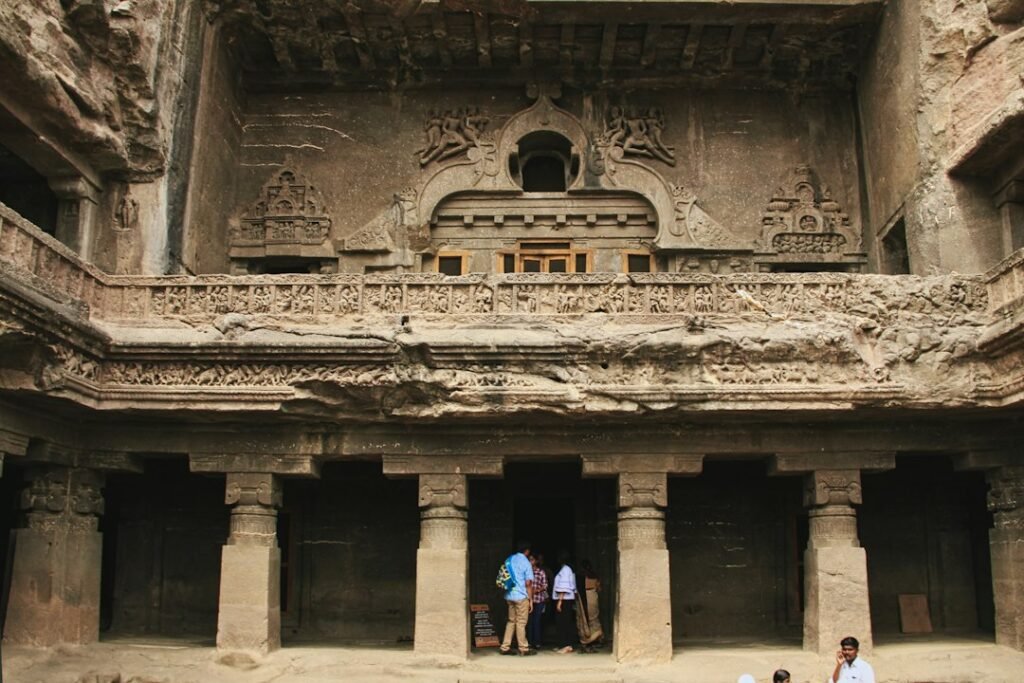
In this investigation
Carving sacred space into living rock is one of humanity’s most dramatic architectural choices. It appears in Buddhist cave monasteries, Hindu and Jain cave temples, Nabataean tomb-temples at Petra and the rock-hewn churches of Lalibela. Yet these traditions did not emerge from one shared secret technology or one universal theology.
Rock-cut architecture repeatedly became attractive because geology, labour, patronage, security, climate, landscape and religious meaning could align in powerful ways. The mountain was simultaneously building material, structural mass and sacred setting.
Rock-cut architecture reverses ordinary construction
A conventional building is assembled by adding material. A cave sanctuary is made by removing it. That reversal changes the engineering problem completely. Builders must imagine the finished void before excavation is complete because mistakes cannot easily be undone.
The result can preserve forms normally associated with timber or masonry even though the structure is monolithic. At many Indian sites, columns, beams, roofs and decorative details were carved from the parent rock rather than assembled.
India developed one of the world’s richest rock-cut traditions
Western and central India contain long sequences of Buddhist, Hindu and Jain excavation. Ellora alone preserves 34 major caves created across several centuries. UNESCO describes the site as evidence of Buddhist, Brahmanical and Jain architectural activity between roughly the sixth and twelfth centuries.
The Kailasa temple at Ellora represents the extreme end of the technique: a monumental temple complex was excavated downward from a mass of rock so that what appears to be assembled architecture is actually carved from a single geological body.
Rock offered permanence
Stone survives fire, insects and many forms of decay that destroy timber. In regions where earlier religious architecture relied heavily on wood, translating familiar forms into rock could create monuments of much greater durability.
Permanence is not only practical. A sanctuary cut into a mountain can appear inseparable from the landscape, giving sacred claims material longevity.
Caves also supported monastic life
Buddhist cave complexes often combined prayer halls, shrines, cells, assembly spaces and water systems. The mountain could therefore support both ritual and residence.
Rock shelters offered thermal stability and physical enclosure, but they were not automatically comfortable. Ventilation, daylight and moisture had to be managed, and many caves depended on carefully placed openings and drainage.
Landscape itself could become theology
At Udayagiri, UNESCO’s 2026 tentative-list documentation emphasizes that shrines, sculpture, inscriptions, topography and circulation formed an integrated sacred landscape. The hill was not simply a cheap quarry; the terrain participated in the religious programme.
This is an important warning against purely functional explanations. Builders may choose rock because it works structurally while also choosing a particular hill because it carries cosmological, royal or mythic meaning.
Petra shows a different rock-cut logic
Petra was not primarily a cave-monastery tradition. Its Nabataean landscape contains monumental tomb and temple facades, religious high places and sophisticated water infrastructure. UNESCO describes the city as half-built and half-carved into rock, blending local traditions with Hellenistic architectural forms.
This demonstrates that similar techniques can serve radically different social purposes. Rock-cut does not equal one religion, one climate strategy or one symbolic meaning.
Lalibela transformed rock into a sacred city
The eleven medieval rock-hewn churches of Lalibela in Ethiopia were carved from volcanic rock and connected by trenches and ceremonial passages. UNESCO describes the complex as a “New Jerusalem,” associated with the attempt to create a substitute sacred landscape when pilgrimage to the Holy Land became difficult.
Here rock excavation became a form of spatial theology: carving the landscape allowed a sacred geography to be reproduced locally.
Security is plausible but not universal
Rock-cut spaces can be defensible and visually discreet, and some remote monastic sites benefited from separation from ordinary settlement. But it would be misleading to claim that sacred caves were mainly hidden refuges.
Many were prominently located, patronized by rulers or merchants and designed to receive visitors. Visibility and pilgrimage could matter as much as seclusion.
Thermal stability is real
Massive rock changes temperature slowly. This can buffer interior spaces against rapid outdoor temperature swings. In hot or highly variable climates, such thermal inertia can be useful.
But rock-cut spaces can also be damp, dark and difficult to ventilate. The environmental advantages therefore depend on geology, depth, openings and local climate rather than on a universal “natural air-conditioning” effect.
Acoustics can be striking
Hard stone surfaces and enclosed chambers can produce strong reverberation. Certain cave halls create memorable sonic responses to chanting, clapping or instruments.
As with freestanding sacred architecture, measurable acoustic effects do not automatically prove they were the original design objective. They may have been noticed, cultivated, tolerated or ritualized after construction.
Why carve instead of build?
Where suitable rock exists, excavation can create enormous durability and eliminate some problems of jointed construction. It can also allow monumental forms that visually merge building and mountain.
The cost is labour, planning difficulty, dependence on geology and the irreversibility of mistakes. Rock-cut architecture therefore usually implies substantial organization, skilled labour and patronage rather than a primitive shortcut.
What survives scrutiny?
- Rock-cut sacred architecture emerged independently in multiple regions and religions.
- Geology and available stone were fundamental constraints.
- Permanence, thermal mass, enclosure and structural continuity are real advantages.
- Darkness, dampness, ventilation and excavation difficulty are real disadvantages.
- Indian cave traditions developed sophisticated monasteries, halls and temples over many centuries.
- Petra and Lalibela demonstrate very different religious and political uses of the same broad technique.
- Landscape symbolism often mattered alongside engineering.
- Claims of mysterious lost machinery are unnecessary to explain the known sites.
The Tradivior Evidence Profile
Historical Authenticity — Strong. Rock-cut sacred and funerary architecture is extensively documented archaeologically across South Asia, the Middle East, Africa and elsewhere.
Original-Purpose Evidence — Strong. Monastic residence, worship, burial, pilgrimage, royal patronage and sacred-landscape creation are directly attested at major sites.
Scientific Mechanism — Strong. Thermal mass, stone durability, structural continuity, daylight constraints and acoustic reflection are straightforward physical properties.
Experimental Evidence — Moderate. Environmental and structural mechanisms are measurable, but reconstructing the intentions of ancient builders remains site-specific.
Cross-Cultural Evidence — Strong. Similar excavation techniques served different religions and social systems, which argues against a single universal explanation.
Modern Relevance — Strong. Conservation, drainage, erosion and tourism continue to determine the survival of these monuments.
The Tradivior Conclusion
People carved sacred spaces into mountains because rock could become more than a material. It could become shelter, monastery, monument, tomb, political statement and sacred landscape at once.
The best explanation is not mystical technology but convergence: suitable geology, organized labour, durable construction, ritual needs and the symbolic power of the mountain. The same technique could therefore produce a Buddhist vihara, a Hindu cave temple, a Nabataean tomb or an Ethiopian church without requiring one shared origin.
Sources and further reading
- UNESCO World Heritage Centre: Ellora Caves.
- UNESCO World Heritage Centre: Elephanta Caves.
- UNESCO World Heritage Centre: Petra.
- UNESCO World Heritage Centre: Rock-Hewn Churches, Lalibela.
- UNESCO World Heritage Centre Tentative List: Udaigiri Caves, India.
Continue exploring
Partially Supported
Why Is the Ganga Sacred?
The Ganga is river, goddess, pilgrimage route, purifier and national symbol. Tradivior will trace how these layers developed and evaluate modern claims about unusual self-purifying properties without confusing microbial findings…

Partially Supported
Why Do People Keep Ashes, Relics and Memorial Objects?
Hair, ashes, bones, clothing, photographs and relics allow the dead to remain materially present. Tradivior will examine why objects carry memory so powerfully and how continuing bonds differ from pathological…

Evidence Supported
Why Do Cultures Set Aside Days to Remember the Dead?
From Pitru Paksha and Qingming to Día de Muertos and All Souls’ Day, cultures repeatedly create calendar time for the dead. Tradivior will compare how recurring remembrance renews kinship, grief…
Historically Practical
Why Did Cremation Become Central to Hindu Death Ritual?
Cremation has deep roots in many Hindu traditions but varies by community, age, status and circumstance. Tradivior will investigate its historical logic, environmental consequences and modern changes without treating one…
Picked for your curiosity
Enable JavaScript to build a reading profile and see recommendations.