 tradivior
In this investigation
Imagine two rice farmers on the same Balinese hillside. The farmer upstream could take water first, plant whenever convenient and leave the downstream field short. The farmer below could respond by demanding more water at the wrong time, or by planting out of sequence. Neither farmer necessarily intends harm. Yet if every household makes an individually sensible decision, the whole watershed can become less productive. The puzzle is not simply how to build a canal. It is how neighbours coordinate choices when water, insects, seasons and sacred obligations cross property lines.
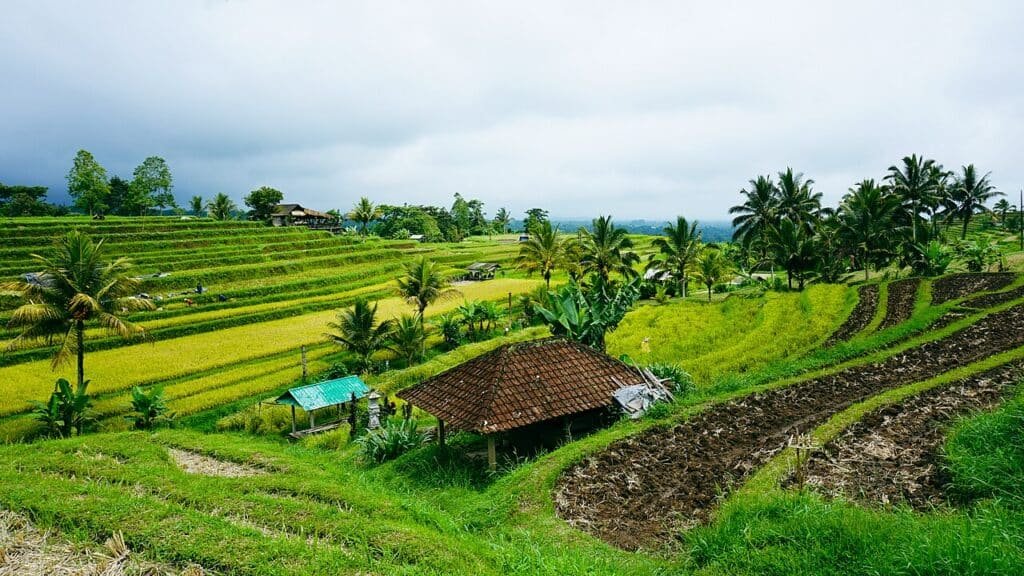
For centuries, Balinese farmers have developed an answer called subak: a cooperative irrigation institution in which canals, rice terraces, customary rules and water temples form parts of one living system. In 2012 UNESCO inscribed selected Balinese subak landscapes on the World Heritage List. The designation recognized something that a photograph of emerald terraces cannot show: water is governed through social relationships, ceremonies and decisions made across connected fields.
This story is often compressed into a slogan that religion somehow “solved” irrigation. That misses both the depth of Balinese religious life and the hard work of agricultural cooperation. The water temples are not decorative relics, but neither are they reducible to an engineering algorithm. Understanding subak requires attending to history, ecology, ritual, farmers’ rights and the changing pressures on land.
The mountain, the spring and the field
Bali’s volcanic mountains and wet tropical climate create conditions for intensive rice cultivation, but water does not distribute itself evenly across terraced slopes. Rivers and springs feed channels, tunnels and weirs; water passes from one field to another. A diversion upstream changes what arrives downstream. Irrigation therefore creates a problem of mutual dependence before anyone debates religious meaning.
UNESCO describes a cultural landscape encompassing five component areas and about 19,500 hectares. The sites include Pura Ulun Danu Batur near Lake Batur, the Pakerisan watershed, the Catur Angga Batukaru terraces, and the royal water temple of Pura Taman Ayun. These are not five interchangeable tourist attractions. They express different relationships between water sources, farming settlements, sacred places and political histories.
At the level of a subak association, farmers cooperate over water delivery and agricultural schedules. Many associations have customary written regulations known as awig-awig, setting out rights and obligations. These rules are not identical everywhere, and the institutional arrangements have changed across centuries. Their importance is that access to water is treated as a shared responsibility rather than a private matter settled solely by the strongest upstream claimant.
Water temples situate that responsibility within a wider sacred landscape. In Balinese Hindu practice, water, agricultural fertility and ritual life are intertwined. UNESCO describes temple traditions shaped by Saivasiddhanta and Samkhya Hinduism, Vajrayana Buddhist influences and Austronesian cosmology. A single label such as “Hindu irrigation system” would flatten this layered history. Nor does the presence of Indian religious influence mean Bali’s customs are merely transplanted Indian practices: they have developed in distinctive local social and ecological conditions.
Tri Hita Karana is not a productivity formula
The philosophical principle Tri Hita Karana is commonly understood through harmonious relationships among the spiritual realm, human community and nature. In the subak landscape, offerings, temple gatherings and agricultural duties help express those relationships. For practitioners, devotion is not merely a way of getting farmers to attend meetings. It is part of what makes the landscape meaningful.
An outside observer may ask whether shared rituals also make coordination easier. That is a legitimate social and ecological question. But the answer to it cannot establish or disprove the truth of a theological belief. A ritual can carry devotional meaning and have observable social effects without one being reducible to the other. Likewise, an ecological model that finds advantages to coordinated planting does not prove that a temple’s sacred claims are empirically testable.
The distinction matters because popular accounts often turn a complex living tradition into a flattering engineering anecdote. They suggest that farmers invented ceremonies only to optimize crop yields, as if worship were an elaborate irrigation meeting. That explanation strips practitioners of their own reasons for acting. A more careful account asks how spiritual commitments, customary law and practical decisions reinforce one another, while allowing them to remain different kinds of claims.
The experimental question: why plant together?
Rice farming involves a second shared resource beyond water: the timing of the crop. If nearby fields are planted and harvested at very different times, pests may move from one patch of vulnerable rice to the next. If many fields follow coordinated cycles, farmers may reduce some pest pressures—but synchronized planting can also create high simultaneous water demand. The challenge is to balance water availability with pest control.
Anthropologist J. Stephen Lansing and collaborator James N. Kremer studied Balinese water temple networks in a 1993 paper in American Anthropologist. Their ecological modelling suggested that networks of coordinated decisions could produce beneficial large-scale patterns without a single centralized manager specifying every field’s schedule. The striking result was not that one ritual magically improved rice. It was that local institutions could help organize a system whose ecological effects emerge across an entire watershed.
A later study by Lansing and Stefan Thurner, published in Proceedings of the National Academy of Sciences in 2017, explored adaptive self-organization in the ancient rice-terrace system. Their work examined how local interactions and ecological constraints can generate coordinated patterns. Such research is valuable because it treats the farmers as participants in a sophisticated adaptive system rather than as passive followers of a timeless tradition.
Models, however, have boundaries. They simplify actual rainfall, water channels, pests and human negotiations. A successful simulation is evidence that a mechanism is plausible under its assumptions, not proof that every historical ceremony originated for that purpose or that every subak performs equally well today. Field observations, institutional histories and the testimony of farming communities remain essential.
The water temple is not a central command room
Modern management language sometimes describes Bali’s temples as if they were offices in a perfectly hierarchical irrigation authority. The real network is more interesting. Farmers coordinate through subak organizations, customary regulations and temple relationships that connect different levels of the watershed. There are negotiations, disputes, practical constraints and changes in political authority. The temple system can help sustain cooperation, but it does not erase conflict.
Consider a hypothetical but realistic scheduling problem. An upstream group wants to start a new planting cycle immediately because its fields are ready. A downstream group needs the same water to finish its previous cycle. If each group acts alone, the upstream decision can impose a cost that does not appear on its own farm ledger. Coordinated scheduling asks the first group to account for the second. A shared institution can make that cost visible and provide a setting for agreement.
This example illustrates the logic of collective action; it is not presented as a transcript of a particular temple meeting. The documented evidence for the broader mechanism comes from ethnography, modelling and the recognized institutions of subak. The distinction between a worked illustration and a recorded episode is important: we should not invent conversations to make a tradition seem more vivid.
The historical record is also layered. UNESCO places the origins of the cooperative water-management tradition around the ninth century and describes water temple networks managing rice-terrace ecology from the eleventh century. Those broad dates should not be mistaken for proof that every surviving ritual, rule or temple building has remained unchanged for a thousand years. Pura Taman Ayun, for instance, belongs to a much later architectural and political history than the earliest irrigation practices.
Jatiluwih: the landscape tourists see and farmers maintain
The Jatiluwih terraces in the Catur Angga Batukaru landscape make the tension between appearance and function especially clear. To a visitor, the terraces may be a spectacular pattern of green curves. To the farmers, they are working fields requiring water rights, maintenance, labour and viable returns. A viewpoint can be protected while the social system that keeps the terraces productive is weakened.
UNESCO’s 2025 conservation assessment raised concern about tourism and development pressure, particularly around Jatiluwih. It noted that the loss or fragmentation of rice fields and the weakening of subak authority could threaten the cultural landscape’s outstanding universal value. This is not simply a fear that buildings might spoil a view. It is a concern that land conversion can sever the relationships among fields, water channels, farmers and temples.
A 2025 article in the UNESCO-associated Blue Papers series similarly emphasized co-creation with local communities, water scarcity and climate adaptation. Such recent work complicates the comforting narrative that heritage listing permanently secures a tradition. A designation can recognize value and encourage protection; it cannot by itself make farming financially viable or prevent every diversion of water.
The most revealing question may be economic. If maintaining terraces becomes less rewarding than selling land or building tourism facilities, what happens to the institutions that depend on active farmers? Ritual continuity cannot be separated from the practical conditions under which people can remain on their land. A sacred landscape needs a living community, not only a legal boundary.
What is supported, and what remains an interpretation?
| Claim | Type of claim | What the evidence permits |
|---|---|---|
| Subak links water distribution, farmer associations and temples | Historical and institutional | Well documented by UNESCO, local regulation and research |
| Coordinated planting can affect water allocation and pest dynamics | Empirical and ecological | Supported as a plausible and studied mechanism; effects depend on local conditions |
| All subak rituals were originally invented to maximize yields | Historical causal claim | Not established; reduces layered religious and social history to one function |
| Tri Hita Karana expresses sacred relationships among people, nature and spirit | Practitioners’ philosophical and devotional understanding | Documented as a living belief; not subject to a laboratory verdict about theological truth |
| Tourism and land conversion can threaten the working landscape | Conservation and socioeconomic | Identified in UNESCO’s recent conservation concerns; impacts vary by place |
Narrow evidence verdict: The proposition that coordinated irrigation and planting schedules can improve collective agricultural outcomes has substantive support from ecological modelling and institutional research, subject to real-world variation. This is not a verdict on the truth, worth or legitimacy of Balinese Hindu devotion.
What Bali can teach without being turned into a slogan
Subak offers a valuable comparison with other commons-management systems, including village irrigation associations in South Asia. Both involve water that moves across individual property boundaries and requires negotiated rules. Yet the comparison should not erase local histories. Bali’s temple network, its religious synthesis and its landscape of terraced rice are distinctive. A useful comparison asks what governance problems recur and how different communities have answered them, not which culture supposedly discovered a universal secret.
The broader lesson is about institutions that make interdependence visible. A farmer’s field may look individually owned, but its water supply and pest environment are collective. A terrace may look ancient, but its survival depends on current decisions about livelihoods, maintenance and development. A temple may look like an object of heritage, but for practitioners it remains part of living worship.
That perspective also changes how visitors should see the landscape. The terraces are not an outdoor museum designed for photographs. They are a continuing relationship among people, earth, water and sacred places. Conservation should therefore ask whether farmers retain meaningful authority, whether canals still function, and whether younger generations have a reason to continue cultivating rice.
The question the terraces leave us with
The engineering puzzle at the beginning has no permanent technical fix. A canal can be repaired; a schedule can be negotiated; a ritual can be renewed. But each generation must decide whether the obligations that sustain shared water are still worth keeping. That is why subak’s achievement is not simply its age. It is the continuing attempt to make individual decisions answerable to a landscape larger than any single field.
Seen this way, the water temple is neither an exotic curiosity nor a disguised computer. It is one institution in a living moral, agricultural and ecological world. The most important question for the future of Bali’s terraces may not be how ancient they are, but whether the people who maintain them will still have enough land, water and authority to carry them forward.
Research, heritage and image sources
- UNESCO World Heritage Centre, Cultural Landscape of Bali Province: the Subak System — official inscription, landscape, chronology, temples and customary governance.
- J. Stephen Lansing and James N. Kremer, “Emergent Properties of Balinese Water Temple Networks” (American Anthropologist, 1993) — ecological modelling of cooperative management.
- J. Stephen Lansing and Stefan Thurner, “Adaptive self-organization of Bali’s ancient rice terraces” (PNAS, 2017) — empirical and modelling research.
- UNESCO World Heritage Committee, 2025 State of Conservation assessment — current concerns about Jatiluwih, development and subak authority (French-language official record).
- Diana Rahman, “Learning from the Subak World Heritage Property” (Blue Papers, 2025) — community co-creation and adaptation challenges.
- Buleleng district government overview of Bali’s subak irrigation heritage — Indonesian local administrative context.
- Featured photograph: “Rice Terrace in Bali – Subak 13,” Anggabuana, 2 December 2023, CC BY-SA 4.0; image depicts Balinese rice terraces, not a reenactment of a particular historical meeting.
Continue exploring
The Festival Born of an Epidemic: How Kyoto’s Gion Matsuri Became a Moving City
Gion Matsuri began with a ninth-century epidemic story and became a living Kyoto tradition of sacred processions, elaborate floats and neighbourhood cooperation.

The Thousand Gates of Fushimi Inari: How Private Prayers Became a Public Path
Behind Kyoto's famous vermilion torii corridors is a history of donations, sacred boundaries and living devotion. What the evidence—and the shrine itself—actually tell us.
Why Do Tibetan Buddhists Turn Prayer Wheels Clockwise?
Explore why Tibetan Buddhist prayer wheels are turned clockwise, how sacred text and ritual action connect, and what historical and scientific evidence can establish.
Why Is Tulsi Worshipped in Hindu Homes? Faith, Botany and Evidence
Why is tulsi sacred in Hindu households? Investigate its devotional history, botanical science, cultural meaning and what medical evidence can actually prove.
Picked for your curiosity
Enable JavaScript to build a reading profile and see recommendations.