 tradivior
In this investigation
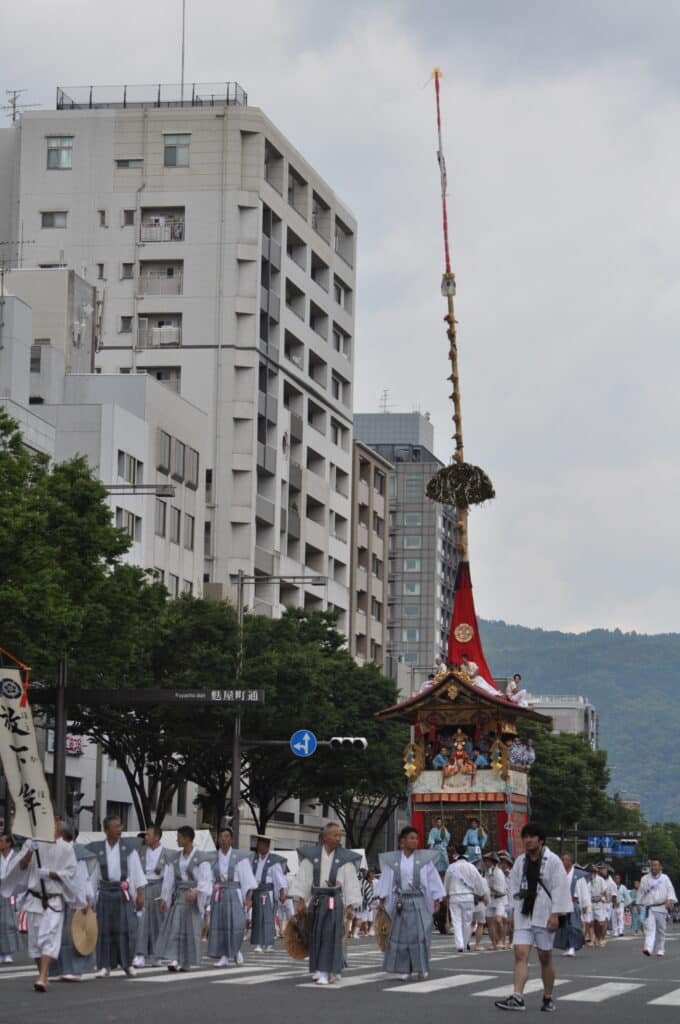
In July, a towering wooden float inches through Kyoto while musicians play above the crowd and neighbours coordinate a turn that cannot be taken casually. The object is richly decorated, heavy, and assembled for a procession that lasts only a fraction of the month. It can look like a magnificent moving museum. Yet Gion Matsuri, the festival of Yasaka Shrine, has a much older and more troubling question behind its beauty: what can a city do when disease spreads and no one can explain why?
Local histories trace the festival’s origins to a ritual response to epidemic in 869. More than eleven centuries later, the event has become a complex collaboration among religious institutions, neighbourhood associations, craftspeople and residents. Its significance lies not in an unbroken, unchanged spectacle, but in the way successive generations have repeatedly rebuilt a public tradition around danger, devotion, work and belonging.
Kyoto in 869: the story begins with fear, not entertainment
According to Kyoto’s official festival history, an epidemic in 869 prompted prayers at the shrine now known as Yasaka Jinja. The account describes sixty-six halberds representing the country’s traditional provinces and supplications to the deity then associated with Gion worship, Gozu Tennō. This is the festival’s transmitted foundation narrative; it is not a contemporary epidemiological report proving that a ritual stopped a disease.
In the religious world of the period, illness and social disruption could be understood in relation to powerful spirits requiring ritual attention. A goryō-e was not simply a public-health measure with premodern instruments. It belonged to a system of belief in which political disorder, death, divine forces and communal welfare were deeply connected. To describe the ritual merely as ‘superstition’ would erase the historical language through which participants understood their situation. To describe it as a scientifically demonstrated cure would make a different error.
The official chronology says the Gion Goryō-e became an annual event from 970. This does not mean every feature of the modern procession already existed in 869. The enormous decorated floats familiar today developed later, especially in the medieval period. The origin of a festival and the origin of its most recognisable visual form are different historical questions.
The objects grew, and so did the city’s role
The modern yamahoko procession contains two broad types of float. Hoko are distinguished by tall poles and elaborate construction; yama often evoke mountain forms and carry figurative scenes. The 2009 UNESCO inscription decision describes the float ceremony as a neighbourhood-transmitted practice involving residents, musicians and artisans who assemble, decorate, move and dismantle the structures.
UNESCO’s account also explains a ritual dimension of the tall poles: they were associated with summoning a plague deity so that destructive power might be transformed into protective power through worship, music and dance. The significance here is not that a wooden pole can be experimentally shown to alter infection rates. It is that a city transformed a fear of invisible harm into an organised, visible, collective act.
Over time, the floats accumulated intricate textiles and metalwork. Kyoto’s official history notes the use of treasures and ornaments from places including China, Persia, Korea and European countries. The procession therefore tells a story about exchange as well as local continuity. A float may be understood as a sacred participant, a neighbourhood emblem and an object carrying evidence of long-distance artistic connections.
Why the phrase ‘moving museum’ is only half the truth
The nickname ‘moving museums’ captures the splendour of textiles and craftsmanship but can mislead. A museum object is often protected by keeping handling to a minimum. A yamahoko float survives as heritage precisely because people continue to assemble it, teach others how it works, move it through crowded streets and take it apart again.
That work depends on knowledge that cannot be stored entirely in an exhibition label. How is a complex wooden structure assembled? Who coordinates a turn? Which families or associations maintain particular objects? How are musicians trained, decorations cared for and responsibilities transferred when younger residents leave the neighbourhood? The tradition’s continuity rests on solving practical problems year after year.
The 2009 UNESCO decision explicitly identifies resident participation, artisanal skills and safeguarding measures as reasons for recognising the ceremony. It is not a certificate that every historical legend is literally true. Its subject is the living cultural practice and the communities that maintain it.
Two processions, one interrupted history
A visitor who sees the July 17 procession has not necessarily seen the whole festival. Gion Matsuri includes multiple ceremonies across July, including shrine-related observances, evening gatherings and two major float processions. The early procession is called Saki Matsuri; the later one is Ato Matsuri.
The two-procession arrangement is a useful case study in how traditions change and are consciously restored. Kyoto’s official festival history records that the two processions were merged into one in 1966 as traffic and urban conditions changed. The separate processions returned in 2014. That is neither proof that the festival was ‘fake’ during the intervening decades nor proof that today’s arrangements reproduce every medieval detail. It shows people negotiating continuity under new circumstances.
The official 2026 festival guide lists the early procession on July 17 with twenty-three floats and the later procession on July 24 with eleven. These are the contemporary scheduled figures for that year. UNESCO’s 2009 description referred to thirty-two floats in its nomination record; the differing counts belong to different dates and inventories and should not be casually treated as an error.
The day before: a neighbourhood opens its doors
The evening events known as Yoiyama are part of the festival’s social texture. Streets glow with lanterns, musicians perform, and some households display treasured folding screens and decorations. The 2026 Kyoto guide identifies July 14–16 for the early Yoiyama period and July 21–23 for the later one. These dates are useful for understanding the rhythm of preparation, not a guarantee that every street or household participates in precisely the same way.
For a resident, the festival may mean hosting, carrying equipment, rehearsing music, maintaining relationships and negotiating the inconvenience of altered streets. For a visitor, the same event may mean a photogenic procession and a crowded night market. Both experiences are real, but they are not equivalent. The first contains obligations and inherited responsibilities that cannot be understood from a spectator’s photograph alone.
That difference matters when cultural events become tourist attractions. Commercial visibility can support preservation, but it can also shift attention toward what cameras capture and away from the labour that makes the performance possible. A respectful account asks not only what an outsider sees but who must organise, pay for, repair and transmit it.
What the procession actually preserves
One tempting interpretation is that Gion Matsuri preserves an ancient ritual unchanged since 869. The documentary record supports a more interesting claim: an early epidemic-related religious observance gradually acquired new forms, with later developments in floats, materials, processional routes and organisation. The ceremony has survived disruptions, including warfare, and has adapted to modern traffic and conservation needs.
Another tempting interpretation is that the religious origin is only an obsolete explanation for a modern street parade. Yet Yasaka Shrine’s role and the continuing ceremonial calendar make that reduction inadequate. The festival’s public splendour coexists with devotion, prayers for well-being and a community’s relationship with sacred space.
Religious meaning cannot be tested as if it were a laboratory proposition. A narrower empirical claim—whether a particular procession directly prevented an epidemic—would require historical disease records and a plausible causal comparison that the transmitted foundation story does not provide. The appropriate conclusion is therefore not a grade assigned to a religion. It is a distinction between documented festival history, participants’ beliefs and an unverified claim of medical causation.
The global textile route hidden in a Kyoto street
The decorated floats also complicate the idea that heritage must be culturally sealed to remain authentic. Imported textiles and ornaments became part of objects that Kyoto communities treated as their own. A material could travel across Asia or from Europe and, through centuries of care and reuse, acquire a local ceremonial identity.
This is not a claim that every piece on every float has been securely traced to a particular workshop. Provenance varies by object, and responsible conservation depends on examining each piece’s documentation. The broader point, supported by Kyoto’s festival history, is that historical exchange and local belonging are not opposites.
In that respect, the procession offers a valuable comparison with other living traditions, including India’s regionally diverse temple chariot festivals. Large sacred vehicles can mobilise artisans, donors and neighbourhood labour in ways that are both devotional and civic. But similarities in visible form do not establish common origin, identical theology or interchangeable ritual rules. Each practice deserves its own history.
UNESCO recognition is not the beginning of the tradition
In 2009 UNESCO inscribed the Yamahoko float ceremony of the Kyoto Gion festival on its Representative List of the Intangible Cultural Heritage of Humanity. Its decision emphasised intergenerational transmission, collective organisation and safeguarding. Recognition can help direct attention and resources toward preservation, but the festival did not become meaningful only when an international institution listed it.
UNESCO also records wider Japanese float-festival traditions in its heritage work. Those broader listings should not be conflated with the specific history of Gion Matsuri. The value of the Kyoto inscription is its detailed account of a community-led practice: people working together to keep a demanding tradition alive, not merely possessing beautiful objects.
What 2014 teaches about ‘authenticity’
The return of the later procession in 2014 is a revealing moment because it makes choice visible. Organisers could not simply claim that whatever currently existed must be the only authentic form. Nor could they recreate an entire past untouched by present-day Kyoto. They selected a historically informed arrangement and worked to make it function in a contemporary city.
Authenticity, in this case, is not the absence of change. It is a serious relationship with records, objects, ritual commitments and community memory, combined with the practical responsibility to carry them forward. A living festival must make decisions about what can change and what deserves protection. Those decisions may be debated among practitioners; they are not settled by a tourist slogan.
How to encounter Gion Matsuri without treating it as a prop
Visitors can begin with a few questions rather than a checklist of photographs. Which float belongs to which neighbourhood? What is the significance of its decoration? How do musicians, craft specialists and volunteers contribute? Which parts of the event are shrine ceremonies, and which are public festivities? The answers vary across the calendar and among communities.
It is also worth checking official guidance for access, crowds and respectful conduct, especially because a procession’s streets are working ceremonial spaces, not only viewing platforms. Photography may be welcome in many public settings, but proximity does not entitle an observer to interrupt a ritual, block movement or treat participants as performers hired for an audience.
The most rewarding experience may come from noticing the preparation: lanterns, assembly, the careful placement of ornaments and the collective attention required for a structure to move safely. A festival is not only its climactic moment. It is the work that makes the moment possible.
From fear of disease to the craft of belonging
In the ninth-century foundation story, a city confronted epidemic through ritual action. In the present, the yamahoko procession gathers neighbours around objects that must be assembled, moved, repaired and remembered. Between those moments lie centuries of transformation. The modern festival cannot be reduced either to a medically effective response to plague or to a picturesque parade emptied of religion.
Its enduring surprise is that something created in response to invisible danger became a highly visible form of cooperation. The floats are spectacular, but the deeper inheritance is the capacity of people to organise themselves across generations around a shared responsibility. The sacred and the civic have not always meant the same thing, yet in Gion Matsuri they have repeatedly met on the same streets.
Evidence, history and further reading
- Kyoto official tourism authority, Gion Matsuri history — foundation tradition, annual observance, float development, foreign decorations and restoration of two processions.
- UNESCO, 2009 inscription decision for Yamahoko — institutional documentation of community organisation, religious associations and safeguarding.
- Kyoto official guide for 2026 — current festival dates, early and later float counts, Yoiyama descriptions.
- Japan National Tourism Organization, Gion Festival — national tourism authority’s overview of public celebrations and festival context.
- UNESCO, Yama/Hoko/Yatai float festivals in Japan — wider comparative framework for community transmission, distinct from the 2009 Kyoto-specific decision.
Featured photograph: a real Yamahoko procession at Gion Matsuri in Kyoto on 17 July 2017, photographed by Wikimedia Commons contributor 江戸村のとくぞう, licensed CC BY-SA 4.0. The photo is not claimed to depict the festival’s ninth-century origins.
Continue exploring
When a Temple Decides Who Gets Water: Bali’s Subak and the Sacred Politics of Rice
Bali's water temples are more than scenic shrines: they help coordinate irrigation, harvests and collective responsibility. A documented history of subak and its present pressures.
The Thousand Gates of Fushimi Inari: How Private Prayers Became a Public Path
Behind Kyoto's famous vermilion torii corridors is a history of donations, sacred boundaries and living devotion. What the evidence—and the shrine itself—actually tell us.
Why Do Tibetan Buddhists Turn Prayer Wheels Clockwise?
Explore why Tibetan Buddhist prayer wheels are turned clockwise, how sacred text and ritual action connect, and what historical and scientific evidence can establish.

Why Is Tulsi Worshipped in Hindu Homes? Faith, Botany and Evidence
Why is tulsi sacred in Hindu households? Investigate its devotional history, botanical science, cultural meaning and what medical evidence can actually prove.
Picked for your curiosity
Enable JavaScript to build a reading profile and see recommendations.