 tradivior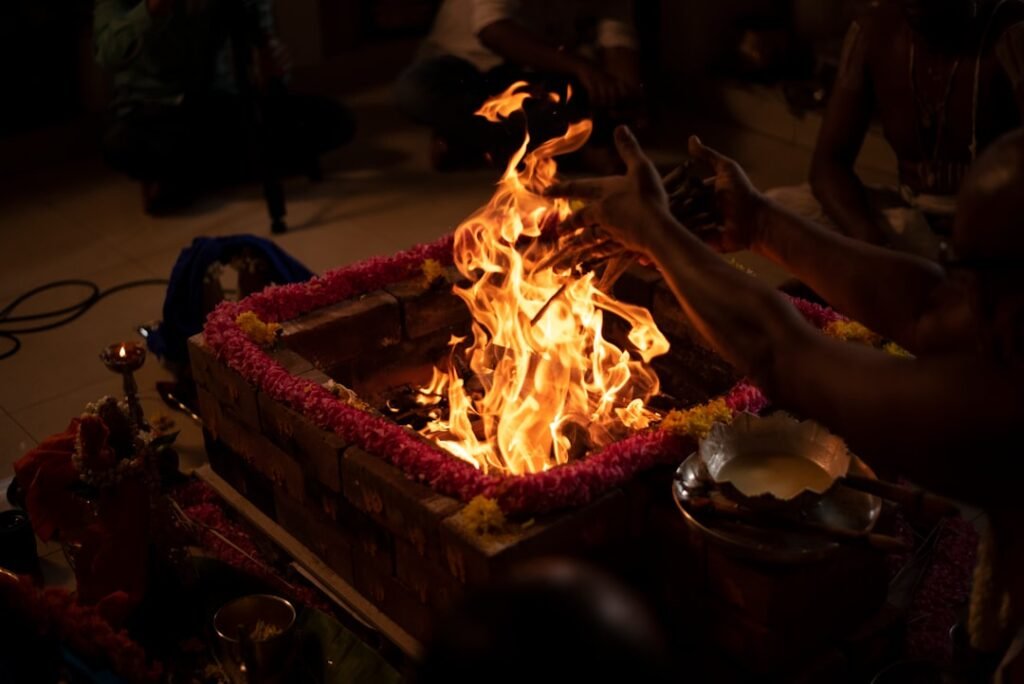
In this investigation
Indians wave camphor flame in aarti because controlled light, fragrance and circular movement create a powerful closing or focal moment in worship. Camphor burns with a bright flame and little solid residue, making it well suited to a ritual in which light is offered to a deity and then received by devotees.
The practice is devotional first. Modern claims that camphor aarti sterilizes whole rooms or produces special therapeutic radiation need independent evidence.
Aarti offers light
In Hindu worship, a lamp or flame is moved before the deity while hymns or bells may accompany the act.
Devotees then often draw their hands over the flame and toward the face or head, symbolically receiving the offered light.
Camphor is chemically distinctive
Camphor is a volatile aromatic compound that can burn readily. Traditional camphor for worship may be derived from plant sources or produced industrially.
Its volatility helps explain why it can burn with relatively little visible residue.
The disappearing fuel invites symbolism
Because camphor can burn away almost completely, later devotional interpretations often use it as a metaphor for ego disappearing in divine awareness.
This is a symbolic reading, not a chemistry lesson disguised as theology.
Bright moving flame captures attention
Human vision is highly responsive to contrast and motion. In a dim temple, a moving flame naturally becomes the visual center of attention.
The circular gesture can coordinate where a congregation looks.
Heat and fragrance create a multisensory event
Participants can see flame, feel warmth, smell camphor and hear bells or singing at once.
Multisensory ritual is more memorable than a purely verbal instruction.
Does burning camphor disinfect the air?
Camphor and related plant compounds can show antimicrobial activity in laboratory assays. But burning a small quantity during aarti is not equivalent to a validated room-disinfection protocol.
Effective sterilization depends on concentration, contact time, organism and exposure method.
Combustion still produces emissions
Any indoor flame produces combustion products. The amount depends on fuel purity, ventilation and burning conditions.
Sacred use does not eliminate ordinary indoor-air chemistry.
Camphor can be toxic if ingested
Camphor poisoning is well documented, especially in children. Religious familiarity should not be confused with safety for ingestion.
Products should be stored securely and used as intended.
Why bells often accompany aarti
Sound and light together intensify attention and mark the ceremonial climax. The bell does not need a hidden frequency to serve this function.
What survives scrutiny?
- Aarti is a longstanding Hindu offering of light.
- Camphor’s volatility and bright flame make it suitable for ritual use.
- Moving flame strongly captures visual attention.
- The ritual combines light, heat, fragrance, sound and coordinated movement.
- Laboratory antimicrobial activity does not prove room sterilization during ordinary aarti.
- Camphor can be toxic if swallowed and should not be treated as harmless because it is traditional.
The Tradivior Evidence Profile
Historical Authenticity — Strong. Aarti and camphor use are deeply established in Hindu devotional practice.
Original-Purpose Evidence — Strong. Offering light, devotion and ritual culmination are explicit.
Scientific Mechanism — Strong for combustion and visual-attention effects; Weak for sterilization claims.
Experimental Evidence — Moderate. Camphor chemistry and toxicity are well studied; ritual-disinfection claims are not strongly established.
Cross-Cultural Evidence — Strong. Ritual flame occurs widely, though camphor aarti is culturally specific.
Modern Relevance — Strong. The practice remains widespread in temples and homes.
The Tradivior Conclusion
Camphor aarti works ritually because light, motion, scent and sound concentrate communal attention around an offering.
Its chemistry helps explain how camphor burns, not why the ritual is spiritually meaningful. Claims that aarti sterilizes rooms or produces unique medical effects go beyond the evidence.
Sources & further reading
- Toxicology literature on camphor exposure and poisoning.
- Research on camphor chemistry and antimicrobial assays.
- Scholarship on Hindu puja and aarti traditions.
Continue exploring

Partially Supported
Why Is the Ganga Sacred?
The Ganga is river, goddess, pilgrimage route, purifier and national symbol. Tradivior will trace how these layers developed and evaluate modern claims about unusual self-purifying properties without confusing microbial findings…

Evidence Supported
Why Do Cultures Set Aside Days to Remember the Dead?
From Pitru Paksha and Qingming to Día de Muertos and All Souls’ Day, cultures repeatedly create calendar time for the dead. Tradivior will compare how recurring remembrance renews kinship, grief…

Historically Practical
Why Did Cremation Become Central to Hindu Death Ritual?
Cremation has deep roots in many Hindu traditions but varies by community, age, status and circumstance. Tradivior will investigate its historical logic, environmental consequences and modern changes without treating one…
Primarily Symbolic/Cultural
Why Do Hindus Perform Shraddha for Ancestors?
Shraddha links the living to ancestors through offerings, memory and obligations after death. Tradivior will trace its textual and regional history and examine how ancestor ritual structures grief and lineage…
Picked for your curiosity
Enable JavaScript to build a reading profile and see recommendations.