 tradivior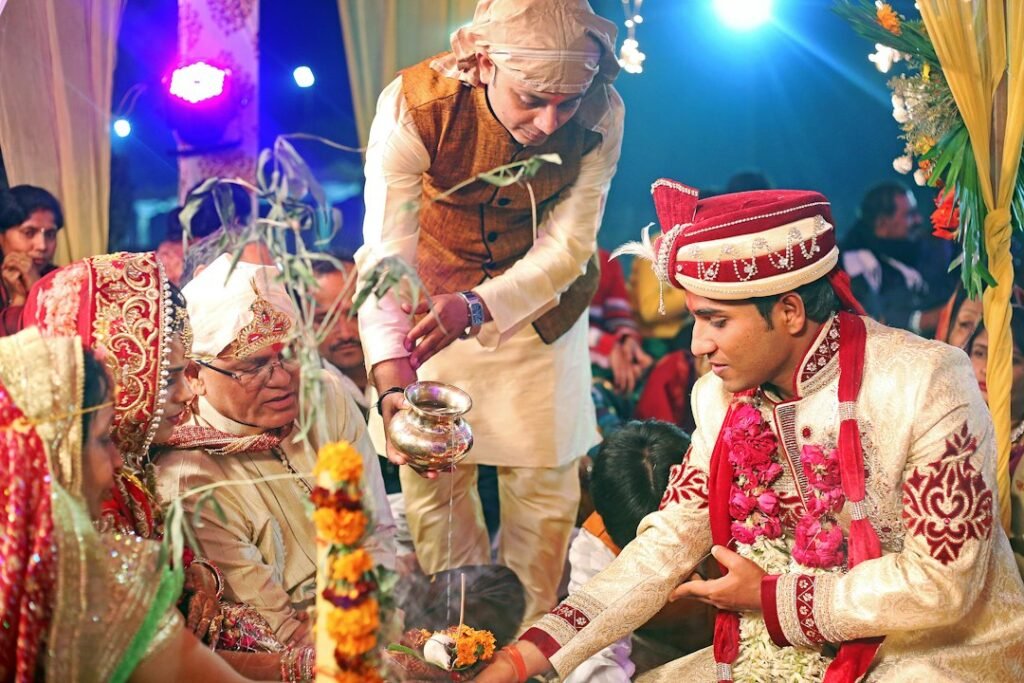
In this investigation
Muhurta is the Indian practice of choosing an auspicious time for an important act. Weddings, house entry, journeys, construction, naming ceremonies, business openings and religious rites may all be assigned times judged favourable through calendrical and astrological rules.
The practice is historically real and culturally important. What is not established is the stronger modern claim that planetary configurations at the chosen moment physically improve the outcome. Tradivior therefore has to separate ritual timing, astronomical calculation, social coordination and causal astrology.
What does muhurta mean?
The Sanskrit word muhurta can refer to a unit or division of time, but in astrological practice it also refers to electional timing: selecting a favourable moment for beginning an action.
The underlying idea is that time is not qualitatively uniform. Two moments that are identical in clock duration may be treated as different in auspiciousness.
Indian calendars were built to organize ritual time
The Hindu calendrical tradition is lunisolar and tracks several interacting cycles. Oxford Bibliographies notes that the panchangam, literally “five limbs,” remains practically important for determining ritual days, festivals, vows, initiation, marriage and other observances.
This calendrical framework is based on genuine astronomical cycles of the Sun and Moon. The step from tracking celestial time to assigning auspicious qualities to particular combinations is the astrological layer.
The five limbs of the panchanga
Traditional panchangas commonly calculate tithi (lunar day), vara (weekday), nakshatra (lunar mansion), yoga and karana. These components help classify the ritual character of a day or interval.
The calculations can be astronomically precise even when the interpretation attached to them is not scientifically validated. This is the same distinction that appears throughout the history of astrology.
Muhurta belongs to electional astrology
Historian Martin Gansten identifies muhurta as a major branch of Indian predictive astrology concerned with selecting times for action. He notes that electional astrology in India forms part of the larger history of interaction between indigenous astral traditions and Hellenistic astrology.
This matters because modern claims sometimes present every feature of muhurta as unchanged “Vedic science.” The historical record is more layered.
Why timing mattered before precise mechanical clocks
Traditional societies needed shared systems for coordinating ritual and civic action. Sunrise, lunar phases, star positions and calendrical markers offered observable public reference points.
A calendrical rule could therefore synchronize a wedding party, temple community or village long before everyone carried a personal clock.
Ritual timing converts an event into a collective commitment
A wedding does not begin whenever one participant feels ready. A house-entering ritual does not happen at an arbitrary instant. Choosing a designated time creates a shared deadline around which relatives, priests and participants organize themselves.
This coordination effect is real whether or not the planets influence the outcome.
Auspicious timing can reduce decision uncertainty
Major life events involve many uncertain choices. A recognized ritual system can reduce one class of decisions by outsourcing the timing choice to tradition or a specialist.
Psychologically, this may reduce conflict within families: instead of arguing endlessly over which date is “best,” participants can accept a culturally authoritative answer.
But reduced uncertainty is not proof of celestial causation
If choosing a muhurta makes participants more confident or coordinated, that is a plausible social mechanism. It does not show that Mars, Jupiter or a lunar mansion physically caused the marriage, journey or business to succeed.
Tradivior separates an indirect behavioural effect from the astrological causal claim.
Why weddings became strongly associated with muhurta
Marriage is socially consequential, expensive and difficult to reverse. Families therefore have strong incentives to ritualize the beginning.
An auspicious moment symbolically marks the marriage as entering the social world under favourable conditions. It can also coordinate priests, relatives and venue logistics.
House construction and entry use similar logic
Beginning construction or entering a new home can be treated as a threshold event. A muhurta gives that threshold a ritually defined beginning.
Traditional architectural and astrological systems may combine orientation, calendar, ritual and household status into one ceremony.
Travel and political action were also timed
Historical astrological literature does not restrict auspicious timing to domestic ritual. Royal journeys, military expeditions and public ceremonies could also be assigned favourable times.
Oxford scholarship on Varahamihira describes a close relationship among astrology, ritual and the timing of royal action, including warfare.
Does choosing a muhurta measurably improve outcomes?
There is no robust experimental evidence that astrologically selected times independently improve marriage stability, business success, health, building durability or other outcomes after ordinary causal factors are controlled.
This is a much stronger claim than saying the practice is meaningful or psychologically reassuring.
The challenge of testing muhurta
A proper test would have to define in advance what counts as an auspicious time, what outcome is predicted, how long the outcome window lasts and which confounders are controlled.
For weddings, researchers would need to control for income, age, family structure, compatibility, social support and many other variables. For business launches, market conditions and management would dominate outcomes. Retrospective success stories cannot isolate astrology.
Selection bias can make auspicious timing look successful
People tend to remember striking successes and failures while forgetting ordinary cases. If a marriage begun at a celebrated muhurta thrives, the timing may receive credit. If it fails, explanations can shift to other chart factors, karma or human behaviour.
A system that can reinterpret every outcome after the fact becomes difficult to falsify.
The astronomy inside the calendar is not the disputed part
Lunar phases, sunrise, planetary positions and star locations can be calculated accurately. The scientific question concerns the inference from those positions to human fortune.
Accurate ephemerides do not establish that one planetary configuration makes a contract, surgery or wedding objectively safer.
Seasonal timing can matter for ordinary reasons
Some historically favoured periods may coincide with weather, agricultural workload, transport conditions or festival cycles. A wedding season can therefore emerge from practical ecology as well as astrology.
If a dry-season date makes travel easier, the advantage is meteorological. It should not automatically be attributed to a planetary configuration.
Why the practice survives modern clocks
Muhurta no longer solves a technological problem of timekeeping, yet it continues because its role is larger than telling time. It connects families to ancestors, calendars, priests and a culturally recognized order.
For many people, beginning an important act without a muhurta can feel incomplete even when they do not expect a measurable planetary force.
Digital panchangas changed the delivery, not the idea
Apps and websites can now calculate auspicious windows instantly. The specialist mathematical labour has been automated, but the social demand remains.
This mirrors digital astrology more broadly: computational precision can increase while the empirical status of the causal interpretation remains unchanged.
Can a muhurta work through expectation?
Potentially, in an indirect sense. If participants believe a chosen time is favourable, confidence may increase and anxiety may decrease. Shared belief can also reduce disagreement.
These expectancy effects are psychologically plausible, but they are not evidence that celestial configurations themselves altered external events.
Why dismissing muhurta entirely misses something
A purely scientific critique that says “the planets do not cause success, therefore the practice is meaningless” overlooks its social functions. Ritual timing coordinates families, signals seriousness and gives transitions a recognized beginning.
Those functions can persist even when the causal astrology is unsupported.
Why calling it “scientifically proven” also misses something
Retrofitting muhurta as hidden chronobiology is equally misleading. Human circadian rhythms are genuinely affected by light and darkness, but there is no evidence that traditional auspicious combinations correspond to a universal biological optimum for marriage, contracts or construction.
Chronobiology and electional astrology are different systems.
What survives scrutiny?
- Muhurta is a historically established branch of Indian electional astrology.
- It operates within sophisticated calendrical systems that accurately track real celestial cycles.
- Auspicious timing is used for weddings, rituals, journeys, house entry and other threshold events.
- The practice can coordinate participants and reduce decision uncertainty.
- Historical astrology also used timing for royal and political action.
- There is no strong controlled evidence that planetary configurations independently improve life outcomes.
- Psychological confidence and social synchronization are plausible indirect effects.
- Astronomical accuracy in a panchanga does not validate the astrological interpretation attached to it.
The Tradivior Evidence Profile
Historical Authenticity — Strong. Electional astrology and auspicious timing are well documented in Indian calendrical, ritual and astrological traditions.
Original-Purpose Evidence — Strong. Selecting favourable times for ritual and important action is explicit rather than speculative.
Scientific Mechanism — Weak for celestial causation; Moderate for social coordination. No established mechanism links auspicious planetary configurations to external success, while scheduling and expectancy effects are plausible.
Experimental Evidence — Weak. Controlled evidence for astrologically improved outcomes is lacking.
Cross-Cultural Evidence — Strong. Electional and auspicious timing systems occur in many astrological and calendrical traditions.
Modern Relevance — Strong. Muhurta remains widely used in contemporary Indian weddings, rituals and household decisions.
The Tradivior Conclusion
Muhurta survives because it makes important beginnings feel ordered. It turns an uncertain transition into a culturally authorized moment and coordinates people around a shared decision.
The historical tradition is strong; the claim of direct planetary causation is not. The most evidence-respecting interpretation is therefore layered: the calendar contains real astronomy, the ritual contains real social coordination and meaning, while claims that an astrologically selected instant independently changes future outcomes remain unsupported.
Sources & further reading
- Gansten M. “Astrology.” Oxford Bibliographies in Hinduism. Oxford University Press, 2014.
- Klostermaier K. “Calendar.” Oxford Bibliographies in Hinduism. Oxford University Press, 2015.
- Geslani M. Rites of the God-King: Santi and Ritual Change in Early Hinduism. Oxford University Press, 2018.
- Historical studies of Indian jyotisha and panchanga traditions, including scholarship on astronomical calculation and ritual timing.
Continue exploring
Partially Supported
Why Do New Year Festivals Cluster Around Seasonal Turning Points?
Why do New Year festivals mark different seasonal thresholds? Compare calendar rules, cultural meanings and the evidence for fresh starts across civilizations.

Why Did Harvest Calendars Become Religious Calendars?
Sowing and harvest once structured food, labour, taxation and survival, so agricultural timing frequently became ritual timing. Tradivior will examine when religion preserved ecological scheduling and when later meanings took…

Why Did the Monsoon Shape Calendars and Rituals in South Asia?
In South Asia, rain determines sowing, travel, disease risk and food security, so the monsoon naturally entered ritual and seasonal calendars. Tradivior will trace how climate uncertainty became social time.

Why Did People Divide the Day Into Sacred Hours?
Canonical hours, prayer watches, sandhya, salat times and other traditions punctuate the day with religious obligations. Tradivior will ask how astronomy, social order and daily rhythm turned clock time into…
Picked for your curiosity
Enable JavaScript to build a reading profile and see recommendations.