 tradivior
In this investigation
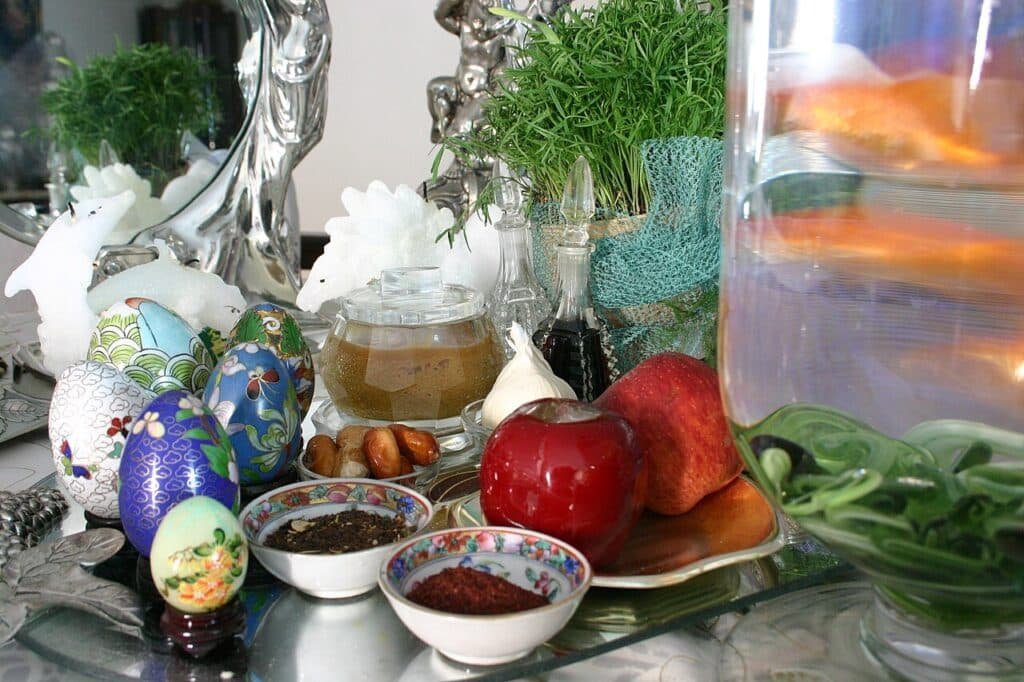
On the evening before Nowruz, a table can become a small landscape of hopes. Green shoots push out of a shallow dish. A bowl of apples catches the light. There may be vinegar, coins, garlic, a mirror, flowers, painted eggs, a book of poetry, or something a family has added because a grandparent always did. The objects are ordinary; their arrangement is anything but. The table is called sofreh-ye haft-sin, usually translated as the “seven S’s” table, because at least seven of its items begin with the Persian letter sin (س).
It is tempting to describe the arrangement as a ritual unchanged for three thousand years. The truth is more interesting. Nowruz has deep historical roots, but the precise seven-S format familiar in many Iranian homes may be much more recent than the festival itself. That is not an attack on the tradition. It is a way of seeing how traditions live: older seasonal symbols can be rearranged, interpreted and lovingly transmitted without remaining frozen in a single ancient form.
The evidence comes from several different places—historical texts, ethnographic descriptions, museum explanations and the ways contemporary communities actually celebrate. Each tells part of the story, and none alone is the whole story.
First, the scene: a family waits for the year to turn
Nowruz means “new day” in Persian and marks the arrival of spring. The Smithsonian’s National Museum of Asian Art describes the celebration as extending across West and Central Asia and into South Asia, with regional variations. Its museum presentation highlights the Haft-Sin table as an important Iranian form of welcome to the new year.
The table does not function like a museum cabinet in which every item has a fixed label. A household might grow sprouts in advance, prepare samanu—a slow-cooked wheat preparation—or place a beloved volume of Hafez’s poetry near a mirror. Someone may insist on garlic; another may choose hyacinths or sumac. A photograph of one family’s table should not be mistaken for the complete rulebook of another’s.
The Encyclopaedia Iranica’s detailed account of Haft-Sin describes not just the seven named objects but mirrors, candles, water, eggs, flowers, fruits, sweets and books. Its ethnographic examples include variation in placement, ingredients and regional practice. This richness is the first clue that the tradition is not simply a mnemonic list of seven groceries.
What the “seven S’s” actually name
The Persian words matter. Translating them into English sometimes makes the pattern disappear, because “apple,” “garlic” and “vinegar” no longer begin with the same sound. The common elements below are examples, not an internationally enforced inventory.
| Persian name | Object | Common contemporary association |
|---|---|---|
| Sabzeh | Sprouted wheat, lentils or other greens | Renewal and growth |
| Samanu | Sweet preparation made from germinated wheat | Abundance, nourishment and patient labour |
| Sib / Seeb | Apples | Beauty, health or fertility |
| Sir / Seer | Garlic | Protection or well-being |
| Serkeh / Serka | Vinegar | Patience, age or endurance |
| Senjed | Fruit of the oleaster tree | Love and fertility |
| Somāq / Sumac | Red spice | Dawn, colour or the return of light |
Coins (sekkeh), hyacinths (sonbol) and other S-words appear in many documented arrangements too. The Smithsonian’s illustrated guide gives one selection that includes coins and hyacinths, while Encyclopaedia Iranica documents additional possibilities such as wild-rue seeds. This is not a contradiction that needs to be “corrected” by choosing a single authentic seven. It reflects household and regional practice.
Some symbolic interpretations are widely repeated today, but they are not measurable properties of the objects. An apple does not cause fertility because it is placed on a cloth; a sprout does not scientifically guarantee prosperity. These are meaningful ritual associations, ways of giving visible form to wishes for the year. Treating them as symbolic acts respects what the participants are doing without converting devotion into a laboratory claim.
Why seven? An old symbolic number is not the same as an old recipe
The number seven has long been important in Iranian religious and cultural imagination. In Zoroastrian thought, the Amesha Spentas are a group of divine beings associated with aspects of creation and moral order. Older spring observances also used plants, food, water and fire to express renewal. Those connections help explain why a contemporary Nowruz table feels like a miniature portrait of the living world.
Yet an appealing historical explanation can travel further than the documents allow. One popular account says the exact modern seven-S list was established in the ancient Achaemenid or Sasanian courts. Another claims it was originally “seven Sh’s” and changed letters after Islam. The historical record does not justify presenting either neat tale as a settled fact.
The Iranica article makes a careful distinction: older accounts refer to seven kinds of seeds and other sevenfold spring displays, but these are not evidence that today’s precise seven-S table existed in the same form. The article also questions speculative etymologies that derive the name from “seven trays” or “seven gathered things.” Similarity is a clue worth investigating, not a license to announce an unbroken chain.
This matters because it reveals two layers of continuity. A society can preserve a seasonal festival and its core values over centuries while changing the objects, words and domestic gestures through which people express them. Calling every visible detail “unchanged since antiquity” actually obscures the creativity of the people who kept the celebration alive.
The documentary twist: a familiar table with a difficult paper trail
Historical writing about Nowruz stretches back much further than many surviving descriptions of the exact Haft-Sin arrangement. The Encyclopaedia Iranica’s study of pre-Islamic Nowruz traces religious and calendrical observances through Iranian history, while warning that the ancient textual record is incomplete. The festival’s deep roots do not mean every modern domestic custom appears in ancient texts.
For the particular seven-S formulation, the evidence is surprisingly uneven. The specialist Iranica entry reports a questionable isolated manuscript reference and relatively sparse nineteenth-century eyewitness mentions of the modern arrangement. It argues that the Haft-Sin form as now known appears to have gained prominence comparatively recently. That is a scholarly interpretation of the surviving evidence, not a proof that no earlier household ever assembled a similar table.
Why is that distinction essential? Domestic rituals are often less well documented than royal ceremonies. A traveler might notice a palace procession but ignore what a family placed on its floor. A missing description can mean the practice was absent, but it can also mean the observer never asked, never entered the household or did not think the detail worth recording.
Good historical method therefore resists two extremes. We should not claim an exact ancient origin without evidence. But we should not assume a living practice was invented on the day a surviving author first wrote about it. The responsible conclusion is narrower: the modern arrangement’s history is less certain, and likely more layered, than popular origin stories suggest.
The wheat dish that reveals how ritual knowledge is carried
Consider samanu. It is not merely an item to purchase and position. Traditional preparation can involve soaking and sprouting wheat, extracting its sweetness and cooking the mixture for hours. Encyclopaedia Iranica describes local preparations in which women gather to make the dish and share portions with neighbours. The exact practices differ by place and family, but the documented preparation shows that a table can contain social labour as well as symbols.
That changes the question from “What does samanu mean?” to “Who teaches someone to make it, and what relationships are renewed in the making?” A dish passed between households can carry memory, reciprocity and hospitality. A visitor who sees only a brown bowl misses the preparation and the people who gave it significance.
The same is true of sprouts. Their growth requires advance attention: a family watches seeds become green shoots as the year turns. That is a powerful experiential metaphor, not because a laboratory has proved it predicts the harvest, but because it lets time itself become visible on the table.
One festival, many countries—and not one universal table
The 2016 UNESCO intangible-cultural-heritage decision lists a multinational nomination for Nowruz under many names, including Nawrouz, Nauryz, Navruz and Nevruz. It includes countries across Central, West and South Asia, including India and Pakistan. This international recognition concerns a family of New Year traditions, not a rule that every participating community must arrange the same seven Persian words.
That distinction is especially important when discussing Afghan, Tajik, Kurdish, Zoroastrian or diaspora practices. Iranica notes that some communities closely connected to Nowruz historically did not observe the specific Haft-Sin arrangement, while others adopted or adapted it in more recent periods. A community can celebrate the new year fully without replicating a Tehran household’s table.
Nor should a modern Iranian family be asked to perform a supposedly pristine ancient version for an outsider’s approval. A book of poetry, a religious text, a photograph of an absent relative or a small personal object may be part of a sincere contemporary observance. What belongs on a particular family’s table is shaped by faith, taste, access, migration and memory.
Mirrors, eggs, books and the meanings beyond the S
The mirror and candles are often placed prominently, although neither is required to start with the Persian letter S. The mirror can suggest reflection and light; eggs evoke new life; a book can bring literary, religious or family meaning into the ceremony. The Smithsonian records the use of Hafez’s poetry and the Qur’an among other objects. These are documented examples, not an instruction to every household.
Look at the table as a composition rather than a checklist. Green growth sits beside preserved food; fresh flowers beside vinegar; a mirror beside the written word. The arrangement can hold several timescales at once: what has survived the winter, what is germinating now, and what a family hopes to carry into the future.
That interpretation is editorial analysis, not a claim that all participants consciously assign each object the same philosophical meaning. The pleasure of a living tradition is that the object can remain familiar while its significance shifts. For one person, coins may recall a wish for material security. For another, a dish prepared with a grandmother may be the centre of the celebration, whatever the formal symbolism says.
What science can and cannot say about the table
Some claims associated with ritual objects are empirical and can be investigated. Sprouted grains grow because of germination under suitable conditions. Food preparation has observable chemistry. Candle flames and reflective surfaces obey physical laws. If a specific health claim is made about eating an ingredient, it should be evaluated using evidence about dosage, safety and clinical outcomes, not the item’s sacred association.
Other claims are symbolic, devotional or philosophical. Whether a table meaningfully honours ancestors, marks renewal or brings a family together is not answered by measuring its effect on crop yield. It would be a category error to declare an entire religious or cultural practice “scientifically supported” or “unsupported” merely because one of its objects has a measurable property.
A narrow, testable proposition might be: “Can wheat seeds germinate indoors before the spring equinox?” Yes, under appropriate conditions. That observation neither validates nor invalidates the spiritual meaning of sabzeh. It simply describes one physical process that people have woven into a much larger act of celebration.
How to approach another family’s tradition without flattening it
Begin with the person’s own description rather than an internet list of mandatory objects. Ask what their family places on the table, who prepares it and whether the arrangement has changed across generations or after migration. Do not assume that a different choice is an error, or that a modern practice is less sincere because historians cannot trace it unchanged to antiquity.
If you are photographing or writing about the celebration, distinguish a specific family’s arrangement from a representative cultural image. Credit the photographer and the community where appropriate. Be particularly careful with claims about ancient origins: cite specialist research rather than repeating a tidy legend because it sounds compelling.
For a related exploration of why communities use seasonal turning points to renew social life, see Tradivior’s article on New Year festivals and the seasons. The shared question is not which festival is “most ancient,” but how human communities turn the passage of time into collective meaning.
The living table is more remarkable than a frozen relic
Nowruz endures because people continue to celebrate it, not because every apple and candle can be traced to a single original inventor. The Haft-Sin table gathers older ideas of spring, prosperity, family and remembrance into a form that can change as families change. Its uncertain documentary history does not diminish the care invested in preparing it.
Perhaps the most respectful way to look at the table is to hold two truths together: its meanings are real to the people who practice them, and historians still have legitimate questions about how its present form developed. The seven S’s are not a code that needs one final decoding. They are a language through which households continue to speak about the coming year.
Sources and historical context
- Encyclopaedia Iranica, “Haft Sin” — ethnographic details, regional variations, origins debate and the limits of historical evidence.
- Encyclopaedia Iranica, “Nowruz i. In the Pre-Islamic Period” — religious, calendrical and historical context.
- Smithsonian National Museum of Asian Art, “A New Day: Celebrating Nowruz” — documented museum presentation of the table and its objects.
- Smithsonian National Museum of Asian Art, Nowruz Family Day — contemporary geographic breadth and museum interpretation.
- UNESCO Intergovernmental Committee, Decision 11.COM 10.b.1 (2016) — multinational inscription of Nowruz.
Featured image: an authentic Nowruz Haft-Sin table photographed by Babak Habibi (2004), made available in the public domain through Wikimedia Commons. Individual family arrangements vary.
Continue exploring
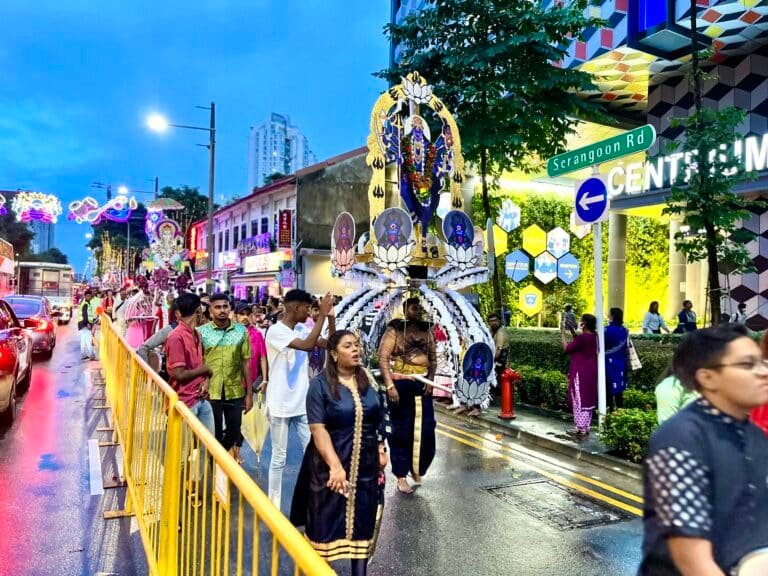
The Burden That Becomes a Promise: Thaipusam’s Journey from Tamil Hills to Singapore Streets
From a 1932 silver chariot stopped by trolley wires to Singapore's 2026 procession, Thaipusam reveals how Tamil devotion and diaspora life reshape one another.
The People Beneath the Tower: How Catalonia’s Castells Learned to Reach Higher
From eighteenth-century dances to modern safety debates, Catalonia's castells reveal how a living tradition balances collective trust, ambition and risk.

When the New Year Has More Than One Star: Matariki, Puanga and the Art of Remembering
Matariki is not one fixed star count or ceremony. Explore Māori regional traditions, Puanga, hautapu, the lunar calendar and New Zealand's public holiday.
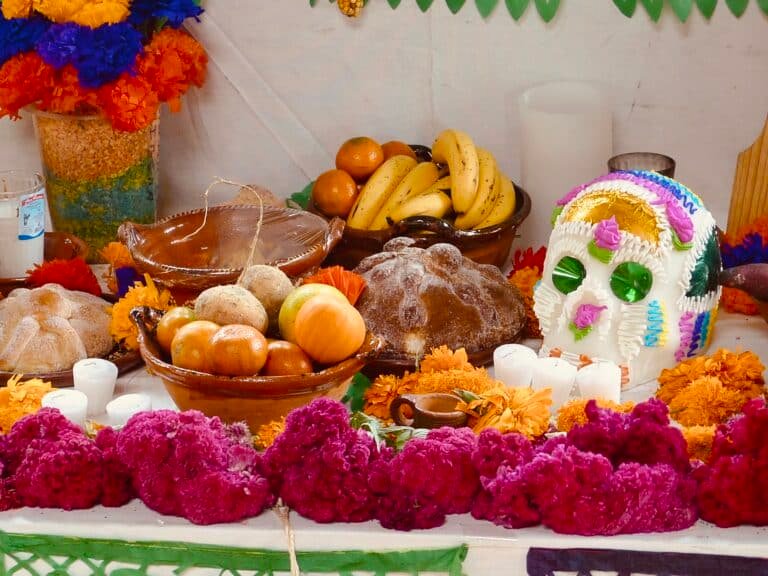
The Altar That Changes Every Year: Día de Muertos and Its Many Histories
A Día de Muertos ofrenda can hold water, marigolds and a loved one's favourite meal. Its meaning is intimate; its history is more layered than an unchanged ancient ritual.
Picked for your curiosity
Enable JavaScript to build a reading profile and see recommendations.