 tradivior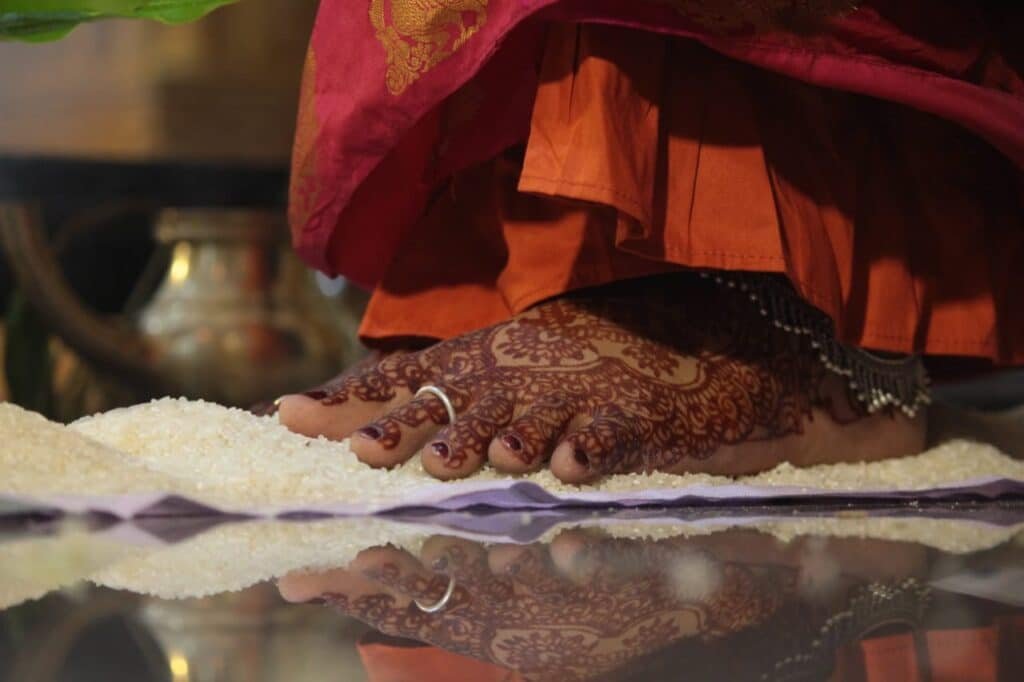
In this investigation
At many Hindu weddings, fire is not decoration. It is witness. The couple makes offerings, takes vows and, in many regional traditions, circles a consecrated fire or takes ritual steps in its presence. The details vary, but the symbolism is clear within Hindu ritual: Agni connects offering, sacred presence and solemn commitment.
Modern explanations sometimes search for hidden health benefits in the smoke, heat or circular movement. That misses the strongest evidence. The ritual’s primary logic is religious and social. Modern psychology can help explain why public vows, synchrony and repeated movement feel binding, but it should not displace the tradition’s own theology.
Why fire carries authority
Fire has a central place in Vedic ritual and later Hindu practice as a medium through which offerings are made. Agni is associated with carrying offerings and witnessing sacred action. Marriage rites inherited this symbolic authority.
A flame is also visually compelling, difficult to ignore and naturally suited to becoming the focal point around which participants and witnesses organize attention.
THE RECORD
Sacred fire in Hindu marriage is historically embedded in ritual theology. Its most defensible explanation is not purification by smoke or a physiological effect of circling, but the public and sacred ratification of vows.
Circumambulation makes commitment visible
Moving together around a sacred centre converts words into embodied action. The couple must coordinate pace, direction and sequence while relatives watch. The commitment becomes something performed rather than merely spoken.
Social-psychology research on synchrony and ritual suggests that coordinated action can strengthen affiliation and shared identity. That is a plausible secondary mechanism, not the historical origin of the rite.
The seven steps are not universal in identical form
Saptapadi, often described as seven steps or seven rounds, is important in many Hindu marriage traditions and has legal significance in some Indian contexts. Yet regional rites differ in sequence, number and emphasis.
It is therefore safer to speak of important Hindu wedding traditions rather than one single pan-Indian ceremony practiced identically everywhere.
Public vows create accountability
Promises made before family and community carry a different social weight from private intentions. Witnesses remember the event and recognize the change in status.
The fire intensifies that seriousness within a sacred frame, while the gathered community intensifies it socially.
THE EVIDENCE
Public vows and coordinated ritual can plausibly strengthen memory, commitment and group recognition. There is no credible evidence that circling fire is medically necessary for marriage or that ritual smoke provides a unique health benefit.
Fire links household and cosmic order
In Hindu thought, marriage is often larger than the couple: it establishes household life, ritual obligations and continuity between generations. Sacred fire can symbolize that the new household enters an order that exceeds individual preference.
This meaning is theological and social, not reducible to fire’s physical properties.
Smoke should not be romanticized
Combustion produces particulates and gases. In poorly ventilated indoor spaces, smoke can irritate eyes and airways. A sacred use does not make smoke toxicologically neutral.
Modern ventilation and smaller controlled fires can preserve ritual form while reducing unnecessary exposure.
Why repetition matters
Wedding vows and rounds are structured rather than improvised. Fixed sequences reduce ambiguity and make the ceremony recognizable across generations.
Predictable ritual can also help participants focus during an emotionally intense event.
Legal recognition and sacred recognition overlap
Modern Indian marriage law interacts with customary rites in complex ways. For many families, registration creates state recognition while sacred fire and vows create religious and familial recognition.
These systems serve different institutions and can coexist.
Agni’s role predates the modern wedding industry
Fire occupies a foundational place in Vedic ritual as a medium of offering and a sacred presence linking human action with divine order. Hindu marriage rites inherit that older ritual vocabulary.
The wedding fire therefore makes historical sense within a broader sacrificial tradition, not as an isolated decorative custom.
Fire is an unusually effective ritual centre
A flame attracts attention, produces light and heat, and remains visually distinct from ordinary household objects. Participants can orient themselves around it physically and symbolically.
This sensory salience may help make the ceremony memorable, while the sacred meaning comes from religious tradition rather than from the flame’s physics alone.
Circumambulation transforms the vow into embodied action
Walking around a sacred centre requires the couple to coordinate movement in front of witnesses. The marriage is performed with the body rather than only stated in words.
Research on synchronized movement makes social bonding a plausible secondary effect, but it does not establish that the rite originated as a behavioural intervention.
Seven rounds and seven steps are related but regionally variable
Popular descriptions often compress Hindu weddings into “seven rounds around the fire.” In practice, saptapadi, pheras and related rites vary by region, community and ritual school.
A historically responsible account should avoid presenting one North Indian sequence as the only authentic Hindu wedding form.
Vows create a public moral script for household life
Marriage rites may invoke prosperity, companionship, fertility, household responsibility and mutual support. These themes tell the couple and community what married life is expected to contain.
The ritual therefore acts as moral instruction as well as status transition.
Sacred fire links marriage with household ritual
Classical Hindu ideals of household life include obligations that extend beyond romantic partnership. Marriage creates a new unit capable of performing domestic, familial and ritual duties.
Fire can symbolize this transition from two individuals to a household situated inside a wider religious order.
Smoke is not the health mechanism of the ceremony
Claims that havan smoke sterilizes the wedding environment or delivers unique medicinal compounds are far weaker than the historical evidence for fire as sacred witness.
Combustion produces particulate matter and gases. In enclosed, poorly ventilated spaces, smoke can irritate eyes and airways even when the ritual itself remains meaningful.
Ventilation can preserve the rite while reducing exposure
A smaller fire, open ventilation or carefully managed ceremonial space can maintain sacred form without filling an indoor venue with unnecessary smoke.
This is a good example of adapting material execution while preserving symbolic core.
The fire’s legal significance depends on customary practice
Indian marriage law recognizes customary rites in complex ways, and not every Hindu marriage requires exactly the same ceremony. Where saptapadi forms part of the customary rite, completion of the steps can carry legal significance.
Religious, familial and civil recognition therefore overlap but are not identical.
The couple’s route around fire can encode hierarchy
Traditional ceremonies may specify who leads during particular rounds or how the couple is positioned. Those details can reflect gender roles and older household expectations.
Modern couples often reinterpret such elements toward mutuality while retaining the circumambulation itself.
Repetition increases memorability
Multiple rounds, repeated mantras and stepwise vows create rhythm and structure. A highly patterned sequence is easier for participants and witnesses to remember than an improvised conversation.
That mnemonic function is ordinary psychology layered onto sacred form.
Witnesses make the marriage socially durable
Family members observe the vows and the movement around the fire. Their presence turns a couple’s private intention into collective knowledge.
The sacred witness and the human witnesses operate on different levels but reinforce the seriousness of the event.
Photography and destination venues change the setting, not necessarily the rite
Modern weddings may take place in hotels, lawns or destination resorts rather than household courtyards. The fire is often recreated in portable form inside a highly commercial event.
This shows how ritual can remain recognizable even when architecture, clothing and technology change dramatically.
Interfaith and diaspora weddings reveal which elements families consider essential
When ceremonies must combine traditions or adapt to foreign fire codes, families negotiate which acts carry core meaning. Sacred fire may be reduced, symbolized or integrated with another ritual form.
Those negotiations demonstrate that living tradition contains interpretation, not just repetition.
There is no evidence that circumambulation medically improves marriage
Walking in circles around fire does not create a unique physiological bond, balance hormones or guarantee fertility. Claims of that kind are modern overreach.
The rite is already significant as sacred witness, embodied vow, memory and public commitment.
The strongest explanation stays inside both theology and social science
Historically, Agni matters because Hindu ritual grants fire sacred authority. Socially, circumambulation and witnessed vows make commitment visible and memorable.
Those explanations complement each other. Neither needs to be replaced by speculative claims about smoke chemistry or hidden physiology.
The fire also links the ceremony to sacrifice without requiring animal sacrifice
Offerings of ghee, grains or other materials into sacred fire place the marriage inside a sacrificial idiom of giving and transformation. The couple does not merely stand beside a flame; the fire participates in a structured ritual exchange.
This historical context is more explanatory than modern claims that the smoke itself creates the marriage’s benefits.
The sacred centre organizes attention in a crowded ceremony
Large Indian weddings can contain music, relatives, photography and movement. The fire creates a visual and ritual centre around which the most consequential acts are organized.
That concentration of attention helps witnesses recognize which moment carries special significance.
Modern fire codes reveal how rituals adapt materially
Hotels and indoor venues may restrict flame size, ventilation or fuel. Families often use smaller ceremonial fires while retaining mantras, offerings and circumambulation.
This is evidence that the symbol and ritual sequence can survive changes in physical implementation.
A sacred witness and a legal certificate answer different questions
The fire can make a marriage religiously meaningful to participants, while registration makes it legible to the state. Neither automatically substitutes for the other.
Modern couples often use both because they seek recognition in multiple institutions.
The rite survives scrutiny when theology is not disguised as science
Agni as witness, offering medium and sacred presence is historically grounded. Public vows, synchrony and witness also have plausible social effects.
Claims of unique medicinal smoke, fertility effects or physiological bonding add little and weaken an otherwise coherent tradition.
Sacred fire works because it is simultaneously material and symbolic
A flame is physically real, visually compelling and difficult to ignore. It produces heat, light, smoke and movement while also carrying theological meaning as Agni. That combination makes fire an unusually effective ritual centre because every participant can orient attention toward the same object.
The physical salience of fire helps explain ritual focus, but it should not be mistaken for the sacred meaning itself. Psychology can explain attention; theology explains why this particular flame is treated as witness.
Embodied vows are easier to remember than abstract promises
Walking, circling, touching, offering and repeating vows create multiple memory cues at once. A couple can later remember not only what was said but where they stood, what they carried and how they moved.
This embodied structure may help explain why wedding rites feel durable. It does not prove that one sequence is psychologically superior to all others.
Regional variation is evidence against one hidden biomedical purpose
Some Hindu weddings emphasize seven steps, some seven rounds, some particular offerings, some regional deities or ancestral customs. The diversity shows that the rite is a living family of traditions rather than a single standardized protocol.
If circling fire had one precise physiological function, such variation would be difficult to explain. Social and theological functions fit the evidence better.
Fire codes demonstrate that sacred form can survive technical adaptation
Modern hotels, halls and diaspora venues often restrict open flames. Families respond with smaller controlled fires, enclosed vessels, ventilation or specially approved setups.
The ritual remains meaningful because the symbolic centre can be preserved while the material implementation changes. Tradition survives by adapting to contemporary safety systems.
Smoke exposure should remain proportionate
Combustion produces particulate matter and gases. A small, well-ventilated ceremonial fire is different from prolonged indoor smoke exposure, but the principle remains: sacred smoke is still smoke from a respiratory-health perspective.
Good ventilation and minimal fuel preserve the ritual while reducing unnecessary exposure.
The rite can remain sacred without claiming hidden health effects
One of the strongest ways to preserve the dignity of sacred-fire weddings is to stop asking the flame to prove itself through speculative physiology. The rite already carries theological, familial and social meaning.
Modern evidence can add practical guidance about ventilation, fire safety and public commitment while leaving Agni’s sacred role within the religious tradition that gives it meaning.
Diaspora weddings reveal the hierarchy of what families consider essential
When ceremonies move into hotels, temples or civic venues abroad, families often shorten sequences, translate vows or adjust the fire setup while keeping the sacred centre and key marital actions.
These adaptations show that traditions contain a hierarchy of elements: some are negotiable logistics, while others carry the identity of the rite.
Preserving the rite therefore means preserving sacred meaning, public vows and the shared centre of attention while adapting fuel, ventilation and venue rules to modern safety. Nothing essential is lost by reducing unnecessary smoke.
The marriage ritual remains complete when symbolic fire is handled safely, because its force comes from sacred witness and shared action rather than smoke exposure itself.
That distinction preserves both meaning and safety.
Meaning endures.
What survives scrutiny?
- Sacred fire is deeply rooted in Hindu ritual traditions and important in many marriage ceremonies.
- Fire functions as sacred witness and offering medium within Hindu theology.
- Circumambulation and vows make commitment embodied and public.
- Coordinated movement can plausibly strengthen shared attention and affiliation.
- Regional Hindu wedding rites differ and should not be treated as one fixed national script.
- There is no established biomedical reason that a couple must circle fire.
- Smoke exposure should be minimized in poorly ventilated spaces.
The Tradivior Evidence Profile
Historical Authenticity — Strong. Sacred fire and fire-centred vows are well rooted in Hindu ritual history.
Original-Purpose Evidence — Strong. Witness, offering, sacred presence and marital commitment are explicit ritual functions.
Scientific Mechanism — Limited. Social coordination and public commitment are plausible; biomedical claims are not established.
Experimental Evidence — Limited. Ritual synchrony research supports general social effects, not the specific sacred-fire rite as a clinical intervention.
Cross-Cultural Evidence — Moderate. Sacred fire and circumambulation have parallels elsewhere, but the Hindu marriage meanings are distinctive.
Modern Relevance — Strong. The rite remains meaningful for families and can be practiced safely with attention to ventilation.
The Tradivior Conclusion
Primarily Symbolic/Cultural. Indians circle sacred fire at weddings because fire has ritual authority as witness, offering medium and sacred presence, while the circling and vows publicly enact commitment. Modern social science can help explain why coordinated, witnessed ritual feels binding. It does not reveal a hidden physiological purpose. The tradition is strongest when understood on its own religious terms rather than translated into speculative health claims.
Continue investigating
Sources & further reading
- Kane PV. History of Dharmaśāstra, sections on marriage rites.
- Jamison SW. Work on Vedic ritual and marriage traditions.
- Turner V. The Ritual Process.
- Research literature on ritual synchrony and public commitment.
Continue exploring
Partially Supported
Why Do Religious Processions Take Sacred Things Into the Street?
Religious processions move sacred presence, symbols and communities through public space. They can expand shared identity through coordinated movement and visibility, but the same public occupation can mark boundaries and…
Primarily Symbolic/Cultural
Why Is Diwali Built Around Light?
Diwali’s lamps are historically and religiously meaningful symbols whose interpretations vary across Hindu, Jain, Sikh and regional traditions. Light makes sacred time visible and transforms homes and streets; modern science…
Primarily Symbolic/Cultural
Why Do Weddings Need Ritual?
Weddings ritualize marriage because marriage reorganizes kinship, property, inheritance, sexuality, residence and public obligations. Ceremony makes a private relationship socially legible; synchrony, witnesses and feasting can strengthen commitment and networks,…

Primarily Symbolic/Cultural
Why Do Religions Regulate Meat?
Religions regulate meat because killing animals, blood, purity, sacrifice and communal identity carry unusually high moral weight. Some rules may have ecological or safety consequences, but Jewish, Islamic, Hindu, Jain,…
Picked for your curiosity
Enable JavaScript to build a reading profile and see recommendations.