 tradivior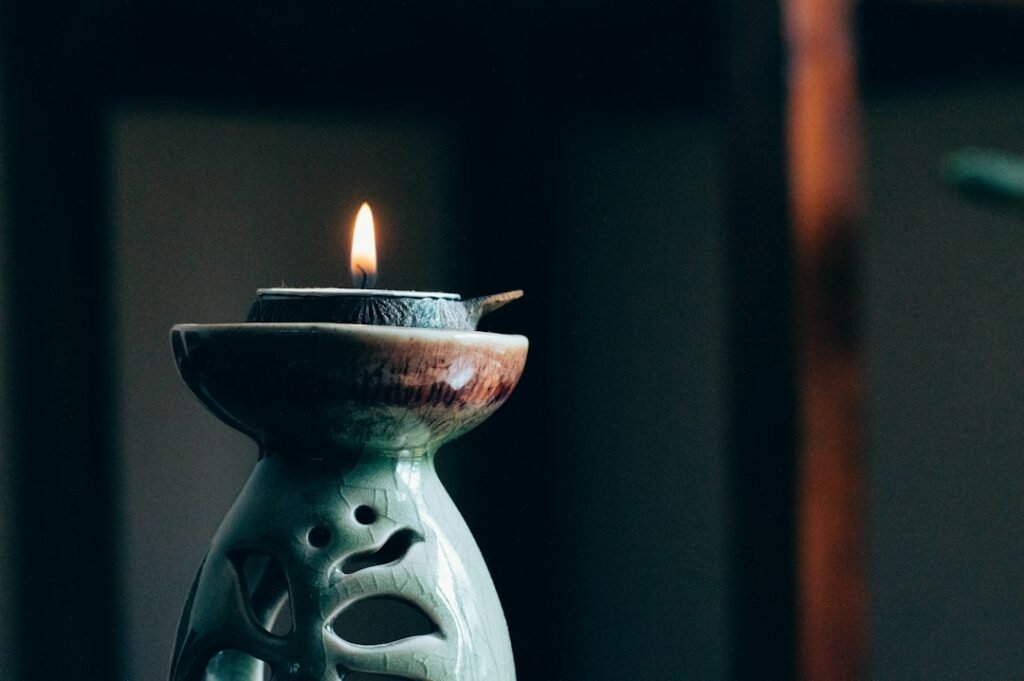
In this investigation
A candle flame in a dark room has become one of the most recognizable images of modern yoga concentration. The practitioner sits still, fixes the eyes on the flame, resists distraction and then closes the eyes to observe the after-image. The exercise is commonly called trāṭaka or jyoti-trāṭaka.
Modern explanations often go much further. Trataka is said to sharpen eyesight, strengthen eye muscles, cleanse the eyes, improve memory, increase concentration, reduce anxiety, awaken intuition or even activate a “third eye.” Some of these claims are historical, some are modern extrapolations, and some mix symbolic language with clinical language in ways that are difficult to test.
The first task is therefore to separate the practice from its later mythology. Classical haṭha-yoga texts do describe trataka. But the classical instruction is broader than candle gazing, and modern scientific evidence is much more modest than many wellness claims suggest.
Classical trataka is steady gazing, not necessarily candle gazing
The Haṭha Yoga Pradīpikā, usually dated to the fifteenth century, includes trataka among the cleansing or preparatory practices of haṭha yoga. Its description instructs the practitioner to gaze steadily at a small target with an unmoving gaze until the eyes fill with tears.
This matters because the text does not define trataka as “stare at a candle.” A flame is an especially practical and visually compelling target and became widely used in modern teaching, but the older idea is sustained visual fixation on a small object or point.
THE HISTORICAL CORRECTION
Trataka is historically a yogic gazing practice. Candle-flame gazing is one form of it. Treating the candle as the original or only authentic target oversimplifies the textual record.
The traditional claim included the eyes—but in premodern medical language
The same verses in the Haṭha Yoga Pradīpikā associate trataka with removing eye disorders and sloth. That claim is historically authentic: it belongs to the traditional description of the practice. It is not, however, equivalent to a modern ophthalmology finding.
Premodern categories of “eye disease” did not map neatly onto glaucoma, refractive error, cataract, dry-eye disease, retinal disorders or neurological vision problems. A classical statement can therefore document what practitioners believed without establishing that trataka treats any specific modern diagnosis.
Why gazing is an unusually direct form of attention training
Most concentration practices ask the mind to remain with something: a breath, sound, image, prayer or bodily sensation. Trataka adds a visible external anchor. The target is physically present and easy to detect when the gaze drifts away from it.
This gives the practice a built-in feedback mechanism. If attention wanders, the eyes often wander with it. Returning the gaze can therefore support returning attention. The scientific mechanism does not require an esoteric explanation: sustained fixation recruits ordinary visual attention, inhibitory control and repeated redirection.
Modern trataka sessions usually contain more than fixation
Research protocols commonly described as “trataka” often include several components: preparatory eye movements, palming, fixation on a candle flame, suppression of blinking for a limited period, closing the eyes, visualizing the after-image, chanting, silence or relaxation.
This is scientifically important. If cognition improves after the session, the study cannot automatically tell us whether the effect came from fixation, relaxation, eye movement, expectation, repeated practice or the combination. Trataka research often evaluates a package rather than one isolated visual mechanism.
Small studies suggest immediate changes in visual-attentional processing
A 2010 study of thirty adults measured critical flicker fusion—the frequency at which a rapidly flickering light is perceived as steady—before and after a trataka session and a control condition. Critical flicker fusion increased after trataka. The result was statistically significant, but the sample was small and the measure is not the same thing as improved eyesight.
Another study examining immediate cognitive performance reported improvements on some attention and cognitive tasks after yogic visual concentration. These findings are compatible with short-term alertness or attentional effects, but they do not establish long-term cognitive enhancement.
THE EVIDENCE LIMIT
A statistically significant change in an attention or visual-processing test does not mean trataka corrects refractive error, cures eye disease or permanently raises intelligence.
One month of practice produced cognitive improvements in an elderly sample
A controlled study in older adults reported improvements after one month of trataka practice in measures including short-term and working memory, selective and focused attention, visual scanning and executive function compared with a wait-list group.
The researchers themselves noted an important limitation: the intervention included multiple components. Preparatory eye exercises, fixation, defocusing, chanting and relaxation could all have contributed. The study therefore supports the possibility that a structured trataka routine can train attention; it does not isolate candle gazing as the active ingredient.
The digital-eye-strain evidence is more relevant than miracle-eye claims
A randomized controlled trial involving people exposed to prolonged digital-display use evaluated trataka for visual strain, mind wandering and mindfulness. After two weeks, the intervention showed improvements in several reported outcomes compared with controls.
This is a much narrower use case than claims that trataka “improves vision.” Digital visual strain involves fatigue, discomfort, dryness and attentional demand rather than a single structural eye disease. A practice combining gaze control, breaks, eye movements and relaxation could plausibly influence symptoms without changing the optical power of the eye.
Blink suppression creates a physiological trade-off
Traditional descriptions emphasize a steady, unmoving gaze, sometimes continuing until tears arise. From a modern ocular perspective, blinking is not a nuisance to be eliminated indefinitely. Blinks redistribute the tear film, help lubricate the ocular surface and contribute to visual comfort.
Sustained fixation with reduced blinking can therefore increase dryness or discomfort in some people, especially in air-conditioned environments or among those already prone to dry eye. The appearance of tears during intense gazing should not automatically be interpreted as “toxins leaving the eye.” Reflex tearing is a normal physiological response to ocular surface irritation and reduced blinking.
The after-image is normal visual physiology
After staring at a bright, high-contrast target and then closing the eyes, many people perceive an after-image. This can feel unusually vivid during candle practice. The phenomenon does not require a supernatural explanation. Photoreceptors and visual neurons adapt to sustained stimulation, producing a temporary complementary image when the stimulus disappears.
Traditional practitioners may use the after-image as an internal object of concentration. That contemplative use is real even though the visual phenomenon itself has a standard physiological explanation.
Attention training does not prove a “third-eye” mechanism
Modern yoga culture sometimes connects trataka with the ājñā cakra, intuition or activation of a “third eye.” Such language belongs to spiritual and symbolic systems that cannot be tested in the same way as blink rate, memory or intraocular pressure.
Scientific findings about focused attention should not be used as retroactive proof that a subtle-energy anatomy has been physically demonstrated. A practice can carry spiritual meaning and measurable attentional effects without one validating the metaphysics of the other.
What does the glaucoma literature actually show?
A 2023 systematic review and meta-analysis examined yoga interventions and intraocular pressure in people with glaucoma. Some included trials used jyoti-trataka together with standard glaucoma treatment and reported reductions in intraocular pressure. Pooled randomized evidence favored yoga interventions over controls.
That finding deserves attention, but not overstatement. The review included only six studies in total, the interventions varied, sample sizes were modest and several protocols combined trataka with breathing exercises or meditation. The authors explicitly called for larger studies and longer follow-up.
It would therefore be irresponsible to tell a person with glaucoma to replace medical treatment with candle gazing. The current evidence suggests a possible adjunctive role for some yoga practices under proper care, not a demonstrated cure.
A newer eye-disorder review still finds the evidence developing
A systematic review published in 2025 examined yoga-based interventions for eye disorders including glaucoma, refractive error, dry eye and visual strain. The existence of enough experimental work to review is significant, but the field remains heterogeneous: different yoga packages, outcomes, populations and durations make broad conclusions difficult.
This is exactly the situation where Tradivior’s multidimensional approach matters. There is enough evidence to reject the claim that trataka is scientifically meaningless. There is not enough evidence to support the claim that it broadly cures eye disease.
Presbyopia claims remain under investigation
A registered randomized trial protocol published in 2025 proposes testing trataka as an addition to standard care for presbyopia, the age-related decline in near focusing ability. The planned study is substantial, but a protocol is a plan, not a result.
This distinction is often lost online. A trial being registered or published as a protocol does not mean the treatment has already been proven. Until outcome data are available and replicated, claims that trataka reverses presbyopia remain unconfirmed.
The most defensible cognitive mechanism is repeated attentional return
Trataka asks the practitioner to do something psychologically simple but difficult: keep attention on one object and notice when it leaves. Each distraction creates another opportunity to return.
This resembles other focused-attention practices. The candle is not necessarily special because of its chemistry or radiation. It is useful because it is visually salient, dynamic enough to hold interest and easy to position as a single clear target against darkness.
A flame may be unusually engaging without being medically unique
Flames flicker, change shape and produce high contrast. That combination can attract attention more easily than a static dot on a wall. Historically, lamps and fire also carry ritual meaning across Indian traditions, which can make the object emotionally and symbolically significant.
None of this proves that candlelight has a unique neurological power. A target can be effective because it is perceptually compelling and culturally meaningful without possessing a special therapeutic frequency.
Why trataka can feel calming even though staring is effortful
Focused-attention tasks narrow the field of competing stimuli. A person who normally shifts continuously between messages, screens, sounds and thoughts now has one permitted object. That simplification can reduce the subjective sense of cognitive clutter.
At the same time, trataka is effortful. Eye discomfort, blinking urges and intrusive thoughts may become more noticeable. Calm may arise partly from the later relaxation phase rather than from fixation itself. Again, the sequence matters more than a single romanticized mechanism.
The practice is better understood as concentration training than ocular exercise alone
Modern descriptions sometimes classify trataka mainly as “eye yoga.” Classical haṭha-yoga placement and modern protocols suggest a broader role. The eyes provide the doorway, but the practice trains attention, persistence and the transition from external fixation to internal visualization.
This wider interpretation also makes better sense of why trataka appears alongside practices concerned with concentration and mental steadiness. The visual system is being used as a handle on attention.
Safety depends on rejecting extreme interpretations
Nothing in the evidence justifies staring into the sun or any dangerously bright source. Solar gazing is not equivalent to ordinary candle trataka and can damage the retina. Pain, persistent blurred vision or significant ocular symptoms should not be treated as signs that a cleansing process is “working.”
People with diagnosed eye disease should also avoid substituting trataka for ophthalmic care. Research in glaucoma has studied yoga as an adjunct to standard treatment, not as permission to discontinue medication or monitoring.
What survives scrutiny?
- Trataka is a historically authentic haṭha-yoga gazing practice.
- The classical instruction describes steady gazing at a small target until tears arise; a candle flame is a common form rather than the only historical definition.
- Traditional texts explicitly associate trataka with eye health and removal of sloth, but those premodern claims do not map directly onto modern diagnoses.
- Small studies report changes in attention, cognitive performance and critical flicker fusion after trataka.
- Controlled research suggests a structured trataka routine may reduce some digital visual-strain symptoms.
- Evidence for glaucoma-related intraocular-pressure effects is promising but limited, heterogeneous and generally adjunctive to standard treatment.
- Modern trataka protocols often include eye exercises, palming, relaxation and visualization, making it difficult to isolate the effect of gazing itself.
- Reduced blinking can dry or irritate the ocular surface; reflex tearing is not evidence of “detoxification.”
- After-images have an ordinary physiological explanation even when used as contemplative objects.
- Scientific evidence for attention does not prove metaphysical claims about a physical “third eye.”
The Tradivior Evidence Profile
Historical Authenticity — Strong. Trataka is explicitly documented in classical haṭha-yoga literature as a steady-gazing practice.
Original-Purpose Evidence — Strong. Classical sources associate it with cleansing/preparatory yoga, eye-related benefit and overcoming sloth, while later traditions emphasize concentration and internal visualization.
Scientific Mechanism — Moderate. Focused visual attention, reduced distraction, repeated attentional return, blink suppression and visual adaptation are plausible and measurable mechanisms.
Experimental Evidence — Limited to Moderate. Small trials report cognitive, visual-strain and intraocular-pressure effects, but protocols are heterogeneous and often combine multiple practices.
Cross-Cultural Evidence — Limited. Concentrative gazing exists beyond yoga, but classical trataka itself is specifically rooted in South Asian yogic traditions rather than being a universal ritual form.
Modern Relevance — Moderate. Trataka remains a practical attention exercise and may have selected adjunctive applications, but exaggerated eye-healing and “third-eye activation” claims go beyond the evidence.
The Tradivior Conclusion
Scientifically Plausible—with limited clinical evidence. Trataka is a genuine historical yoga practice whose core action—sustained visual fixation—provides a plausible way to train focused attention. Modern studies offer encouraging signals for attention, cognitive performance, digital visual strain and some glaucoma-related outcomes, but the evidence base remains small and methodologically mixed. The strongest surviving claim is that trataka can function as structured concentration training. Broad claims that it cures eye disease, permanently improves eyesight, detoxifies the eyes or scientifically activates a “third eye” are not established.
Continue investigating
- Why Do Humans Meditate?
- Why Do People Close Their Eyes During Prayer and Meditation?
- Why Do Traditions Use Silence as a Discipline?
Sources and further reading
- Haṭha Yoga Pradīpikā, Chapter 2, verses 31–32, on trāṭaka.
- “Health and therapeutic benefits of Shatkarma: A narrative review of scientific studies.” 2021. PMCID: PMC8039332.
- Mallick T, Kulkarni R. “The effect of trataka, a yogic visual concentration practice, on critical flicker fusion.” Journal of Alternative and Complementary Medicine. 2010;16(12):1265–1267. PMID: 21091294.
- “Immediate effect of yogic visual concentration on cognitive performance.” 2016. PMCID: PMC4738033.
- “Effect of trataka on cognitive functions in the elderly.” 2014. PMCID: PMC4097909.
- Swathi PS, Saoji AA, Bhat R. “The role of trataka in ameliorating visual strain and promoting psychological well-being during prolonged use of digital displays: A randomized controlled trial.” Work. 2022. PMID: 35095011.
- “Effect of yoga on intra-ocular pressure in patients with glaucoma: A systematic review and meta-analysis.” 2023. PMID: 37203026; PMCID: PMC10391478.
- “Yoga for Eye Disorders—A Systematic Review.” 2025. PMID: 41217898.
- “A protocol for management of presbyopia through ancient yogic eye purificatory method: A randomized controlled trial.” 2025. PMID: 41211193. Protocol publication; outcomes not yet established by the protocol itself.
Continue exploring

Partially Supported
Why Do Religious Processions Take Sacred Things Into the Street?
Religious processions move sacred presence, symbols and communities through public space. They can expand shared identity through coordinated movement and visibility, but the same public occupation can mark boundaries and…
Primarily Symbolic/Cultural
Why Is Diwali Built Around Light?
Diwali’s lamps are historically and religiously meaningful symbols whose interpretations vary across Hindu, Jain, Sikh and regional traditions. Light makes sacred time visible and transforms homes and streets; modern science…

Primarily Symbolic/Cultural
Why Did Indians Circle Sacred Fire at Weddings?
Sacred fire in Hindu weddings is historically a witness, offering medium and divine presence rather than a hidden biomedical technology. Circumambulation and vows make marriage public, memorable and religiously binding;…

Primarily Symbolic/Cultural
Why Do Religions Regulate Meat?
Religions regulate meat because killing animals, blood, purity, sacrifice and communal identity carry unusually high moral weight. Some rules may have ecological or safety consequences, but Jewish, Islamic, Hindu, Jain,…
Picked for your curiosity
Enable JavaScript to build a reading profile and see recommendations.