 tradivior
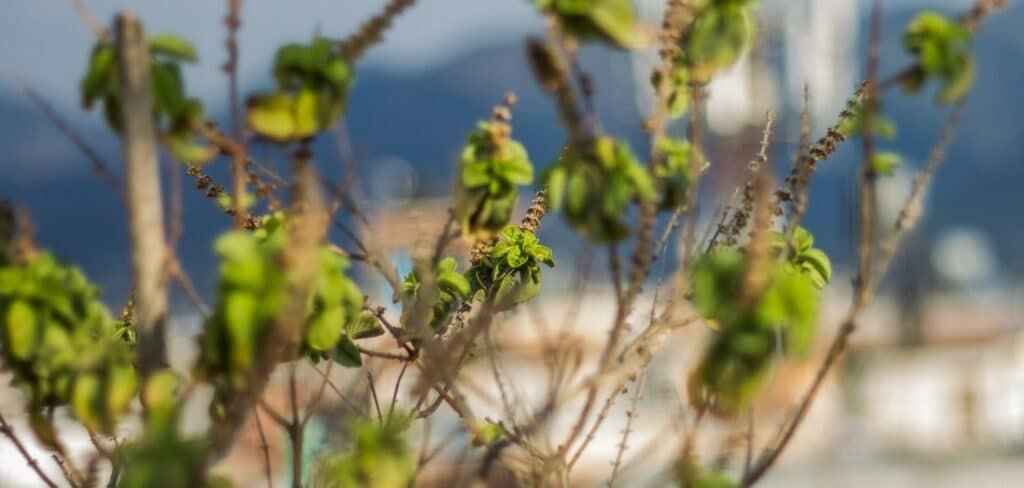
In this investigation
Why is a modest basil plant sometimes given the attention of a shrine? Tulsi worship brings together Hindu devotion, domestic space, inherited custom and a real botanical species. The investigation becomes clearer when each kind of evidence is examined on its own terms.
The plant in the courtyard
In many Hindu homes, tulsi stands in a raised planter near an entrance or courtyard. It may receive water, lamps and prayers, and become part of the household’s daily rhythm. These practices vary across regions and families. The question is not simply why people grow a fragrant herb, but how a living plant became a participant in devotion.
Which species is tulsi?
The Royal Botanic Gardens, Kew recognises Ocimum tenuiflorum L. as the accepted scientific name; Ocimum sanctum is a familiar synonym. It is an aromatic member of the mint family, distinct from ordinary culinary basil. Kew describes its native range across tropical and subtropical Asia into the western Pacific and records both sacred and traditional medicinal uses. Identifying the species matters when evaluating claims about chemistry or health.
Tulasi and Vishnu devotion
In Vaishnava traditions, Tulasi is associated with Vishnu and Krishna and may be revered as a divine person rather than merely a useful plant. Leaves are offered during worship, and devotional stories connect Tulasi or Vrinda with faithfulness and divine relationship. These are religious explanations, not chemical hypotheses. A historical account should record what practitioners actually believe without pretending that faith can be proved by an experiment.
Why keep a sacred plant at home?
A courtyard plant can bring religious practice into daily life without requiring a visit to a temple. Watering, cleaning the area and lighting a lamp become repeated acts of care. It is reasonable to investigate whether these actions reinforce routine, memory and identity. But it would be speculative to insist that a single ancient designer invented the custom as a psychological intervention.
Tulsi Vivah and the calendar
In several communities, Tulsi Vivah symbolically celebrates a marriage involving the sacred plant and Vishnu or Krishna. Dates and local practices differ. The ritual situates a plant within stories of devotion and seasonal celebration. It should not be flattened into a universal agricultural rule or an alleged hidden medical lesson; its explicit religious meaning matters.
What science can establish
Botany can identify the plant, examine its growth requirements and study aromatic compounds. Kew records chemical constituents including eugenol in some populations and discusses traditional medicinal uses. But laboratory activity does not establish that keeping a tulsi plant nearby cures disease or disinfects a room. Such claims require controlled exposure measurements and meaningful health outcomes.
Traditional medicine is not automatic proof
A long history of use is important cultural evidence, but it is not a substitute for evaluating dose, preparation, safety and efficacy. A concentrated extract, herbal tea and living courtyard plant are different exposures. Studies of one preparation cannot automatically justify claims about another. Medical decisions should follow appropriate clinical evidence and professional guidance.
Was conservation the original motive?
A sacred plant may receive extra care and protection, potentially benefiting the local environment. That does not prove conservation was the original reason for worship. Devotional texts give explicit religious explanations; ecological consequences may be secondary effects or later interpretations. The attractive story that every traditional ritual was secretly invented to teach modern science often overstates the historical evidence.
Cross-cultural comparisons
Other societies also attach obligations, memory and religious significance to living plants and trees. Such comparisons show that sacred vegetation is not unique to one region. They do not demonstrate identical theology, a shared origin or a universal medical mechanism. A Buddhist Bodhi tree and a Hindu Tulasi plant can both be sacred while carrying very different histories and meanings.
How would we test the claims?
Historical claims need dated texts and records. Social claims can be examined through interviews and observation. Medical claims need clearly specified preparations, comparison groups and outcomes. Air-quality claims require controlled measurements in realistic homes. These methods answer different questions; no single study can verify the entire religious tradition.
Why the practice endures
For families living far from ancestral homes, a small tulsi plant may connect language, prayer, memories and relatives. Some value it devotionally, some culturally, and others horticulturally. Those motivations can coexist without becoming interchangeable. A living organism can carry meanings beyond its chemistry.
One living plant, several different questions
A plant kept in a courtyard can be observed in at least three ways. A botanist can identify the species and describe its flowers, aromatic compounds and distribution. A historian of religion can ask when particular texts, images and communities associated tulsi with Vishnu, Krishna or the goddess Tulasi. A family may describe why daily care for that plant matters in its own devotional life. Confusing these perspectives is the fastest route to an unconvincing explanation.
The Royal Botanic Gardens, Kew identifies Ocimum tenuiflorum L. as an accepted species, with Ocimum sanctum as a synonym, and traces its native range across tropical and subtropical Asia towards the western Pacific. Kew also records both religious and medicinal uses. That reference establishes which organism the discussion concerns; it cannot date the first prayer ever offered to the plant or establish that every household practice began for medical reasons. The separation is important for interpreting tradition without inventing a convenient modern origin story.
Think about the practical difference between the claims ‘many households care for tulsi as part of worship’, ‘certain preparations of the plant contain compounds investigated by pharmacologists’, and ‘keeping the plant in a room prevents disease’. The first can be documented through religious and ethnographic sources, the second through identified laboratory studies, and the third would require evidence in real settings with appropriate controls and health outcomes. Only the last claim would justify a household-health recommendation, and the former two do not establish it automatically. See Kew’s species record and its general-information compilation.
Why botanical identity matters to cultural history
The word tulsi identifies more than a generic fragrant herb. Botanically, the plant commonly associated with the practice is Ocimum tenuiflorum L., also historically called Ocimum sanctum. Royal Botanic Gardens, Kew treats the former as the accepted scientific name and places it in the mint family, Lamiaceae. Its documented native range extends across parts of tropical and subtropical Asia, including India. A precise species identification matters because claims about the chemistry or effects of one basil species cannot automatically be transferred to every plant sold under a similar common name.
Tradition and botany classify things for different purposes. A Vaishnava practitioner may describe tulasi through a sacred narrative and devotional relationship. A botanist describes a plant’s taxonomy, morphology, distribution and biochemical properties. Neither classification is simply a translation of the other. Confusion begins when an explanation of religious meaning is offered as laboratory evidence or when a botanical description is presented as disproving the existence of meaningful devotion.
The daily ritual is more than possession of a useful herb
In households where tulsi is revered, the significance often rests in repeated attention: watering, tending, cleaning a plant’s surroundings, offering prayers and incorporating the plant into the rhythm of domestic life. These actions make a small living organism a recurring focus of memory, duty and belonging. The ritual can also connect household identity to wider Vaishnava devotion. That does not make every family’s practice identical. Regional customs, sectarian interpretation, access to outdoor space and personal belief all shape how tulsi is kept.
One tempting modern explanation is that earlier generations deliberately designed the practice to promote biodiversity. A valued household plant may indeed be protected and propagated, and that can be an ecological consequence. But a consequence is not proof of an original intention. To claim that a ritual began primarily as a conservation programme, a historian would need sources showing that motive among people who established or transmitted it. The much better-documented explanation is that sacred significance, domestic custom and plant use developed together in complex ways.
What plant chemistry can and cannot tell us
Holy basil contains chemically active compounds, and plant extracts have been studied for several biological effects. That is a legitimate research topic. The critical question is which preparation was tested, at what dose, in what organism, against which outcome and with what degree of independent replication. A laboratory result from concentrated extract does not automatically support an everyday medical recommendation about eating leaves or keeping a pot by a window. A promising biological mechanism is also different from proof of clinically useful benefit in people.
Air-quality claims need similarly careful treatment. Plants interact with their immediate environments, but a single courtyard plant does not establish a universal capacity to disinfect surrounding air or eliminate disease risks. Controlled measurements of pollutants, air exchange, ambient conditions and suitable comparison settings would be needed. Sacred respect for tulsi stands on its cultural terms without requiring every advertised health benefit to be scientifically validated.
How an investigator should read the sources
Evidence for this question comes from at least four kinds of source. Devotional writing tells us how participants understand the plant. Ethnographic work can document what households actually do and how traditions vary. Botanical records establish classification and distribution. Controlled experimental research tests specific biological claims. The sources are complementary but cannot be interchanged. A religious text does not measure volatile organic compounds, and a chromatography report does not settle why a devotee offers a prayer.
Kew’s taxonomic record supports the species identification; its species account also recognises the longstanding religious and medicinal uses. These are useful starting points, not controlled proof of any particular treatment. Devotional descriptions are primary evidence of religious interpretation, and should be presented as such rather than mistaken for independent medical studies.
What remains meaningful if a medical claim fails?
The practice would not become meaningless simply because an extravagant claim about air purification or universal healing failed testing. Caring for a sacred plant may express continuity with family, seasons, festivals and a particular understanding of the divine. Those social and religious meanings are not medical hypotheses. Conversely, observing cultural value is not a reason to stop testing health claims that people may act upon. Respectful investigation asks a more precise question for each source and is willing to say when the evidence cannot decide.
The Tradivior Evidence Profile
Historical Authenticity — Strong: tulsi worship is a well-documented living tradition, though exact origins are not established here.
Original-Purpose Evidence — Moderate to Strong: devotional purposes are explicit; a single scientific origin is not demonstrated.
Scientific Mechanism — Moderate: plant chemistry is established, but sweeping household-health claims are not.
Experimental Evidence — Limited for ritual claims: studies of extracts cannot verify supernatural or universal air-purification assertions.
Cross-Cultural Evidence — Moderate: sacred plants recur across cultures but have different meanings.
Modern Relevance — Strong: the plant remains important to household identity and worship.
What can be documented, and what still needs testing?
Botanical identification and the existence of tulsi-centred devotion are strongly documented, although the origins and regional development of particular rituals deserve their own historical research. Pharmaceutical or environmental claims must be evaluated one preparation, dose and setting at a time. The religious value of tending the plant is not reducible to a medical experiment, and the tradition itself should not be marked with a single ‘supported’ or ‘unsupported’ label.
The Tradivior conclusion
Tulsi is honoured principally within living traditions of devotion. Its biological properties deserve study, but they neither exhaust its religious meaning nor prove claims that require clinical evidence. Respect and scrutiny are compatible when their questions are kept distinct.
Sources
- Royal Botanic Gardens, Kew: Ocimum tenuiflorum
- Vrajapedia: Tulasi in Vaishnava practice (devotional source)
Featured photograph: Sushanta Rokka / Unsplash. Evidence reviewed 15 October 2026.
Continue exploring

The Festival Born of an Epidemic: How Kyoto’s Gion Matsuri Became a Moving City
Gion Matsuri began with a ninth-century epidemic story and became a living Kyoto tradition of sacred processions, elaborate floats and neighbourhood cooperation.
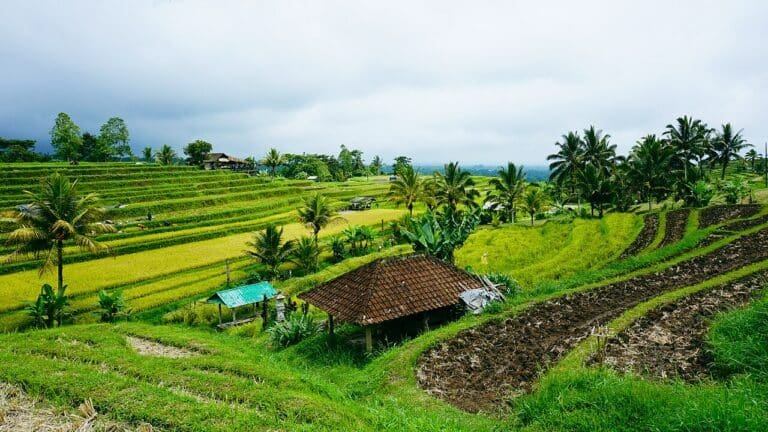
When a Temple Decides Who Gets Water: Bali’s Subak and the Sacred Politics of Rice
Bali's water temples are more than scenic shrines: they help coordinate irrigation, harvests and collective responsibility. A documented history of subak and its present pressures.

The Thousand Gates of Fushimi Inari: How Private Prayers Became a Public Path
Behind Kyoto's famous vermilion torii corridors is a history of donations, sacred boundaries and living devotion. What the evidence—and the shrine itself—actually tell us.
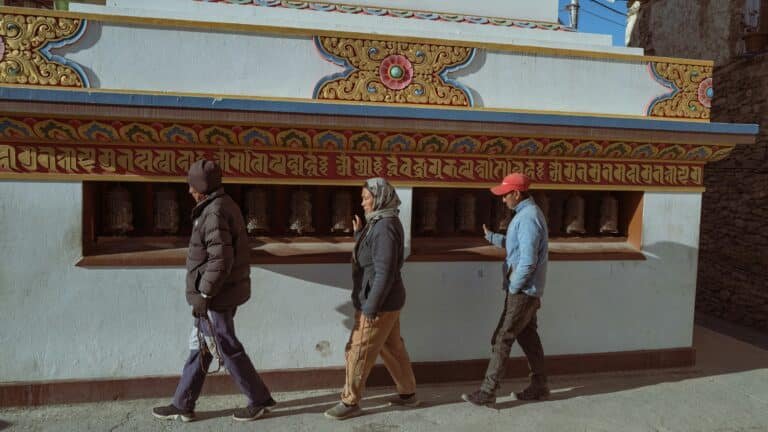
Why Do Tibetan Buddhists Turn Prayer Wheels Clockwise?
Explore why Tibetan Buddhist prayer wheels are turned clockwise, how sacred text and ritual action connect, and what historical and scientific evidence can establish.
Picked for your curiosity
Enable JavaScript to build a reading profile and see recommendations.