 tradivior
In this investigation
Why does turning a cylinder of written prayers count as a religious act? Tibetan prayer wheels connect text, motion and devotion. Their construction can be studied historically, while the significance of turning them belongs to living Buddhist traditions.
The object that holds a prayer
A Tibetan prayer wheel is a cylinder containing written mantras or sacred texts. Small handheld wheels and larger installed wheels appear in Himalayan Buddhist settings. Museum collections preserve examples made of metal, wood and paper, sometimes with counterweights or intricate inscriptions. The object makes written devotion part of a repeated bodily action.
Why turn it clockwise?
The Rubin Museum of Himalayan Art explains that wheels are conventionally turned clockwise so the mantras inside follow their correct reading direction. The McClung Museum also notes a traditional association with the direction of the sun. These explanations describe ritual convention; they do not demonstrate that clockwise rotation generates a special physical force.
Turning and the idea of merit
Practitioners may understand the turning of a wheel containing mantras as an act equivalent to recitation and associated with the accumulation of merit or purification. The Bowers Museum describes a wheel containing the six-syllable mantra Om Mani Padme Hum. A historian can document that belief without claiming that a laboratory can measure karma or spiritual merit.
Different sizes, different settings
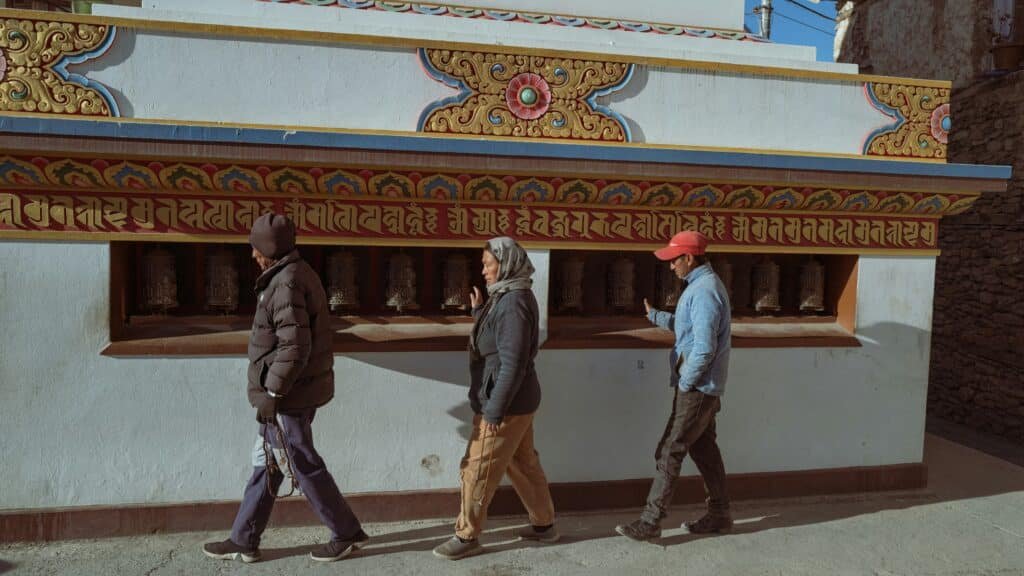
A handheld wheel can accompany personal recitation, while rows of large cylinders invite participation along a monastery path. The design changes how the ritual fits into movement and community. Museum objects show that there is no single universal material or construction method. Their common element is the relationship between text, turning and devotion.
Prayer wheels and circumambulation
In many Buddhist contexts, people walk around sacred structures in a customary direction. Prayer wheels may be installed along those routes. Repeated movement can structure attention and social participation, but these observable effects do not establish that psychological regulation was the original purpose. Religious communities often describe the action through prayer and intention.
Does the wheel release energy?
Physical rotation can be measured, as can sound, friction and movement. But a claim that turning a prayer wheel releases healing frequencies or measurable spiritual energy requires a specified mechanism and controlled evidence. Museum descriptions do not make such claims. Religious ideas about merit belong to theological interpretation, not ordinary physical measurement.
An accessible form of participation
The Rubin Museum notes that people who cannot read written mantras can still participate by turning wheels containing them. That is an important social function, although it would be wrong to conclude that all users were illiterate or that accessibility alone explains the tradition. Written language, intention and movement operate together.
What a careful comparison reveals
Prayer beads, repetitive chanting and ritual processions in other traditions also connect repetition with attention and devotion. Similarity of form does not prove a common origin or identical religious meaning. Tibetan Buddhist practice has its own histories and lineages, which should not be erased by an overly broad theory about all rituals.
What survives scrutiny
The material existence of prayer wheels and the convention of clockwise turning are strongly documented. Their traditional purpose is described by Buddhist communities and museums. Claims about measurable spiritual merit or physical healing energy are not established by the evidence presented. Distinguishing these statements preserves both historical accuracy and respect for religious meaning.
From a scroll of mantras to a turning ritual: what museums actually preserve
Consider a physical object rather than an abstract claim about ‘ancient energy’. The Rubin Museum’s Project Himalayan Art describes a prayer wheel from Tibet or Mongolia dated to the seventeenth or eighteenth century, while its wider survey discusses a surviving roll of mantras and spindle from roughly the twelfth or thirteenth century. The object is at once craftsmanship, written language and a device that makes repeated devotion possible. Its cylinder conceals text, but its rotation puts that text at the centre of a public or private ritual.
The same museum explains the relationship with circumambulation: many Himalayan Buddhist devotees move clockwise around a stupa or shrine, often turning prayer wheels on the way. It also distinguishes the counter-clockwise circumambulation customary among followers of Bon. This contrast matters. ‘Clockwise’ is not a universal law of sacred movement; the direction belongs to particular traditions, histories and interpretations. Even the mechanism of a handheld wheel—the counterweight that keeps its cylinder spinning—reveals how deliberately material engineering and religious practice have been combined.
In the tradition’s own terms, merit, intention and compassion matter. A scientific account of angular momentum may explain how the wheel moves, but not replace the practitioner’s explanation of why the act is worthwhile. The Rubin Museum’s art-historical essay is particularly useful because it joins specific objects, historical descriptions and living Buddhist interpretations instead of dismissing or endorsing a theological claim as an engineering result.
One museum object can reveal several layers of a ritual
A particularly revealing object is the Metropolitan Museum of Art’s Tibetan Prayer Wheel and Xylographic Folio Page, dated to the nineteenth or twentieth century. The museum describes a compact wheel made from repurposed objects, including a jade archer’s ring, copper-alloy fittings and a small written folio. This is not an abstract diagram of Tibetan belief: it is material evidence of how someone built or used a devotional object. Its components also caution against imagining that every historical prayer wheel had the same materials, scale or design.
The Metropolitan Museum explains that the cylinder is turned clockwise and contains auspicious writings. That description directly supports the combination of physical motion and written content in the practice. It also makes the object a useful reminder that religious technology need not be elaborate. A handheld wheel and a large fixed wheel can differ greatly in engineering while participating in recognisably related devotional traditions.
Why clockwise is not merely a mechanical preference
The question ‘why clockwise?’ has at least two levels. One is descriptive: contemporary Tibetan Buddhist practice generally uses a clockwise turning direction, and museum records show that this is not a recent invention of tourists. The other concerns interpretation: practitioners may understand the movement in relation to the ritual orientation of sacred objects and the established pattern of circumambulation. A historian can document the convention and trace descriptions of its use without pretending to derive its entire spiritual meaning from an engineering calculation.
Clockwise directions should not be treated as universal across all spiritual practices. A practice from one school or community cannot be mapped mechanically onto every religious tradition across Asia. Even within closely related religious settings, rules may carry local histories and instructions. This matters when a visitor sees a wheel beside a temple and assumes that any rotation in any direction is interchangeable. For practitioners, following the established form can itself express respect and intention.
The relationship between text, body and attention
A written mantra is normally understood through reading, recitation, memorisation or ritual use. A prayer wheel introduces deliberate motion into that relationship. Its rotating cylinder holds a text that the participant might not read aloud while turning it. The bodily act can accompany recollection, spoken recitation or silent intention. These are different forms of engagement and should not be collapsed into the claim that the wheel is literally broadcasting words into the surrounding air.
There is a plausible human explanation for part of the experience: regular movement can create a repeated moment of attention and participation. But that possibility does not tell us everything about the devotional meaning. To study psychological effects one would compare measured outcomes under controlled conditions, and still distinguish differences in familiarity, motivation and expectations. To study merit as understood in Tibetan Buddhism, by contrast, one must first take seriously the tradition’s religious vocabulary and the way practitioners themselves explain the activity.
What physical science can measure
Physics can describe rotational motion, friction, the distribution of mass, the effect of a counterweight and the durability of materials. Conservators can examine pigments, metals, papers and inscriptions. These studies help date, preserve and explain historical objects. They cannot measure whether a person receives spiritual merit in the theological sense. That claim is not a substitute for an engineering theory, and an engineering theory is not a test of the tradition’s metaphysical view.
Claims about a special frequency, healing radiation or invisible energy require a different standard. A measurable energy claim should specify the physical quantity, units, instrument, expected conditions and a way to distinguish the effect from ordinary motion and environmental noise. The presence of a sacred object does not automatically provide such evidence. Critically evaluating a modern scientific-sounding explanation does not deny that the wheel has meaning within a religious community.
Why comparing rituals requires care
Other traditions also connect repeated bodily action with prayer: walking a prescribed route, counting beads, bowing or performing repeated gestures. That resemblance can motivate comparative questions, but it does not prove that the traditions share an origin or identical meanings. Good cross-cultural research asks what each participant intends, which texts prescribe the act, whether objects have a documented chronology and what role public or private practice plays. Similar movements can arise from different histories and interpretive systems.
Tibetan prayer wheels also connect the abstract word ‘tradition’ to individual makers, patrons and users. The Met’s repurposed archer’s-ring wheel is a particularly vivid example: an object can be inventive, personal and devotional at once. Treating all prayer wheels as unchanging ancient mechanisms would erase the people who maintained and adapted the practice.
A better answer to the original question
People turn prayer wheels clockwise because they are following an established devotional convention that relates movement to sacred text and religious participation. The exact details vary with place, object and instruction. Historical collections document the objects and their use; living practitioners explain their meaning; psychology may investigate aspects of attention; physical science can explain the device. Each contributes evidence, but none replaces the others.
Primary collection evidence: Metropolitan Museum of Art, Prayer Wheel and Xylographic Folio Page; Bowers Museum, Prayer Wheel collection record. Object records support claims about artefacts and documented use, not supernatural effects.
The Tradivior Evidence Profile
Historical Authenticity — Strong: museums preserve physical wheels and texts.
Original-Purpose Evidence — Strong: mantra recitation, merit and devotion are explicit explanations.
Scientific Mechanism — Moderate for repetitive action; unsupported for healing-energy claims.
Experimental Evidence — Limited: spiritual merit is not an established physical variable.
Cross-Cultural Evidence — Moderate: other repetitive rituals exist but differ in meaning.
Modern Relevance — Strong: prayer wheels remain part of living practice.
What the evidence establishes—and what belongs to belief
The physical objects, the clockwise convention in Tibetan Buddhist settings, and the tradition’s stated purpose are well documented. Merit and blessings are theological and devotional understandings, not variables tested by rotational mechanics. Specific medical or physical-energy effects, if claimed, would require separate empirical study. These conclusions apply to distinct propositions; the ritual as a whole does not deserve a misleading single scientific score.
The Tradivior conclusion
A prayer wheel is a religious technology that turns written devotion into bodily action. Its importance cannot be reduced to a mechanical device or a universal psychological explanation.
Sources
- Rubin Museum of Himalayan Art: Prayer Wheel
- Metropolitan Museum of Art: Tibetan Prayer Wheel
- Bowers Museum: Prayer Wheel
Featured photograph: Jimmy Liu / Unsplash. Evidence reviewed 15 October 2026.
Continue exploring
The Festival Born of an Epidemic: How Kyoto’s Gion Matsuri Became a Moving City
Gion Matsuri began with a ninth-century epidemic story and became a living Kyoto tradition of sacred processions, elaborate floats and neighbourhood cooperation.

When a Temple Decides Who Gets Water: Bali’s Subak and the Sacred Politics of Rice
Bali's water temples are more than scenic shrines: they help coordinate irrigation, harvests and collective responsibility. A documented history of subak and its present pressures.
The Thousand Gates of Fushimi Inari: How Private Prayers Became a Public Path
Behind Kyoto's famous vermilion torii corridors is a history of donations, sacred boundaries and living devotion. What the evidence—and the shrine itself—actually tell us.

Why Is Tulsi Worshipped in Hindu Homes? Faith, Botany and Evidence
Why is tulsi sacred in Hindu households? Investigate its devotional history, botanical science, cultural meaning and what medical evidence can actually prove.
Picked for your curiosity
Enable JavaScript to build a reading profile and see recommendations.