 tradivior
In this investigation
A culturally situated investigation of the Māori New Year, its regional knowledge traditions, the hautapu ceremony and the meaning of a modern national holiday.
The new year begins when someone knows where to look
Before dawn in the cold season of Aotearoa New Zealand, a small cluster of stars rises in the eastern sky. It is known in many Māori traditions as Matariki. A visitor might expect a simple astronomical rule: see seven stars, mark a date, celebrate a new year. But that expectation runs into a richer reality. Some iwi identify seven stars in the cluster, others nine. Some communities mark the season through Puanga, the bright star known internationally as Rigel, because local horizons and inherited knowledge make it the more useful marker. A date printed on a national holiday calendar is therefore not a substitute for the practices that give the season meaning. The remarkable story of Matariki is how a living, locally varied set of relationships—with ancestors, food, land, weather and one another—has also become a public holiday. Understanding that development requires attention to both the sky and the people who read it. The stars do not announce one universal ritual. Communities interpret them through knowledge sustained across generations.
A star cluster, a season and several kinds of knowledge
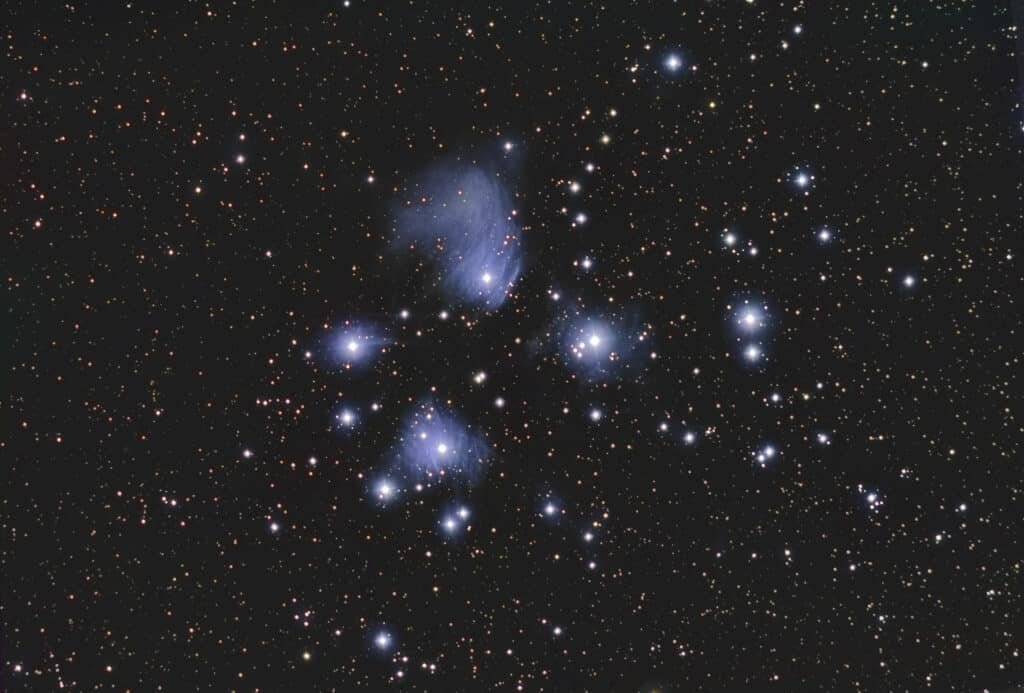
Astronomically, Matariki is associated with the Pleiades, a star cluster also called Messier 45. The cluster is visible from many parts of the world and has accumulated different names and stories. But translating Matariki simply as ‘the Pleiades festival’ would miss the Māori framework in which its rising relates to the maramataka, a lunar calendar shaped by observation of the natural world. The relevant time is not determined by the Gregorian date alone. It involves the season, lunar phases and local visibility. Te Papa Tongarewa, New Zealand’s national museum, explains that some traditions identify seven stars while others identify nine, and that iwi, hapū and whānau may pass on different kōrero—accounts and inherited knowledge. This is not a problem that can be settled by counting every astronomical object in a telescope image. The question ‘How many stars?’ may be asking about a culturally significant group rather than a modern astrophysical catalogue. A respectful investigation therefore distinguishes the physical cluster from the inherited relationships through which it is understood.
Why seven and nine can both be right
Te Papa lists seven commonly named stars—Matariki, Pōhutukawa, Tupuānuku, Tupuārangi, Waitī, Waitā and Ururangi—and notes that Waipunarangi and Hiwa-i-te-Rangi bring another well-known account to nine. In the nine-star framework, different stars are associated with aspects of the natural and social world, including the earth, forests, fresh water, salt water, winds, rain, remembrance and aspirations. A classroom diagram that labels nine stars can be useful, but it should not be presented as the only authentic Māori map of the sky. The museum explicitly acknowledges the influence of different iwi in residence on how it presents Matariki. That institutional choice is important: the museum does not claim that one national exhibit can eliminate regional knowledge. The difference between seven and nine is not evidence that the tradition is confused. It is evidence that an apparently singular festival has multiple knowledge lineages. For readers used to a calendar printed with fixed national observances, this pluralism is one of Matariki’s most revealing features.
Puanga changes the map
In a Te Papa account, Che Wilson of Whanganui iwi explains why some iwi give prominence to Puanga. Puanga is Rigel in Orion, and it can be easier to observe from certain places where Matariki is less clearly visible. Te Papa identifies traditions associated with Whanganui, Taranaki and other regions. This is not a simple split between people who ‘believe in’ Matariki and people who do not. Puanga and Matariki can belong to related narratives, with local geography affecting which marker is prominent. A University of Auckland discussion in 2025 also emphasised the role of horizon, weather and inherited knowledge. Imagine two communities sharing a season but living with different eastern skylines. One has a clear view toward the cluster; the other’s view is obscured by terrain or frequent mist. Their calendars can express a common orientation toward renewal while using different visible cues. The landscape is not a backdrop to the tradition. It participates in how the tradition is practised.
The hautapu is not a decorative performance
Te Papa describes whāngai i te hautapu, commonly shortened to hautapu, as an offering ceremony associated with the rising of Matariki. Its account identifies three broad parts: viewing the stars, remembering those who have died since the previous rising, and offering food to the stars. Food may be drawn from domains associated with the land, forest, fresh water and sea. The description includes the preparation of an earth oven whose steam rises as part of the offering. This is a specific ritual sequence, not a generic ‘festival feast’. Its meanings should be understood from the perspectives of the people who practise and explain it. An outside observer can document that the ceremony is performed, describe the sequence, and note the agricultural and environmental relationships expressed in it. That observer cannot turn a spiritual offering into a laboratory test of whether the stars literally consume food. The latter question misidentifies the kind of claim being made. In the tradition’s own frame, remembrance, gratitude, reciprocity and connection to place are central.
The living and the dead share a calendar
Matariki is often described through three broad movements: remembering the past, celebrating the present and looking to the future. These principles appear in New Zealand’s Te Kāhui o Matariki Public Holiday Act 2022. Their simplicity should not obscure the specificity of the practices they gather together. Remembrance can include speaking the names of those who died during the year. Celebration can mean gathering with whānau and sharing food. Looking ahead can involve reflection on hopes, responsibilities and the coming cycle of work. The three movements give the season a temporal depth that a single festive photograph cannot capture. They also resist a familiar modern division: private grief belongs in one space, public celebration in another. Here the new year can hold both. That is a cultural insight, not a claim that every household observes exactly the same ceremony. Traditions are lived through family, locality and choice, and contemporary participation varies.
What the 2022 law changed—and what it did not invent
New Zealand established Matariki as a national public holiday through legislation in 2022. The statute explicitly recognises values including aroha, remembrance, unity, hospitality, environmental awareness, sharing and gathering. It provides a national civic framework for recognition. But the legal creation of a holiday must not be confused with the creation of the traditions it acknowledges. A state can set a day off work; it cannot retroactively make a centuries-old practice uniform or replace the authority of local knowledge holders. The distinction matters when discussing cultural recognition. Public visibility can support learning, participation and respect, yet it can also tempt institutions to package a complex set of practices into one standardised performance. The law’s language is most useful when read as an acknowledgement of Māori relationships and values rather than a claim that the government invented a new festival in 2022. It is also worth remembering that an official holiday can be meaningful to people who do not themselves practise every ceremony associated with it.
Why the date moves
For 2026, New Zealand’s official public-holiday calendar places Matariki on Friday, 10 July. Te Papa explains that public-holiday dates are tied to the Tangaroa period of the lunar calendar in the month of Pipiri, and that the relevant Friday changes from year to year. This is a practical example of what happens when a lunar-seasonal framework meets the fixed expectations of a modern employment calendar. A school, employer or traveller needs a published date; a ritual specialist may attend to a broader period of observations and locally appropriate timing. Neither function should be mistaken for the other. A printed date is a coordination device. The maramataka is an observational and cultural system. Te Papa’s public list shows different holiday dates for successive years, which makes it easy to verify the narrow claim that the national date is not a fixed Gregorian anniversary. The official date helps people plan; it does not exhaust the ways Matariki is experienced.
The environment is not merely symbolism
Some star associations relate to foods, waters, weather and seasonal abundance. In a modern science classroom, the temptation may be to ask whether a particular star’s brightness objectively predicts harvest yields. That question can be studied, but it is narrower than the cultural system as a whole. The environmental knowledge involved includes repeated observation of seasons, local conditions and the behaviour of living things. Te Papa’s account of hautapu describes tohunga examining the appearance of stars as part of an interpretive practice. Whether any particular predictive relationship survives controlled statistical testing would require a carefully specified proposition, measurements, and a defined location and period. No such test is established merely by describing the ceremony. The documented fact is that environmental observation and responsibility form part of the knowledge system. Reducing that to ‘scientifically proven’ or ‘disproven’ would conflate ethnographic description with a different kind of empirical claim. A better question is what a community’s observances ask people to notice and care for.
An evidence profile that respects the claim being tested
Historical continuity: Māori seasonal knowledge and practices predate the 2022 holiday; the statute formalised public recognition, not the origin of Matariki. Regional variation: Te Papa and iwi-informed accounts document different star counts and the prominence of Puanga in some regions. Calendar: official dates change with the lunar-seasonal framework; 10 July is the published date for 2026. Ritual practice: Te Papa documents the components of hautapu, but this does not mean every Māori family practises the same sequence. Environmental relationships: star and food-domain associations are documented as part of mātauranga Māori; no universal quantitative harvest prediction is asserted here. Contemporary meaning: the public holiday makes remembrance and gathering visible nationally while local forms remain diverse. Narrow evidence verdict: the proposition ‘Matariki has one fixed date, one universal star count and one identical ceremony across Aotearoa’ is not supported by the documented regional and calendar evidence. This verdict is about uniformity, not the truth or value of spiritual belief.
A careful way to encounter Matariki
A visitor, teacher or reader can begin with three acts of care. First, identify the community whose practice is being described instead of treating every example as nationally representative. Second, distinguish a public holiday’s official date from the wider season and the locally guided ritual calendar. Third, credit Māori knowledge holders and institutions when sharing stories or images, especially when material has been made public for educational purposes. This is more demanding than repeating that Matariki is the ‘Māori New Year’, although that phrase is a useful introduction. It asks whose new year, observed through which knowledge, in which place, and with what responsibilities. For readers in India or elsewhere, the temptation to compare Matariki with familiar lunar festivals is understandable. Comparison can illuminate how calendars connect sky and society, but it should not flatten distinct histories into the claim that all traditions are essentially the same. Similar questions do not produce identical answers.
The stars do not need to agree for the season to matter
The most striking feature of Matariki may be the way national recognition coexists with legitimate local difference. One museum exhibit can acknowledge seven and nine stars. One country can mark a public holiday while some iwi follow Puanga. One season can include mourning, food, learning, environmental attention and hope. None of this requires an outsider to decide which belief is most ‘scientific’. The empirical questions—when a star rises, how a public date is set, whether regional variation is documented—can be investigated. The devotional and relational meanings must be heard in their own terms. The deeper lesson is that a calendar can be more than a row of dates. It can be a community’s method of remembering people, reading place and deciding what deserves attention in the year ahead.
Further reading on distinct remembrance traditions: Obon in Japan and Día de Muertos in Mexico. These are comparisons, not claims of common origin.
Documentary sources
- Museum of New Zealand Te Papa Tongarewa: seven or nine Matariki stars
- Te Papa: Puanga and regional variation, including Che Wilson of Whanganui iwi
- Te Papa: the hautapu ceremony
- New Zealand legislation: Te Kāhui o Matariki Public Holiday Act 2022
- Te Papa: official holiday dates and Tangaroa lunar period
- Ministry for Culture and Heritage: Matariki official dates and engagement
- University of Auckland (2025): why some iwi acknowledge Puanga
Featured photograph: Matariki/Pleiades star cluster, photographed by pbkwee, CC BY 2.0 via Wikimedia Commons. It is an astronomical image, not a photograph of a hautapu ceremony or an endorsement by any iwi.
Continue exploring
The Burden That Becomes a Promise: Thaipusam’s Journey from Tamil Hills to Singapore Streets
From a 1932 silver chariot stopped by trolley wires to Singapore's 2026 procession, Thaipusam reveals how Tamil devotion and diaspora life reshape one another.

The People Beneath the Tower: How Catalonia’s Castells Learned to Reach Higher
From eighteenth-century dances to modern safety debates, Catalonia's castells reveal how a living tradition balances collective trust, ambition and risk.
The Altar That Changes Every Year: Día de Muertos and Its Many Histories
A Día de Muertos ofrenda can hold water, marigolds and a loved one's favourite meal. Its meaning is intimate; its history is more layered than an unchanged ancient ritual.
When Ancestors Come Home: Obon, Japan’s Summer Fires, and the Festival with Three Calendars
Why does Obon unfold in July, August and the lunar calendar? Explore Kyoto's farewell fires, Gujō's overnight dances and the history of Japanese ancestor remembrance.
Picked for your curiosity
Enable JavaScript to build a reading profile and see recommendations.