 tradivior
In this investigation
The route is a vow, not a parade
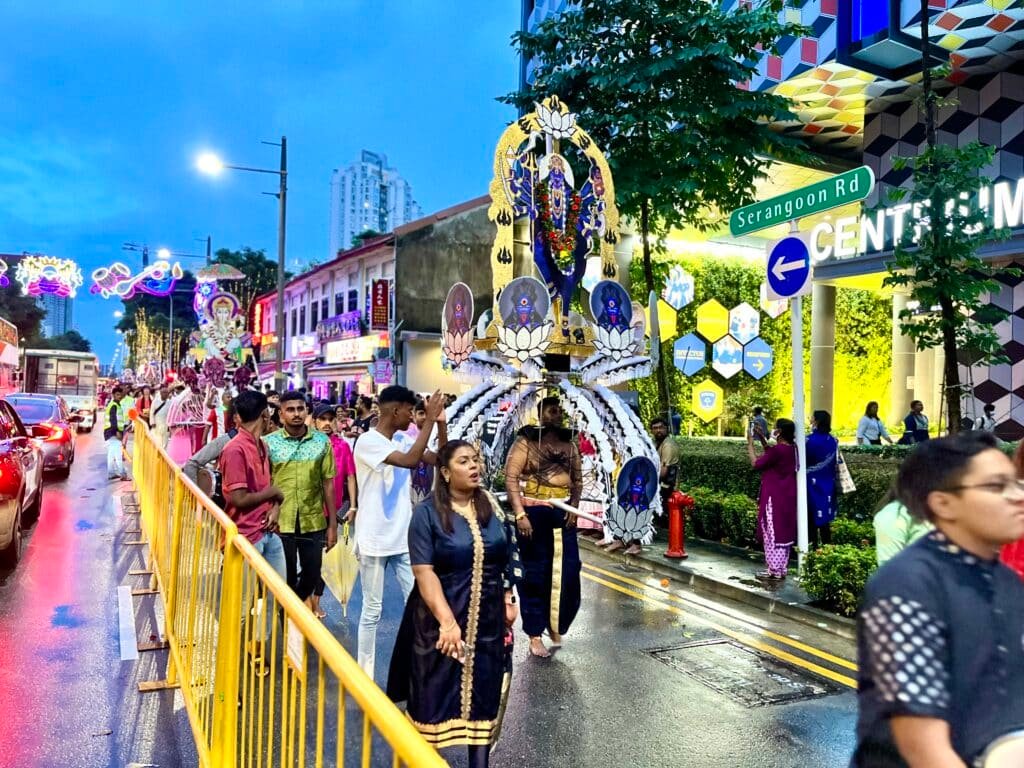
Before sunrise, the streets of Singapore’s Little India begin to serve a purpose different from their weekday traffic. Devotees prepare milk pots and kavadis, structures that may be carried on the shoulders or supported by more elaborate frames. Family members arrange offerings, offer water and accompany the bearers with prayer and song. The procession travels from Sri Srinivasa Perumal Temple on Serangoon Road toward Sri Thendayuthapani Temple on Tank Road. To a passer-by the most visible fact may be the weight or the piercing. To a participant the defining fact may be a promise made long before the festival morning.
Thaipusam is observed in the Tamil month of Thai, around the full moon associated with the star Pusam, and honours Murugan. Its practice in Singapore and Malaysia belongs to a wider history of Tamil religious life, migration and urban change. This investigation follows one concrete path—the Singapore procession—while keeping South Indian and Malaysian observances distinct. It asks how a personal devotional burden became a shared public institution without treating its theological meaning as a laboratory hypothesis.
Murugan’s spear carries more than one history
In Tamil tradition Murugan is associated with youth, courage, the hills, the peacock and the vel, or spear. The National Library Board’s historical study traces references to a hill deity in early Tamil literature and later associations with Skanda or Kartikeya within wider Hindu traditions. These strands cannot be reduced to a single moment when the modern festival was supposedly invented.
Devotional narratives recount the gifting of the vel and Murugan’s triumph over hostile forces. Their significance for worshippers is religious: the lance symbolises protection, strength and the defeat of harmful powers. Historical scholarship can investigate when particular texts, images and processions are attested; it cannot settle whether a divine event occurred. That distinction does not diminish the practice. It allows a reader to understand both the continuity of Murugan devotion and the many historical forms in which people have expressed it.
What exactly is being carried?
A simple kavadi can be a decorated wooden arch resting on the shoulders, with flowers, peacock feathers or offerings. A paal kudam is a vessel of milk carried as an offering; it is a major form of participation in its own right. Other kavadis are tall metal frameworks, and some devotees undertake piercing as part of a vowed practice. The English word ‘burden’ captures one aspect of kavadi, but it cannot communicate every devotional association or the difference between one family’s vow and another’s.
The Singapore heritage account documents historic wooden forms and modern metal forms in museum collections. This is an important corrective to photographs that make the most visually dramatic kavadi seem representative of every participant. Women, children and men may carry milk offerings; not all devotees undergo piercing. An observer who describes only needles and spectacle has missed the ordinary but central work of prayer, preparation, kinship and thanksgiving.
A 1932 chariot and a very modern obstacle
One of the most revealing episodes in the Singapore history is almost comically material. According to Nalina Gopal’s research for the National Library Board, Sri Thendayuthapani Temple acquired a larger silver chariot in 1932, but its height made it incompatible with overhead trolley-bus wires. The chariot could not immediately travel the intended route. Only a later change in urban transport infrastructure made its use practical. A religious object, however revered, still had to fit the geometry of a modern street.
This episode overturns the lazy contrast between ‘ancient ritual’ and ‘modern city’. Thaipusam in Singapore has never been a sealed antique preserved outside history. It has interacted with municipal routes, commercial districts, vehicles, crowd management and the changing lives of the Tamil community. The chariot’s obstruction by trolley wires is not a footnote to a supposedly timeless ceremony; it is evidence that the ceremony’s public form has always been negotiated with the city around it.
The procession’s route was not always fixed
The same historical account notes that early kavadi processions could begin from different Hindu temples. Over time the route from Sri Srinivasa Perumal Temple to Sri Thendayuthapani Temple became the established Singapore practice. The destination, dedicated to Murugan, provides a ritual endpoint; the journey itself offers a visible expression of a vow. The specific street alignment is therefore historically traceable, rather than proof that every earlier Tamil community walked an identical path.
Such changes are not necessarily evidence of weakened authenticity. A tradition can preserve relationships among deity, offering, vow and community while adjusting the physical route by which those relationships are enacted. For migrants, that flexibility can be part of continuity. A festival carried across the sea must acquire new addresses, new neighbours and new practical rules, even as devotees recognise the spiritual grammar of what they do.
1952: the year the expected procession did not happen
The National Library Board article records that Singapore’s Tamil community scaled down Thaipusam observances and did not hold its usual procession in February 1952 following the death of King George VI. That historically specific interruption shows the public festival responding to political circumstances far beyond temple walls. In 2021, pandemic restrictions again prevented the customary street procession.
These episodes invite a distinction between a religious observance and a particular public form of it. Devotion did not begin or end with a permit to walk through a street. Yet the absence of the shared route mattered because collective presence is one way a diaspora makes itself visible to itself. Public worship has a social life as well as a liturgical one. Treating the missing procession as ‘nothing happened’ would erase the religious and communal meaning of adaptation under constraint.
The participant who has been preparing for decades
An unusually valuable first-person perspective appears in a 2023 Singapore government interview with devotee S. Ganesh. He described having carried his first kavadi at age fourteen and participating for decades, with family traditions of supporting the procession. His preparation included fasting and dietary and personal disciplines. This is a documented account from one practitioner, not a template that every devotee must follow.
Ganesh’s testimony changes the scale of the story. The most dramatic photograph captures a few seconds of effort; the vow may involve months of anticipation and many years of family memory. A bearer is not a detached performer whose only purpose is to impress spectators. The companions who help prepare offerings and sustain the journey are not background extras. They are part of the ritual’s social structure. The festival can be physically demanding without being reducible to a test of pain tolerance.
Batu Caves: the same deity, a different public world
In Malaysia, the procession and pilgrimage associated with Batu Caves have become a major expression of Tamil Hindu life. The limestone setting, steep steps and large gatherings create a different ritual geography from Singapore’s temple-to-temple urban route. Carl Vadivella Belle’s 2017 study of Thaipusam in Malaysia situates the festival within Tamil migration, colonial knowledge and local Hindu reform debates. It is not enough to describe Batu Caves as a larger copy of Singapore.
Tourism adds another layer. Azilah Kasim’s 2011 research on Batu Caves asks how tourism can be balanced with the religious experience of devotees. Cameras, transport, food stalls and public celebration can sustain local livelihoods, but they can also encourage outsiders to see worship as entertainment. The central ethical question is not whether visitors are allowed to admire the scene. It is whether their presence leaves room for devotees to undertake what they came to do.
The 2026 procession shows change in real time
For Thaipusam on 1 February 2026, Singapore’s organisers required online registration for certain forms of participation and introduced capacity-management arrangements. Contemporary reporting records more than 19,000 milk-pot bearers and 349 kavadi bearers. These figures describe a particular year’s organised event, not a timeless participation rate, and the registration requirements should not be projected backward into earlier decades. They demonstrate that a living festival can be simultaneously devotional, technologically coordinated and constrained by crowd safety.
The choice to register a ritual journey online may seem paradoxical only if we imagine authenticity as the absence of administration. A route carrying thousands of people through a modern city requires attention to medical response, traffic, waiting times and access. Rules can be debated by devotees and organisers; their existence does not by itself establish either the loss or the preservation of spiritual meaning. That judgment belongs in part to the community whose worship is being organised.
What should an outsider see?
A respectful description begins with consent and context. Ask whether the image depicts a Singapore street procession or a Malaysian pilgrimage; whether the person is carrying a milk pot, a shoulder kavadi or a more elaborate structure; and whether the photograph was taken during preparation, the walk or the offering at the temple. Do not describe every piercing as a miracle or assume that all participants experience pain identically. Do not turn a person’s body into an anonymous specimen.
Public spectatorship can be generous when it includes listening. The heritage archive’s images of older wooden kavadis and the testimony of Ganesh tell stories that a sensational close-up cannot. So does the 1932 chariot stopped by trolley wires: devotion is carried by people who live in real cities, with traffic and family obligations. Tradivior’s investigation of Kyoto’s Gion Matsuri offers another example of religious history shaped by neighbourhood organisation and public infrastructure, though the two traditions must not be treated as interchangeable.
Evidence profile: a narrow claim, not a verdict on faith
Proposition examined: ‘Singapore’s Thaipusam street procession has followed one unchanged route and form for centuries.’ Historical documentation: National Library Board research describes changing starting points and twentieth-century transport constraints. Material evidence: museum collections record different kavadi forms. Geography: Singapore and Batu Caves have distinct ritual routes. Chronology: the 1952 and 2021 interruptions show the public form was not uninterrupted. Practitioner perspective: Ganesh’s account emphasises personal vow and family continuity. Contemporary observation: 2026 registration and crowd management show ongoing adaptation.
Conclusion on that testable proposition: Not supported. The documentation supports continuity of Murugan devotion alongside historical changes in route, objects and public organisation. This is not a scientific grade for Murugan, the sincerity of a vow or the spiritual meaning of kavadi. The distinction matters because a claim about historical sameness can be investigated without claiming authority over a religious experience.
What the burden finally carries
At the end of the journey, offerings reach the temple. A camera might record the removal of a kavadi and conclude that the event is finished. For the devotee, the offering may belong to a longer relationship of gratitude, obligation and hope; for the community, the festival belongs to a longer history of migration, adaptation and public belonging. Both time scales are needed to understand the ritual.
Thaipusam’s most revealing object may be neither the largest metal frame nor the silver chariot. It may be the route itself: a path that has changed with the city yet remains recognisable to those who walk it. The burden is carried by an individual, but the possibility of carrying it is sustained by relatives, temples, organisers and generations of memory. That is why the most important question for a spectator is not how much weight a body can bear. It is what promise the community is helping that person keep.
Documentation and photograph
- National Heritage Board, A Journey of Devotion
- Nalina Gopal, The Divine Lance, National Library Board (2023)
- Singapore government, Thaipusam through a devotee’s eyes (2023)
- Carl Vadivella Belle, Thaipusam in Malaysia (2017)
- Azilah Kasim, tourism and religious experience at Batu Caves (2011)
- Singapore Tourism Board, Thaipusam guide
- 2026 participation reporting, Straits Times, 1 February 2026
Featured image: an authentic photograph of a Thaipusam kavadi procession on Serangoon Road, Singapore, by Jimmytst, CC BY-SA 4.0, via Wikimedia Commons. It documents a particular public procession, not a universal representation of all devotees or a scene from the historical episodes described.
Continue exploring
The People Beneath the Tower: How Catalonia’s Castells Learned to Reach Higher
From eighteenth-century dances to modern safety debates, Catalonia's castells reveal how a living tradition balances collective trust, ambition and risk.

When the New Year Has More Than One Star: Matariki, Puanga and the Art of Remembering
Matariki is not one fixed star count or ceremony. Explore Māori regional traditions, Puanga, hautapu, the lunar calendar and New Zealand's public holiday.
The Altar That Changes Every Year: Día de Muertos and Its Many Histories
A Día de Muertos ofrenda can hold water, marigolds and a loved one's favourite meal. Its meaning is intimate; its history is more layered than an unchanged ancient ritual.
When Ancestors Come Home: Obon, Japan’s Summer Fires, and the Festival with Three Calendars
Why does Obon unfold in July, August and the lunar calendar? Explore Kyoto's farewell fires, Gujō's overnight dances and the history of Japanese ancestor remembrance.
Picked for your curiosity
Enable JavaScript to build a reading profile and see recommendations.