 tradivior
In this investigation
Tradivior cultural investigation. The human towers of Catalonia are an evolving collective practice, not a frozen historical stunt. This investigation separates documented history, participant knowledge, safety evidence and cultural meaning.
The moment the square begins to hold its breath
In a Catalan town square, a crowd can become part of the structure it is watching. People press shoulder to shoulder at the base of a human tower, supporting the weight and stability of those climbing above. A musician plays the gralla, a piercing wind instrument whose melody helps mark the stages of construction. At the top, a child called the enxaneta may briefly raise a hand. To an outsider the tower can look like a feat of individual daring. The more accurate description is collective engineering performed as a public tradition: most of the participants are not visible from a photograph of the summit, yet the tower depends on them. The question worth investigating is not simply how high people can climb. It is how a community learned to turn trust, competition, technique and risk into a ritual that is repeated, revised and argued over across generations.
A dance became a structure with its own ambitions
The Generalitat de Catalunya’s heritage account traces the oldest forms to eighteenth-century Valencian-style dances in the Tarragona area, where small human towers formed a culminating element. The towers eventually developed a distinct identity as castells, associated especially with Valls and nearby towns. A separate Catalan heritage account identifies a document from 1791 as the earliest known record of a castell performance uncovered by historian Alexandre Cervelló. These are not proof that one person invented the practice on a particular day. They are pieces of a documentary trail showing how a festive form evolved into a recognisable public institution. The distinction matters: cultural practices rarely have a single founding moment, and later communities may remember beginnings differently from the earliest surviving records.
The 1819 tower and the competitive impulse
One heritage narrative records a milestone on 19 July 1819, when the Colla dels Menestrals raised an eight-level tower during a period of rivalry with the Colla dels Pagesos. The detail is more revealing than a generic claim that Catalans have always loved human towers. Groups competed, refined technique and took pride in the achievements of named teams. Competition was not an accidental modern addition to an otherwise static ceremony. It helped drive the form’s technical evolution. Yet competition alone does not explain the tradition’s endurance. An increasingly difficult tower requires more disciplined preparation and more people willing to perform unglamorous supporting roles. The same incentive that encourages a group to reach higher also makes its internal organisation more important.
Reading a castell from the ground up
UNESCO describes the pinya as the dense group supporting the base, the tronc as the main vertical body, and the pom de dalt as the upper levels. The exact arrangement varies by type of tower; numbers in a castell’s name encode structural details that specialists learn to interpret. A photograph captures a vertical achievement, but the live event is temporal. Participants assemble, balance, climb and descend, while the gralla marks the progress. The lowering phase is not a trivial afterthought. The tower’s success depends on how it is completed and dismantled, and observers should not assume that reaching a peak alone makes every attempt equivalent. These distinctions are a reminder that a tradition is also a vocabulary of skills. Without the language used by practitioners, outsiders can admire the spectacle while missing what its participants are actually trying to accomplish.
The pinya is an argument about community
The most arresting social fact about castells is that the people closest to the ground are not mere spectators. UNESCO notes that anyone is welcome to join the pinya, although participation in a real event still depends on organisers’ instructions and safety practices. The base distributes forces and helps stabilise the structure. In a symbolic reading, the tower makes an ethic visible: the highest person relies on those who are least celebrated. But it would be too easy to turn that observation into a sentimental claim that every group is automatically equal or conflict-free. Colles have leadership, selection decisions, training requirements and competitive reputations. The more useful interpretation is that castells make interdependence unavoidable, while leaving participants the difficult work of negotiating how fairly that interdependence is organised.
Why shirts, sashes and music matter
Groups identify themselves through distinctive shirt colours. Participants also wear a long sash, or faixa, which serves practical purposes, including back support and providing a grip for climbers. These garments are not simply picturesque costumes to decorate a tourist brochure. They form part of a practical material culture developed for the task. The gralla and accompanying music provide audible cues to a crowd that cannot see every movement inside the structure. The sounds connect the performance to local festive life while also helping participants coordinate. A tradition can therefore be simultaneously aesthetic and functional. Treating clothing and music as ‘mere symbolism’ would overlook how bodily technique and public meaning are intertwined.
A history of expansion, decline and revival
The Coordinadora de Colles Castelleres de Catalunya describes a long history concentrated around Valls, followed by spread through parts of the Tarragona and Penedès regions. The practice experienced periods of contraction and renewal. In the twentieth century, new groups outside the older centres, the effects of the Spanish Civil War, and later revivals changed the map of participation. A second major period of growth began in the late twentieth century, with more groups, ambitious structures and wider public visibility. UNESCO’s 2010 inscription recognised the tradition as intangible cultural heritage; it did not freeze the practice in its eighteenth-century form. This chronology matters because phrases such as ‘ancient and unchanged’ can erase the very adaptations that allowed a community practice to survive.
The difficult truth about children and risk
Children occupy important positions near the top of many towers. That fact makes safety a central issue, not an optional footnote. A 2006 fall during a performance in Mataró resulted in the death of a young participant, Mariona Galindo; the Enciclopèdia Castellera describes the tragedy as a turning point in contemporary safety and prevention discussions. The responsible response is neither to romanticise danger as proof of authenticity nor to use one tragedy to caricature an entire community. Practitioners and medical advisers have developed and debated protective measures, training methods and safer rehearsal environments. Sources describing protective nets and impact-absorbing surfaces show that risk management has a history of its own. No article can guarantee that a physically demanding collective performance is risk-free. A respectful account must take both cultural agency and the wellbeing of participants seriously.
What the safety research actually says
The Casteller encyclopaedia’s technical discussion of rehearsal nets reports their growing use, including an estimate that more than 72 percent of groups used nets in 2011. This is a dated figure, not a current census. Its discussion of impact-absorbing flooring describes efforts to test whether materials familiar from playgrounds could reduce injuries during rehearsals. The same source cautions against allowing passive protection to produce complacency about active prevention. These details undermine a misleading binary in which tradition is either untouched by modern technology or has somehow ceased to be traditional. Safety innovations can become part of how a living practice protects its continuity. The relevant empirical question is how well particular measures work in particular conditions, not whether science can certify the cultural value of the towers.
What UNESCO recognition does—and does not—mean
UNESCO inscribed human towers on its Representative List of the Intangible Cultural Heritage of Humanity in 2010. Its description emphasises group transmission, festive settings, characteristic structures, clothing and music. Inscription documents recognition of a living cultural practice; it is not an international engineering safety certificate, nor a judgment that every claim about origins is historically proven. It also should not be mistaken for a claim of ownership by a single town or organisation. Castells belong to networks of participating communities, with regional identities and rivalries that continue to evolve. Heritage policy can support visibility and safeguarding, but the people who rehearse, organise and debate the practice remain central to what it becomes.
Six-dimensional Evidence Profile
1. Documentary history: eighteenth-century origins and the 1791 record are supported by Catalan heritage documentation; a single inventor is not established. 2. Regional variation: the practice has a strong Valls–Tarragona history but spread to other areas; no single contemporary group represents every style. 3. Social transmission: UNESCO describes skills learned through repeated participation within groups; this is a documented cultural process. 4. Material and performance practice: pinya, tronc, upper levels, sashes and gralla are observable elements, with different structures and methods. 5. Risk and adaptation: documented injuries and evolving protection measures make claims of inherent safety untenable; current risk requires current evidence. 6. Meaning and interpretation: solidarity, rivalry, identity and celebration are meaningful to participants, but their personal value cannot be reduced to a laboratory verdict. This profile evaluates evidence for narrow historical and practical propositions, not whether anyone should feel pride in the tradition.
A narrow verdict, rather than a grade for a culture
Testable proposition: ‘Catalan castells have remained structurally and socially unchanged since their eighteenth-century beginnings.’ Verdict: Not supported. Historical accounts document growth from festive dance elements into independent towers, changes in geographic participation, expanding technical ambition, new safety measures and modern heritage recognition. This verdict says nothing about the authenticity of contemporary castells or the legitimacy of the communities that practise them. A living tradition can change profoundly and still remain recognisably itself. Indeed, the evidence suggests that learning and adaptation are part of its continuity, not necessarily a betrayal of it.
What the tower teaches without becoming a slogan
The image of an enxaneta above a packed square is memorable because it compresses a community into one vertical moment. But the deepest story is horizontal: the relationships among people who train, support, argue, mourn, compete and return. The tower is neither a fossil of a vanished past nor an uncomplicated celebration of fearless risk. It is a practice whose history includes ambition, tragedy, technical change and public joy. To understand it well, watch not only the summit but also the base, the rehearsal, the descent and the decisions made after an unsuccessful attempt. A culture is most interesting when we allow it to be a living argument rather than a postcard.
Documentary sources and cultural references
- UNESCO, Human towers (inscribed 2010)
- Generalitat de Catalunya, Castells heritage overview
- Generalitat de Catalunya, historical account of early towers
- Coordinadora de Colles Castelleres, historical overview
- Enciclopèdia Castellera, safety and prevention history
- Enciclopèdia Castellera, rehearsal safety nets
- Enciclopèdia Castellera, impact-absorbing floors
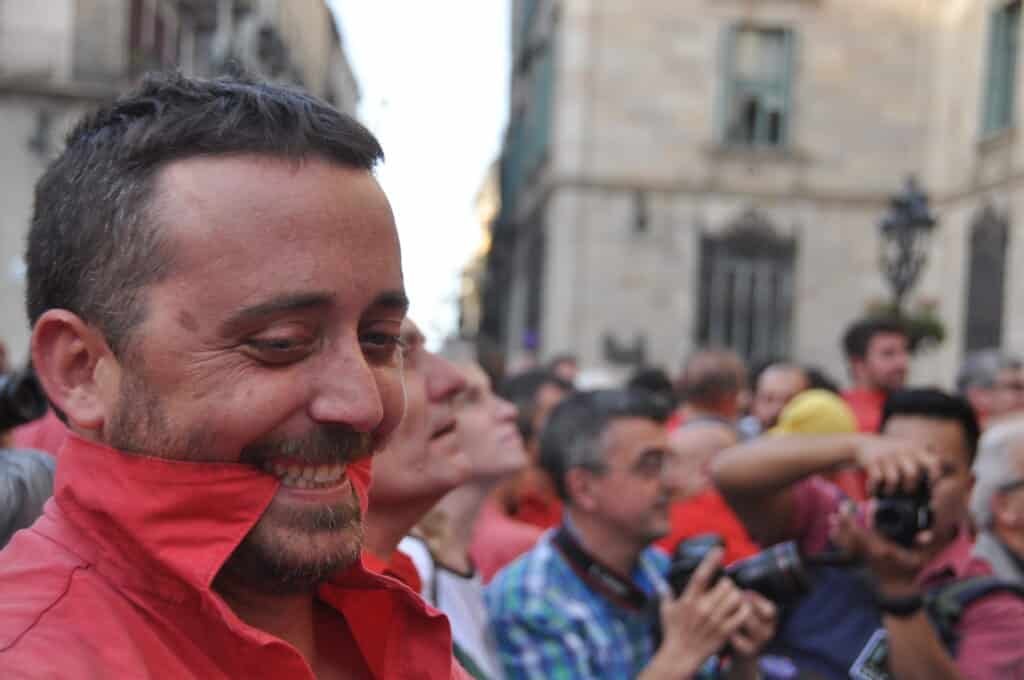
Featured photograph: A real Catalan human-tower performance in Barcelona in June 2019, photographed by Felvalen, CC BY-SA 4.0; it is not a depiction of the 1819 or 2006 events discussed above.
Continue exploring
The Burden That Becomes a Promise: Thaipusam’s Journey from Tamil Hills to Singapore Streets
From a 1932 silver chariot stopped by trolley wires to Singapore's 2026 procession, Thaipusam reveals how Tamil devotion and diaspora life reshape one another.

When the New Year Has More Than One Star: Matariki, Puanga and the Art of Remembering
Matariki is not one fixed star count or ceremony. Explore Māori regional traditions, Puanga, hautapu, the lunar calendar and New Zealand's public holiday.
The Altar That Changes Every Year: Día de Muertos and Its Many Histories
A Día de Muertos ofrenda can hold water, marigolds and a loved one's favourite meal. Its meaning is intimate; its history is more layered than an unchanged ancient ritual.
When Ancestors Come Home: Obon, Japan’s Summer Fires, and the Festival with Three Calendars
Why does Obon unfold in July, August and the lunar calendar? Explore Kyoto's farewell fires, Gujō's overnight dances and the history of Japanese ancestor remembrance.
Picked for your curiosity
Enable JavaScript to build a reading profile and see recommendations.