 tradivior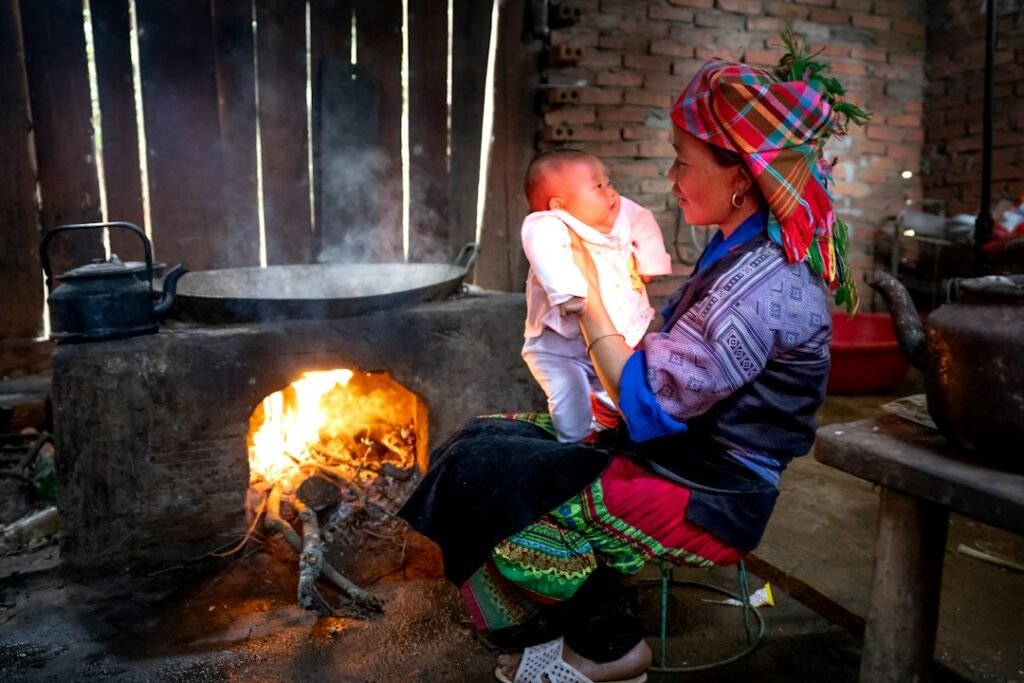
In this investigation
For thousands of years, a household fire was more than an appliance. It cooked food, warmed bodies, dried clothing, hardened materials, heated water, lit the evening and created a place around which people could gather. In many homes, the hearth was therefore not simply placed somewhere inside daily life; daily life was organized around it.
The centrality of the hearth can sound romantic when described from a distance. Firelight evokes stories, family, warmth and ritual. But the same hearth also filled homes with smoke, consumed fuel and concentrated domestic labour. The strongest explanation for its persistence is practical multifunctionality, later layered with social and sacred meanings.
A single fire solved several household problems at once
Before electricity, gas distribution and modern heating systems, households needed sources of heat for both food and bodies. Maintaining separate systems was expensive in fuel and labour. A domestic hearth could do both.
Fire also produced light after sunset, heated water, dried damp materials and supported crafts requiring heat. The household therefore gained efficiency by concentrating activity near one controlled combustion point.
THE PRACTICAL CORE
The hearth was central because energy was scarce. One maintained fire could perform several functions that modern houses divide among stoves, water heaters, radiators, lamps and appliances.
Cooking made the hearth socially unavoidable
Food preparation is a daily requirement. Once cooking depends on a fixed or semi-fixed fire, the location of that fire shapes movement through the house. Fuel must reach it. Water and ingredients must be brought to it. Utensils accumulate around it. People return to it several times a day.
This is one reason archaeological hearths are so informative. Burned surfaces, ash, charcoal, food remains and tool debris can reveal where domestic activity repeatedly occurred even when walls have disappeared.
Archaeology treats the hearth as evidence of household organization
Household archaeology examines where people cooked, crafted, stored food, worked and interacted. Hearths often anchor these reconstructions because fire leaves durable traces.
But archaeologists also warn against assuming that every hearth was identical. A fire feature might be used for cooking, heating, craft production, ritual or several purposes across its lifetime. Context matters.
Heat makes the hearth attractive in cold environments
Where winter temperatures are low, gathering near the fire reduces the energy cost of warming the whole building. The warmest social zone naturally develops around the combustion source.
In poorly insulated dwellings, moving farther from the hearth could mean a substantial drop in temperature. Seating, sleeping and evening activity therefore clustered according to thermal gradients.
In hot climates, the same fire could become a problem
Cooking fire adds heat to the house. In warm regions, traditional architecture often moved cooking toward courtyards, verandas, detached kitchens or highly ventilated spaces.
This variation is important. The “central hearth” was never a universal optimum. Climate could push the kitchen to the edge while the symbolic importance of household fire remained.
Smoke is the major cost hidden by hearth nostalgia
Burning wood, dung, crop residue, charcoal or coal in inefficient stoves releases fine particles, carbon monoxide and other pollutants. In poorly ventilated dwellings, exposure can become extremely high.
The World Health Organization estimates that billions of people are still exposed to harmful household air pollution from polluting fuels and inefficient cooking technologies. The health burden includes respiratory and cardiovascular disease, with exposure falling disproportionately on people who spend the most time near the domestic fire.
THE HEALTH TRADE-OFF
The traditional hearth provided essential energy but could expose household members to dangerous smoke. Its historical usefulness should not be confused with medical harmlessness.
Women and children often carried the highest exposure
Domestic cooking labour has historically been gendered in many societies. When women spend hours tending a smoky fire, exposure is not distributed equally across the household.
Children staying close to caregivers may also spend long periods near the cooking area. Public-health research therefore treats household energy as an issue of gender and poverty as well as technology.
Ventilation became a crucial architectural response
Chimneys, roof openings, courtyards, smoke holes and detached cooking spaces all address the same problem: combustion gases need somewhere to go.
These solutions vary in effectiveness, but their existence shows that traditional builders were not indifferent to smoke. Repeated experience could reveal that enclosed smoke was unpleasant and dangerous long before particulate matter was measurable.
A hearth creates a natural social circle
Fire concentrates attention. People facing the same flame are physically oriented toward a shared centre. Heat rewards proximity, while light falls off rapidly with distance.
This geometry encourages conversation. In the evening, when productive daylight ends, the hearth becomes one of the few illuminated places available for talk, repair work, storytelling and ritual.
Firelight may have helped create a distinctive storytelling niche
Recent evolutionary work has proposed that fireside evenings created conditions especially suited to narrative. Once practical work diminished and visibility narrowed, speech could carry imagined events, distant places and social memory beyond the immediate environment.
The theory remains an evolutionary argument rather than direct proof from prehistoric households. But ethnographic evidence consistently shows that evening firelight changes the content and social tone of conversation in some small-scale societies.
The hearth can turn a house into a social unit
Sharing one cooking fire often maps onto sharing one household economy. People who cook and eat from the same hearth may be understood as one domestic group.
This symbolic link is so strong that “hearth” becomes a metaphor for household, family and home in multiple languages and traditions.
Fire also creates boundaries around who belongs
If one hearth defines one household, access to the hearth can define membership. Guests may be welcomed to eat while remaining outside food preparation. Servants or outsiders may have separate cooking arrangements. Ritual rules may restrict who tends sacred fire.
The hearth therefore unites insiders while potentially marking outsiders.
Sacred fire grows naturally from an already central technology
It is unsurprising that fire acquired religious meanings. It transforms food, produces light from darkness, destroys material, provides heat and visibly consumes offerings. A force so central to survival is an obvious candidate for ritual symbolism.
In Vedic ritual, Zoroastrian practice, Roman domestic religion and many other traditions, fire could mediate between household life and sacred order. But the fact that fire is useful does not prove that religious traditions developed solely from practical utility.
Domestic and ritual fires could be conceptually linked
Some societies treat continuity of household fire as a sign of continuity of family or lineage. Extinguishing or relighting fire can therefore mark migration, marriage, death or ritual transition.
Here a technology becomes a symbol because it is already embedded in everyday life. Fire is not imported into religion from outside domestic experience; religion elaborates what people already depend on.
The hearth organizes time as well as space
Morning lighting, meal preparation, evening gathering and nighttime extinguishing create a daily rhythm. Fuel collection adds another schedule. Seasonal demand changes with temperature.
Before instant ignition, maintaining embers could save labour. The condition of the fire therefore mattered across the day rather than only when food was cooking.
Keeping embers alive is a practical technology
Starting fire from scratch once required more effort than turning a knob. Preserving embers overnight or borrowing fire from a neighbour could reduce time and uncertainty.
This creates a practical basis for traditions emphasizing an ever-burning domestic flame. Religious meaning may later develop around a behaviour that originally also conserved labour.
Fire changes food safety and digestibility
Cooking destroys many pathogens, denatures proteins, softens plant tissues and changes starch digestibility. The hearth therefore sits at the centre of one of humanity’s most consequential technologies.
But these benefits belong to cooking, not necessarily to indoor smoke. Modern clean cooking separates the useful thermal process from the harmful combustion exposure.
The hearth supports preservation as well as cooking
Smoke and heat can dry foods, reduce moisture and contribute to preservation. Hanging meat, fish, grain or other products near a smoky roof zone has practical precedent in multiple societies.
Again, useful preservation does not make chronic smoke inhalation healthy. The same process can benefit food and harm lungs.
Domestic labour clusters around energy
Cooking, heating water, washing utensils, feeding children and preserving food all depend on the household’s energy system. When that system is one fire, work necessarily clusters around it.
This helps explain why the hearth became associated with gendered labour in many societies. The person responsible for food and fuel spends more time in the fire zone.
The social warmth of the hearth came with unequal labour
Family members may remember the hearth as a place of belonging, but someone had to gather fuel, manage smoke, maintain fire and cook. Romantic imagery can hide this workload.
In many rural households, fuel collection itself consumes hours and contributes to physical strain. Modern clean energy changes social life partly because it changes labour demand.
Modern stoves fragmented the old multifunctional centre
Gas and induction stoves provide cooking heat without warming the entire room. Electric lighting replaces flame. Water heaters move hot water elsewhere. Space heating can be controlled separately.
Once these functions split into specialized technologies, the hearth no longer needs to be the household centre.
Television and digital screens replaced some evening hearth functions
The modern living room still often contains a focal point, but it may be a television rather than a fire. Furniture faces the screen the way benches once faced the hearth.
This comparison reveals that social centres are partly architectural. People gather around the technology that captures shared attention.
Fireplaces remain popular even when they are no longer efficient necessities
In wealthy homes, fireplaces can persist after central heating makes them unnecessary. Their value becomes emotional, aesthetic and symbolic.
This is a case of a practical technology becoming heritage. The function shifts from survival to atmosphere without losing the cultural memory of warmth and gathering.
Clean cooking preserves the benefit while removing much of the harm
The strongest modern lesson is not to restore open indoor fires. It is to retain reliable cooking and household energy while reducing emissions.
WHO guidelines prioritize clean fuels and technologies precisely because the useful service—heat—does not require dangerous smoke exposure.
What survives scrutiny?
- Domestic hearths were historically multifunctional technologies for cooking, heat, light, hot water, drying and craft activity.
- Because one fire supplied several forms of household energy, daily activity naturally clustered around it.
- Hearths are important archaeological evidence for household organization, but not every hearth had the same purpose.
- Firelight and warmth create physical conditions that encourage evening gathering and conversation.
- Recent evolutionary work proposes a plausible connection between fireside sociality and storytelling, though direct prehistoric proof is necessarily limited.
- Hearths could symbolize household identity, continuity and sacred order because they were already central to survival.
- Indoor biomass and coal combustion can generate dangerous household air pollution.
- Women and children often receive disproportionate smoke exposure because of gendered domestic labour.
- Ventilation, chimneys and detached cooking spaces are practical responses to combustion risk.
- Modern clean energy preserves the benefits of household heat and cooking without requiring the smoke exposure of an open hearth.
The Tradivior Evidence Profile
Historical Authenticity — Strong. Hearth-centred domestic activity is widely documented archaeologically and ethnographically across many societies.
Original-Purpose Evidence — Strong. Cooking, heating, lighting, water heating, preservation and craft support provide direct practical explanations, with social and sacred meanings developing alongside them.
Scientific Mechanism — Strong. Fire provides thermal energy and light while combustion of polluting fuels produces well-characterized particulate and gaseous hazards.
Experimental Evidence — Strong. The health effects of household air pollution and benefits of cleaner fuels are supported by large epidemiological and public-health literatures.
Cross-Cultural Evidence — Strong. Hearth-centred households recur widely, although climate, architecture, fuel and social organization produce different forms.
Modern Relevance — Strong. The social symbolism of the hearth remains influential, while modern health evidence strongly favours clean cooking and ventilation over open indoor combustion.
The Tradivior Conclusion
Historically Practical—with a major health trade-off. Homes centred daily life around the hearth because one fire efficiently combined cooking, heat, light and other household functions. That concentration of energy naturally produced a social centre and later supported powerful family and sacred symbolism. But traditional indoor combustion also exposed households—especially cooks and children—to harmful smoke. The hearth survives scrutiny as an extraordinarily useful premodern energy system and social technology, not as a health-neutral ideal that should be recreated without modern ventilation and clean fuels.
Continue investigating
- Why Did Indian Kitchens Separate Cooking, Eating and Purity Zones?
- Why Did Courtyard Houses Appear Across Hot Climates?
- Why Did People Sleep on Mats, Floors and Low Beds?
Sources and further reading
- Hendon JA. “Archaeological Approaches to the Organization of Domestic Labor: Household Practice and Domestic Relations.” Annual Review of Anthropology. 1996;25:45–61.
- World Health Organization. WHO Guidelines for Indoor Air Quality: Household Fuel Combustion. 2014.
- World Health Organization. Current household air-pollution data and health guidance.
- International Agency for Research on Cancer. Research on indoor biomass and kerosene combustion and associated cancer risk.
- “Indoor air pollution from biomass combustion and its adverse health effects in central India: an exposure-response study.” PMID: 24019602.
- Recent evolutionary research on firelight, fireside storytelling and spoken language. PMID: 42680191.
- Household archaeology literature on hearths, domestic labour and spatial organization.
Continue exploring

Partially Supported
Why Is the Ganga Sacred?
The Ganga is river, goddess, pilgrimage route, purifier and national symbol. Tradivior will trace how these layers developed and evaluate modern claims about unusual self-purifying properties without confusing microbial findings…

Partially Supported
Why Do People Keep Ashes, Relics and Memorial Objects?
Hair, ashes, bones, clothing, photographs and relics allow the dead to remain materially present. Tradivior will examine why objects carry memory so powerfully and how continuing bonds differ from pathological…

Evidence Supported
Why Do Cultures Set Aside Days to Remember the Dead?
From Pitru Paksha and Qingming to Día de Muertos and All Souls’ Day, cultures repeatedly create calendar time for the dead. Tradivior will compare how recurring remembrance renews kinship, grief…
Historically Practical
Why Do Cultures Preserve the Dead?
Mummification, embalming, freezing, smoking and desiccation reflect very different beliefs about bodies and afterlives. Tradivior will compare preservation traditions with the chemistry of decomposition and the practical limits of each…
Picked for your curiosity
Enable JavaScript to build a reading profile and see recommendations.