 tradivior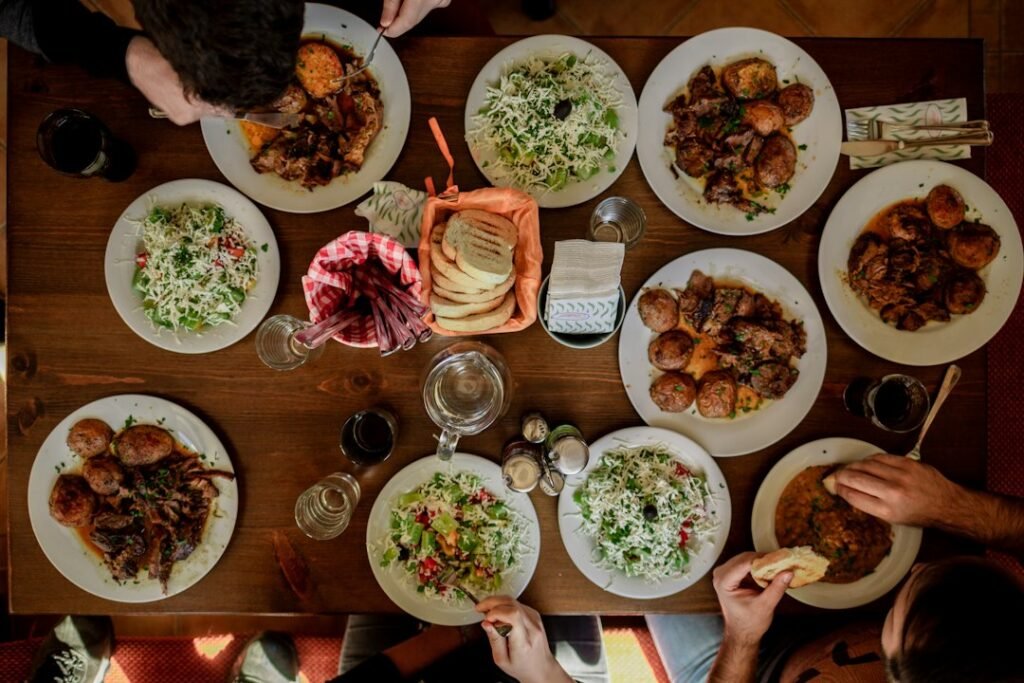
In this investigation
Humans do not merely eat near one another; they build social worlds around eating together. Families gather around tables, soldiers share messes, religious communities break fasts together, diplomats dine after negotiations and strangers become companions over tea or bread.
Anthropologists call this commensality: the practice of eating together. The meal is biologically ordinary but socially unusual. Food is consumed individually—what one person eats cannot be eaten by another—yet the act of sharing transforms that private biological necessity into a collective event.
Modern experiments suggest that shared or similar food can increase trust and cooperation under some conditions. But the deeper historical importance of commensality is broader: meals create repeated contact, mark inclusion, display equality or hierarchy, transmit rules and give groups a predictable setting in which relationships can be maintained.
Eating together turns food into a relationship
A solitary meal solves hunger. A shared meal solves several additional social problems. It determines who belongs, who serves, who eats first, who sits where and what rules everyone accepts.
That is why meals can communicate alliance or exclusion without anyone stating it explicitly.
THE SOCIAL FUNCTION
To eat together is to accept temporary coordination around the same food, place, timing and social rules.
Commensality is ancient because food is unavoidable
Humans must repeatedly stop to eat. Turning those repeated moments into social gatherings creates an efficient opportunity for communication and bonding.
Archaeological evidence of feasting, communal cooking and large serving vessels suggests that shared eating has long been used for ritual, alliance and social display.
Sharing scarce food is a visible trust signal
Food has immediate biological value. Giving another person access to it therefore demonstrates willingness to bear a cost.
The signal becomes especially strong when food is scarce, valuable or labour-intensive to prepare.
A common meal creates a temporary common fate
Diners often consume food from the same kitchen, pot or serving system. If the meal is good, everyone benefits. If it is contaminated, everyone may suffer.
That shared exposure can make eating together symbolically powerful: the group is literally taking the same substance into their bodies.
Religions use shared food to make community tangible
Communal meals appear in festivals, fast-breaking, temple food, church meals, langar and memorial feasts. The theological meanings differ, but the social pattern is recognizable.
Belonging becomes something people do together rather than merely believe privately.
Sikh langar deliberately uses commensality to challenge status
In Sikh tradition, the communal kitchen and meal known as langar invite people to eat together regardless of caste or social position.
The meal therefore does more than feed. Shared seating becomes a practical statement about equality before the community.
Who may eat together can be as important as the food itself
Historical caste, religious and class systems often regulate commensality. Some people may be forbidden to share kitchens, vessels or dining space.
This shows the reverse side of the bonding mechanism: if eating together signals belonging, refusing to eat together can mark social distance.
Commensality can reproduce hierarchy
A shared meal is not automatically egalitarian. Seating order, serving order and food quality can display rank.
The ruler may eat first. Guests may receive better dishes. Servants may eat separately. Men and women may occupy different spaces.
The meal can therefore integrate and stratify at the same time
Everyone may participate in one feast while still being visibly ranked within it.
This is why “eating together builds trust” should not be confused with “eating together makes everyone equal.”
Shared meals increase opportunities for conversation
A meal creates a predictable block of time in which people are physically co-present and not focused entirely on another task.
Families can exchange news, negotiate plans, teach children manners and discuss problems.
Children learn social membership at the table
Anthropological research on mealtime socialization shows that children learn much more than eating technique. They learn turn-taking, politeness, appropriate topics, family stories and moral expectations.
A meal therefore acts as a repeated classroom for cultural membership.
Eating the same food can create perceived similarity
Food preferences are closely tied to identity. When another person eats the same food, they can feel more familiar—even if the similarity is accidental.
A 2017 series of experiments found that strangers assigned to eat similar foods showed greater trust in a trust game and greater cooperation during a negotiation than strangers given dissimilar foods.
THE EXPERIMENT
Shared food can act as a cue of similarity and cooperation. The effect is real in controlled settings, but it does not mean one meal can overcome deep conflict or guarantee trustworthiness.
Food similarity can accelerate cooperation between strangers
The same experimental work found that similar-food pairs reached more cooperative outcomes during labour negotiations.
This suggests that food can function as an incidental social signal rather than merely a source of nutrition.
Shared consumption creates behavioural synchrony
Diners coordinate sitting, serving, chewing, passing dishes and conversation. Meals therefore contain low-level synchrony even when no one deliberately coordinates.
Research in other domains shows that behavioural synchrony can increase affiliation and cooperation. Commensality naturally creates conditions in which such coordination occurs.
Ritual timing intensifies synchrony
When an entire community breaks a fast at the same time or begins a feast after a common prayer, coordination becomes more explicit.
Everyone moves from deprivation or waiting into consumption together, creating a powerful shared temporal boundary.
Feasts can create alliances between groups
Large communal meals often accompany weddings, treaty-making, funerals and political gatherings because food helps stabilize new relationships.
The host demonstrates generosity; guests publicly accept the relationship by attending and eating.
Refusing food can reject the relationship
In many cultures, refusing an offered meal may signal distrust, anger or social distance.
This does not mean people must eat against their will. It reveals how strongly food acceptance can symbolize acceptance of the host.
Eating together creates reputational information
Meals reveal behaviour. Who serves others? Who takes more than their share? Who waits? Who tells the truth? Who is generous?
Repeated meals allow people to observe one another in low-stakes settings, gradually building reputational knowledge.
Trust is easier when people meet repeatedly
Cooperation research consistently shows that repeated interaction changes incentives. People who expect to meet again have stronger reasons to maintain reputation.
A recurring family dinner, workplace lunch or community meal creates exactly this kind of repeated contact.
Family meals correlate with many positive outcomes
A 2023 umbrella review synthesizing forty-one systematic reviews found that more frequent family meals are associated with better diet, lower obesity risk, fewer risk behaviours, better mental health and well-being, and stronger academic outcomes among children and adolescents.
These associations are substantial enough to take seriously—but they require causal caution.
Correlation is a major limitation in family-meal research
Families who manage regular shared meals may differ from other families in time, income, schedules, relationship quality and parental involvement.
A 2020 systematic review specifically examining family meals concluded that intervention evidence was too limited to establish that increasing meal frequency alone causes all the associated health benefits.
The quality of the meal environment matters
A family meal filled with conflict, criticism or coercive eating may not produce the same benefits as a calm and supportive one.
Frequency alone cannot capture whether people feel heard, safe and connected.
Shared meals can also become sites of control
Parents may police children’s bodies or food intake. Senior relatives may control seating and portions. Women may perform most preparation and cleanup.
A tradition associated with family cohesion can therefore distribute labour and authority unequally.
The labour behind commensality is often invisible
A meal does not appear by itself. Shopping, cooking, serving and cleaning can take hours.
When one person repeatedly performs that labour, everyone else may experience bonding while the cook experiences burden.
Restaurants commercialize commensality
Restaurants sell food, but much of their value comes from providing a place for people to eat together. Birthdays, dates and business meetings are organized around meals because the setting supports interaction.
Hospitality research therefore treats commensality as a central social dimension of dining rather than an accidental side effect.
Business meals use food to soften negotiation
Eating introduces a social script alongside the commercial one. People share dishes, exchange small talk and observe etiquette before discussing difficult issues.
The meal can humanize the counterpart, though it does not eliminate strategic interests.
Diplomatic banquets display both trust and hierarchy
State dinners place adversaries or allies at the same table, but seating order and menu choices are carefully controlled.
Commensality therefore signals peaceful engagement while preserving political rank.
Eating alone is not inherently unhealthy
Modern enthusiasm for communal eating can become moralizing. Some people enjoy solitary meals, live alone or need quiet.
The evidence does not support treating every solo meal as a social failure.
The problem is unwanted isolation, not solitude itself
A person who wants company but repeatedly eats alone may experience the meal as evidence of loneliness. Another person may choose to eat alone and find it restorative.
As with solitude more broadly, choice changes the meaning.
Digital devices can change the social quality of a shared meal
People can occupy the same table while attending primarily to phones. Physical co-presence does not guarantee conversation.
This reinforces the idea that the mechanism is not simply eating at the same time. Attention and interaction matter.
Video meals recreate only part of commensality
Families separated by migration sometimes eat together over video calls. They share timing and conversation but not smell, serving or physical food exchange.
This shows that commensality contains multiple components that technology can reproduce unevenly.
Food taboos define group boundaries
Religious dietary rules determine which meals can be safely shared. Kosher, halal, vegetarian and caste-based food rules can make some kitchens acceptable and others unacceptable.
Shared food therefore creates solidarity partly because everyone accepts the same dietary code.
Different food can signal different identity
The same mechanism seen in laboratory studies can operate culturally. People recognize familiar food as evidence of shared upbringing, region or religion.
“We eat the same things” can become shorthand for “we are similar people.”
Shared meals can reduce social distance when boundaries are deliberately crossed
Interfaith meals, community kitchens and mixed-caste dining can use commensality intentionally to challenge inherited separation.
The act is powerful precisely because exclusion from common eating has historically marked social boundaries.
But contact works best under supportive conditions
One meal does not automatically erase prejudice. If people arrive under unequal status or coercion, the encounter may reproduce tension.
Commensality provides an opportunity for connection, not a guaranteed transformation.
Why meals are especially effective social rituals
Food is frequent, necessary, emotionally salient and easy to ritualize. Unlike rare ceremonies, meals recur daily.
This makes them ideal for maintaining relationships through repeated low-intensity contact.
The strongest mechanism is repeated coordinated interaction
Trust does not come from a magical property of food. Shared eating creates conditions that favour trust: mutual provision, similarity, conversation, synchrony, repeated contact and reputational observation.
Those mechanisms explain why the meal is so effective without requiring the claim that eating together always produces harmony.
What survives scrutiny?
- Eating together is a widespread form of human social organization known as commensality.
- Shared meals mark belonging, alliance, hierarchy and exclusion as well as simple nutrition.
- Meals create repeated opportunities for conversation, cultural learning and reputational observation.
- Experiments show that strangers eating similar foods can display greater trust and cooperation under controlled conditions.
- Shared timing, food and serving create forms of behavioural coordination and perceived similarity.
- Family-meal frequency is associated with many positive child and adolescent outcomes.
- Much of that family-meal evidence is correlational, and intervention evidence does not prove that meal frequency alone causes all benefits.
- Meal quality, conversation and emotional climate matter as much as simply sitting at the same table.
- Commensality can reproduce hierarchy and impose unequal cooking or serving labour.
- Shared meals can challenge social boundaries when people who were historically separated deliberately eat together.
- The strongest explanation is that meals create structured, repeated social interaction—not that food itself magically generates trust.
The Tradivior Evidence Profile
Historical Authenticity — Strong. Communal eating, feasting and shared ritual meals are extensively documented archaeologically, historically and ethnographically.
Original-Purpose Evidence — Strong. Alliance, hospitality, ritual belonging, hierarchy, family socialization and political display are well-documented functions.
Scientific Mechanism — Strong. Perceived similarity, reciprocity, repeated interaction, synchrony, conversation and reputational observation provide credible social mechanisms.
Experimental Evidence — Moderate. Controlled studies support effects of food similarity on trust and cooperation; broader family-meal outcomes remain heavily correlational.
Cross-Cultural Evidence — Strong. Commensality appears across cultures while rules about who may eat together differ dramatically.
Modern Relevance — Strong. Shared meals remain central to family life, religion, diplomacy, hospitality, workplaces and interventions against social isolation.
The Tradivior Conclusion
Evidence Supported—with causal limits. Eating together can build trust because shared meals combine several relationship-building mechanisms at once: food sharing, perceived similarity, conversation, synchrony, repeated interaction and reputation. Controlled experiments support some direct trust and cooperation effects, while observational family-meal research shows broad associations with well-being. But a shared meal is not automatically healthy, equal or harmonious. Its power comes from the quality of interaction and the social meaning of sharing, not from eating beside another person alone.
Continue investigating
- Why Is Feeding the Guest a Sacred Duty in So Many Cultures?
- Why Do Communities Treat Hospitality as a Moral Obligation?
- Why Do People Exchange Gifts?
Sources and further reading
- Woolley K, Fishbach A. “A recipe for friendship: Similar food consumption promotes trust and cooperation.” Journal of Consumer Psychology. 2017;27(1):1–10. doi:10.1016/j.jcps.2016.06.003.
- Kerner S, Chou C, Warmind M, et al. “What Is Commensality? A Critical Discussion of an Expanding Research Field.” 2021. PMCID: PMC8295993; PMID: 34207626.
- Harvey KN, et al. “Family Mealtimes: A Systematic Umbrella Review of Characteristics, Correlates, Outcomes and Interventions.” Nutrients. 2023;15(13):2841. PMID: 37447168.
- Robson SM, et al. “Family Meal Frequency, Diet, and Family Functioning: A Systematic Review With Meta-analyses.” Journal of Nutrition Education and Behavior. 2020;52(5):553–564. PMID: 31982371.
- Middleton G, et al. “What can families gain from the family meal? A mixed-papers systematic review.” Appetite. 2020;153:104725. PMID: 32422173.
- Ochs E, Shohet M. “The cultural structuring of mealtime socialization.” New Directions for Child and Adolescent Development. 2006;(111):35–49.
- “Commensality research in commercial hospitality: A systematic review.” International Journal of Hospitality Management. 2023.
- Anthropological and archaeological literature on feasting, communal eating, taboo and ritual commensality.
Continue exploring

Partially Supported
Why Is the Ganga Sacred?
The Ganga is river, goddess, pilgrimage route, purifier and national symbol. Tradivior will trace how these layers developed and evaluate modern claims about unusual self-purifying properties without confusing microbial findings…

Partially Supported
Why Do People Keep Ashes, Relics and Memorial Objects?
Hair, ashes, bones, clothing, photographs and relics allow the dead to remain materially present. Tradivior will examine why objects carry memory so powerfully and how continuing bonds differ from pathological…

Evidence Supported
Why Do Cultures Set Aside Days to Remember the Dead?
From Pitru Paksha and Qingming to Día de Muertos and All Souls’ Day, cultures repeatedly create calendar time for the dead. Tradivior will compare how recurring remembrance renews kinship, grief…

Historically Practical
Why Do Cultures Preserve the Dead?
Mummification, embalming, freezing, smoking and desiccation reflect very different beliefs about bodies and afterlives. Tradivior will compare preservation traditions with the chemistry of decomposition and the practical limits of each…
Picked for your curiosity
Enable JavaScript to build a reading profile and see recommendations.