 tradivior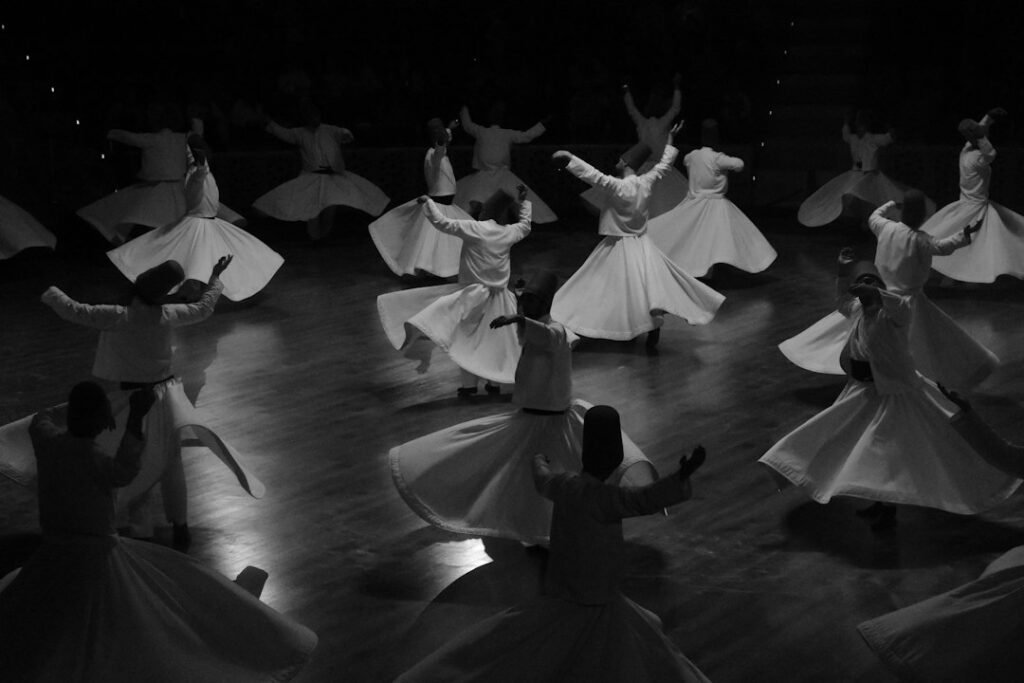
In this investigation
Sufi traditions use music and movement because some devotional paths treat disciplined listening as a way to intensify remembrance of God. Practices such as sama, qawwali and the turning ceremony of the Mevlevi order combine poetry, rhythm, repetition and bodily attention.
They are not universal to Islam or even to all Sufis. Some Muslim scholars historically accepted regulated devotional music, while others strongly criticized it.
Sama means attentive listening
In Sufi history, sama refers broadly to spiritual audition: listening to poetry, chant or music in a devotional setting.
The purpose is not entertainment alone. The listener is expected to orient emotion toward remembrance and spiritual transformation.
Poetry carries doctrine emotionally
Sufi verse often speaks of longing, absence, love, annihilation of ego and union with the beloved.
Music makes those metaphors emotionally immediate and easier to repeat communally.
Qawwali builds intensity through repetition
South Asian qawwali uses lead singing, chorus response, handclaps, harmonium and percussion to build musical momentum.
Repeated phrases allow listeners to move from semantic attention toward emotional absorption.
The Mevlevi sema integrates movement and music
The famous turning ceremony associated with the Mevlevi order combines flute, drums, vocal music and controlled rotation.
UNESCO recognizes the Mevlevi Sema ceremony as intangible cultural heritage, emphasizing its long religious and artistic tradition.
Turning is technically demanding
Sustained rotation challenges the vestibular system. Experienced practitioners learn posture, gaze and movement strategies that help them turn without immediately losing balance.
Training, not a supernatural exemption from dizziness, explains much of this capability.
Rhythm supports coordinated movement
Musical pulse gives dancers and listeners a common temporal structure. This is the same broad entrainment mechanism seen in other forms of collective music.
The religious interpretation, however, is specifically Sufi.
Breath, repetition and attention interact
Devotional chanting and singing regulate phrasing and breathing. Repetition can narrow attention and increase absorption.
These mechanisms can contribute to altered subjective experience without fully explaining its spiritual meaning.
Not all Sufis use music
Sufi orders differ. Some emphasize silent remembrance, recitation or other disciplines. Historically, debates over lawful and unlawful music were significant.
Calling music “the Sufi method” erases this diversity.
Ecstasy is culturally guided
Participants learn when emotional expression is appropriate and how intense states should be understood. A listener may interpret tears, movement or absorption as spiritual response.
The social setting helps shape the experience.
Does Sufi music heal?
Listening to music can affect mood, arousal and stress, and music therapy has clinical applications. These findings do not establish that qawwali or sema cures disease through a unique sacred frequency.
Therapeutic claims need condition-specific clinical evidence.
Why controversy is part of the history
Critics worried that music could stimulate sensuality or distract from proper worship. Defenders argued that the effect depends on the listener’s intention and spiritual state.
This debate itself shows that practitioners never treated sound as mechanically holy.
What survives scrutiny?
- Sama, qawwali and Mevlevi sema are historically important Sufi devotional practices.
- Music and poetry intensify remembrance through repetition and emotion.
- Rhythm coordinates movement and can support absorption.
- Sustained turning requires training and vestibular adaptation.
- Sufi traditions differ sharply over the use of music.
- Medical healing claims go beyond the evidence unless tested clinically.
The Tradivior Evidence Profile
Historical Authenticity — Strong. Sufi musical and movement traditions are extensively documented.
Original-Purpose Evidence — Strong. Remembrance, devotion, spiritual listening and disciplined transformation are explicit.
Scientific Mechanism — Moderate to Strong. Entrainment, emotion, repetition, vestibular adaptation and social synchrony are plausible and measurable.
Experimental Evidence — Moderate. General music and movement mechanisms are supported; specific mystical outcomes are not experimentally reducible.
Cross-Cultural Evidence — Strong. Comparable music-induced absorption occurs elsewhere, while Sufi theology remains distinct.
Modern Relevance — Strong. Qawwali and sema remain living devotional and heritage traditions.
The Tradivior Conclusion
Sufi music and movement work because devotion is not only conceptual. Poetry, rhythm, breath and movement can concentrate emotion and attention around remembrance.
The evidence supports ordinary but powerful psychological and bodily mechanisms. Those mechanisms explain how the practices affect participants without settling what the experiences mean within Sufi theology.
Sources & further reading
- UNESCO: Mevlevi Sema Ceremony.
- Qureshi RB. Sufi Music of India and Pakistan: Sound, Context and Meaning in Qawwali.
- During J. Studies of Sufi music, sama and devotional performance.
Continue exploring

Partially Supported
Why Did Traditional Medicine Classify the Body Into Systems?
Ayurveda, Chinese medicine, Greco-Arabic medicine and other traditions organized illness through coherent but very different models of the body. Tradivior will ask what these systems achieved clinically and where modern…

Primarily Symbolic/Cultural
Why Do Societies Create Prohibitions Around Sacred Days, Places and Objects?
Sacred time and space are often protected by rules about work, food, touch, speech or access. Tradivior will investigate how prohibitions create boundaries and commitment, and when they also conserve…

Primarily Symbolic/Cultural
Why Do Menstrual Taboos Appear Across Cultures?
Menstruation has been treated as sacred, dangerous, polluting, powerful or private in different societies. Tradivior will investigate why restrictions emerged and distinguish rest or privacy from exclusion that harms health…

Primarily Symbolic/Cultural
Why Are Certain Spaces or People Considered Polluting?
Ideas of contamination often extend far beyond dirt or microbes to death, sexuality, caste, food and sacred boundaries. Tradivior will compare ritual pollution systems with modern disgust science without equating…
Picked for your curiosity
Enable JavaScript to build a reading profile and see recommendations.