 tradivior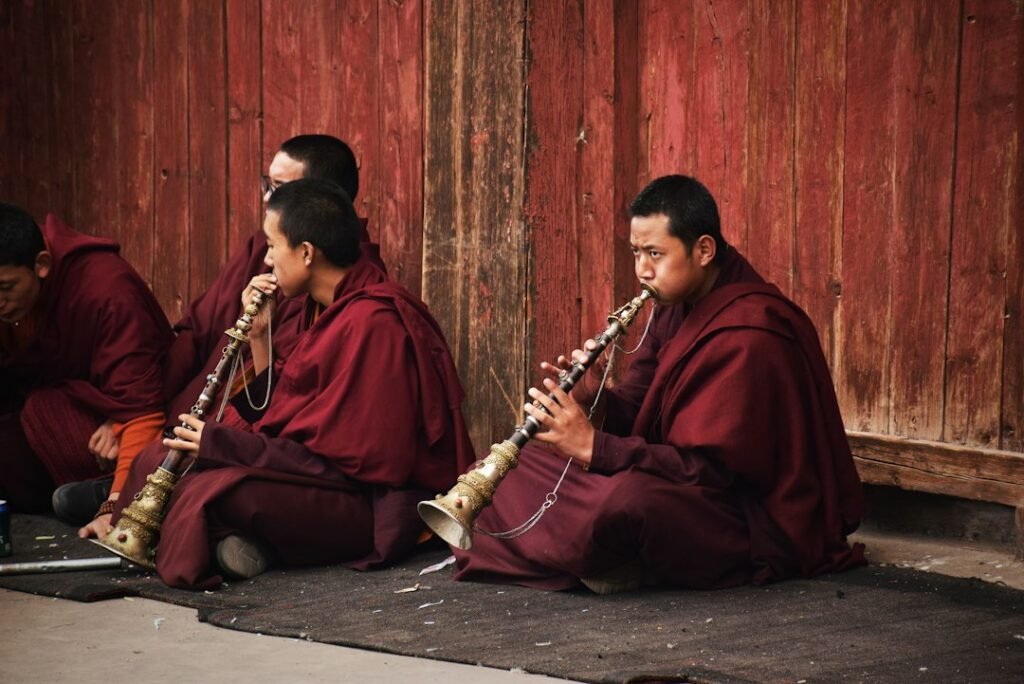
In this investigation
Buddhist prostration is one of the clearest examples of a religious act that modern observers can easily misread. From outside, lowering the body to the ground can look like submission, exercise or theatrical humility. Within Buddhist traditions, prostration is usually understood through reverence, taking refuge, merit, purification, gratitude and training of the self.
There is no single Buddhist prostration. Theravada, Mahayana, Tibetan, East Asian and Himalayan traditions use different forms, frequencies and ritual settings. Some involve kneeling and touching the forehead to the ground. Tibetan and Himalayan practices may include full-length prostrations repeated many times. The meanings also vary.
Reverence toward the Triple Gem
At its broadest, prostration expresses reverence toward the Buddha, Dharma and Sangha. It is not necessarily worship of a creator god. The gesture places the practitioner in a relationship to awakening, teaching and community.
That distinction matters because translating every prostration as “worship” can import assumptions from other religions. Buddhist traditions often frame the act as reverence, refuge, gratitude or ethical training.
Why lower the whole body?
Full-body lowering makes humility physical. A practitioner does not merely think “I should reduce pride”; the body enacts a position of non-dominance. In Tibetan and Himalayan contexts, practitioners may explicitly connect prostration with reducing pride, purifying negative karma and accumulating merit.
Recent ethnographic research among Monpa Tibetan Buddhists in the Eastern Himalayas describes prostration as an embodied practice involving body, speech and mind. Practitioners combine movement, recitation and visualization rather than treating the act as exercise alone.
Prostration is learned through repetition
Like many rituals, prostration can be learned before its full doctrinal meaning is understood. Repeated movement links the body with monasteries, teachers, images, texts and sacred places. Over time, the posture becomes a cue for entering a devotional frame.
Motor memory helps explain why the act can remain emotionally powerful after years of practice. But motor memory is not the historical purpose; it is one mechanism through which a religious practice becomes durable.
Merit and purification
In Tibetan Buddhist settings, prostration may be understood as generating merit and purifying negative karma. These are religious categories that modern psychology cannot simply translate into “stress reduction” or “calorie burning.”
A scientific account can study behaviour, emotion and physiology. It cannot determine karmic consequences with experimental instruments. Tradivior therefore keeps the traditional claim and the measurable mechanism distinct.
Why prostration can feel psychologically powerful
Embodiment research suggests that posture can shape emotion and cognition, but effects depend strongly on context. Lowered postures can communicate deference and reduce felt dominance. When repeated in a meaningful devotional setting, those bodily signals may reinforce humility or receptivity.
The context dependence is crucial. The same physical movement performed as exercise, punishment or devotion will not necessarily produce the same experience.
Prostration and attention
A full prostration requires coordinated movement. The practitioner must attend to sequence, balance, recitation and sometimes visualization. Repetition can narrow attention and reduce competing choices.
This can make the practice absorbing. Yet claims that prostration was designed as an attentional training technology should be treated cautiously unless historical sources say so. The explicit traditional explanations are devotional and karmic.
The role of sacred objects and images
Prostrations may be performed before Buddha images, stupas, teachers, texts or sacred sites. The physical object helps organize attention and relationship. It makes an abstract ideal spatially present.
Psychology can explain how meaningful objects become emotionally potent through memory, association and social learning. It cannot decide whether the religious referent is metaphysically real.
Why pilgrimage intensifies prostration
In some Tibetan and Himalayan traditions, practitioners prostrate repeatedly along pilgrimage routes. This converts travel into bodily devotion. Distance is no longer crossed only by walking; progress itself becomes ritualized.
Such practices are physically demanding and can become costly signals of commitment. But reducing them to signalling alone would ignore the practitioner’s own understanding of merit, devotion and purification.
Is prostration exercise?
Repeated full-body prostrations clearly involve muscular work, joint movement and cardiovascular effort. In large numbers, they can become strenuous. That makes exercise physiology relevant to safety and physical consequences.
It does not make exercise the origin of the practice. A person may gain physical conditioning from a ritual without the ritual having been designed as fitness training.
Physical limits and safety
Repetitive kneeling and full-body lowering can strain knees, wrists, shoulders or the lower back, especially when technique, surface or volume is poorly matched to the individual. Older practitioners and people with injuries may require modification.
Traditional practice itself is not always rigid. Communities often recognize differences in age, health and capacity. Modern health advice should therefore avoid turning one exact movement into a spiritual requirement.
Why humility cannot be measured by posture alone
A person can prostrate while remaining arrogant, just as a person can stand upright while being deeply humble. Ritual posture rehearses an ideal; it does not guarantee character transformation.
This is an important limit to embodiment claims. Bodily action can influence experience, but social meaning and sustained ethical practice determine what follows.
What survives scrutiny?
Buddhist prostration is historically authentic and has clear traditional meanings involving reverence, refuge, merit, purification and humility. Modern embodiment research makes it plausible that lowering the body can reinforce some of these experiences, especially when the posture is culturally familiar.
What does not survive is the idea that prostration is best understood as hidden exercise science or as a universal neurological technique. Its primary logic is religious and ethical.
The Tradivior Evidence Profile
Historical Authenticity — Strong. Prostration is well documented across multiple Buddhist traditions.
Original-Purpose Evidence — Strong. Reverence, refuge, merit, purification and humility are explicit traditional purposes.
Scientific Mechanism — Moderate. Embodied deference, attention, motor repetition and social learning provide plausible secondary mechanisms.
Experimental Evidence — Limited. General posture research is relevant, while direct controlled evidence on Buddhist prostration remains sparse.
Cross-Cultural Evidence — Strong. Prostration occurs widely in religious traditions, but meanings differ.
Modern Relevance — Strong. Prostration remains a living practice across many Buddhist communities.
The Tradivior Conclusion
Primarily Symbolic/Cultural—with plausible embodied effects. Buddhists prostrate because the act embodies reverence, refuge, merit and humility within Buddhist religious worlds. Modern psychology can help explain why the posture may reinforce non-dominance, attention and commitment, but those mechanisms do not replace the traditional explanation or prove that the practice was designed as exercise or neuroscience.
Sources and further reading
- Nagaoka K. The Embodied Experience of Prostration (chaktsal): Senses, Aesthetics, and Politics in the Eastern Himalayas. Journal of Somaesthetics, 2025.
- Van Cappellen P et al. Kneel, stand, prostrate: The psychology of prayer postures in three world religions. PLOS ONE, 2024.
- Specialist Buddhist studies and ethnographic sources should guide interpretation across Theravada, Mahayana and Vajrayana contexts.
Continue exploring
Partially Supported
Why Do Religious Processions Take Sacred Things Into the Street?
Religious processions move sacred presence, symbols and communities through public space. They can expand shared identity through coordinated movement and visibility, but the same public occupation can mark boundaries and…

Primarily Symbolic/Cultural
Why Do Religions Regulate Meat?
Religions regulate meat because killing animals, blood, purity, sacrifice and communal identity carry unusually high moral weight. Some rules may have ecological or safety consequences, but Jewish, Islamic, Hindu, Jain,…
Partially Supported
Why Did Religions Across the World Practice Fasting?
Why did fasting emerge across Judaism, Christianity, Islam, Hinduism, Jainism and Buddhism? The evidence points to multiple religious purposes—not one hidden metabolic origin—while modern science confirms that different fasting protocols…

Evidence Supported
Why Do Festivals Move Through the Lunar Calendar?
Religious festivals move on the Gregorian calendar because many remain anchored to lunar or lunisolar systems. Pure lunar calendars drift through the seasons, while lunisolar calendars insert leap months to…
Picked for your curiosity
Enable JavaScript to build a reading profile and see recommendations.