 tradivior
In this investigation
The cup is the smallest part of the invitation
A guest can drink a cup of coffee in minutes. In many Ethiopian homes, the preparation and sharing of buna may take far longer, and the time is not a defect in the service. It is part of what is being offered. Green beans are roasted; the fragrance is shared; a clay pot is prepared; cups are filled; people sit and talk. The drink matters, but the ceremony’s distinctive achievement is to create a period in which attention is directed toward the people gathered around it.
That difference is easy to flatten when the ceremony appears in travel advertising as a picturesque sequence of objects: charcoal, incense, a slender-necked jebena and tiny cups. The objects are real, but they do not explain why people continue to make time for them, or why the custom has travelled with Ethiopian and Oromo communities far beyond Ethiopia. Nor is there one script observed identically by every family, faith or region. The ceremony is a living social practice whose details change with the people performing it.
A particularly revealing record is preserved not in an Ethiopian village but in the Smithsonian Institution’s collection in Washington, D.C. It concerns a coffee pot used at an Ethiopian restaurant, where the owners brought patrons together to talk and learn about one another. The object shows that the ceremony is neither a relic nor a performance confined to its place of origin. It can become a way of making community in a new city.
What a jebena can tell a museum
The Smithsonian’s National Museum of American History catalogues a brown, long-necked ceramic jebena used during coffee ceremonies at DAS Ethiopian Restaurant in Washington. The object had been acquired in Ethiopia in the late 1990s or early 2000s. Its significance in the collection is not merely that it is a distinctive vessel. It carries a documented account of how Ethiopian-born restaurateurs Sileshi Alifom and Elizabeth Wossen used hospitality to bring people into conversation.
According to the museum’s object history, the restaurant occasionally invited patrons to participate in a ceremony. A woman staff member hosted while Alifom explained elements such as incense and fresh grass. Participants gathered around a low table, snacks were offered, beans were roasted and ground, and coffee was brewed repeatedly. The aim was not to demonstrate an exotic kitchen technique to spectators. The hosts wanted guests to encounter Ethiopian culture while forming connections with one another.
The setting matters. The museum records that Alifom and Wossen had migrated to the United States in different waves and later took over the restaurant in Georgetown. A practice associated with domestic hospitality thus entered a commercial dining room without losing its capacity to organize conversation. This is a documented example of adaptation, not evidence that every Ethiopian restaurant conducts the ceremony or that every guest experiences it in the same way.
The sequence is slow because it does social work
Accounts of the ceremony commonly begin with the preparation of a space and the roasting of green coffee beans. The roasting releases an aroma that can be offered to the assembled guests. Beans are then ground and brewed in the jebena; coffee is served in small cups, sometimes with snacks and incense nearby. The Smithsonian account describes three rounds of brewing during its documented restaurant ceremonies. Some households and communities name successive rounds, but terms and expectations should not be treated as a single universal rule across Ethiopia and Eritrea.
The apparent inefficiency is instructive. A café optimized for throughput separates production from consumption: the machine prepares a drink while customers continue other activities. The ceremonial arrangement often makes preparation itself a shared event. The time taken to roast and brew gives people a reason to remain present, exchange news and acknowledge one another. Its value is partly in what cannot be accelerated without changing the occasion.
This does not mean that every ceremony is peaceful or that every participant has unlimited time. Preparing and hosting require work, fuel, equipment and skill. An invitation may be a pleasure, an obligation or both. To call the ritual simply ‘relaxing’ is to describe the guest’s possible experience while overlooking the host’s labour. A respectful account has to keep both in view.
Women’s knowledge is not background decoration
The gendered dimensions of buna are especially important. The Smithsonian notes that women typically host the Ethiopian ceremonies it describes. A 2004 ethnographic study by Janet Yedes, Robbin Clamons and Amal Osman examined Oromo women’s coffee gatherings across generations in the United States, including Muslim Oromo participants. Its abstract emphasizes mutual support, greetings, respect for elders, prayer and conversation. In that setting, the gathering provided a space where women could sustain relationships and religious practice across migration.
The study does not authorize a claim that all Oromo women practise the same ceremony or that its spiritual meaning is identical for Muslims, Christians and practitioners of other traditions. Indeed, the researchers specifically describe adaptations in indigenous, Christian and Muslim contexts. That variation is part of the subject. A ritual can be recognizable across communities while its language, prayer, social expectations and significance change.
There is a tension worth noticing. The ceremony can make women’s social networks visible and powerful, but the work of hosting can also be taken for granted precisely because it is familiar domestic labour. An outsider who praises the hospitality without noticing who prepares the space, roasts the beans and cleans up afterward has understood only half the scene. The act of making coffee may create a place for women to speak; it should not make their work invisible.
A meeting place for people inside institutions
Sarah Howard’s 2018 anthropological study of rural government workers in eastern Amhara Region adds a less expected dimension. Based on research conducted between 2011 and 2015, it examines how coffee gatherings helped low-level officials build group solidarity amid the difficulties of their working lives. Here the ceremony was not merely a family tradition or a religious occasion. It operated within the everyday social world of the state.
That finding complicates a familiar division between formal institutions and informal community life. A government office may have rules, reporting lines and written procedures, yet the people working there still need trust and mutual support. Coffee gatherings can provide a setting in which those relationships develop. The study does not prove that drinking coffee makes government more effective; it shows that institutional life is also made through repeated social practices.
There is an illuminating comparison with the Smithsonian’s restaurant example. In Washington, a ceremony helped customers and migrants connect across cultural distance. In rural Amhara, the practice helped workers navigate a shared institutional world. The preparation may look similar, but the social problem it addresses differs. The ceremony is not a fixed symbol with one function. It is a flexible form that communities put to work.
When hospitality becomes an organized intervention
The power of the form also invites deliberate use. A 2011 study by Anteneh Mekuria Tesfaye investigated a programme in Addis Ababa that used traditional coffee ceremonies as settings for discussion of child abuse, exploitation and other social problems among women around Merkato. The research drew on interviews, focus groups and observations. It found opportunities for discussion, but also serious limits: the sessions could become too formal, facilitators were not always equipped to support participation, and the agenda was often set by the sponsoring organization rather than the women themselves.
That is a valuable counterexample to the idea that the ceremony automatically produces equality or dialogue. Borrowing a familiar gathering format does not guarantee that participants control the conversation. A ritual can create a welcoming setting, but power still matters: who chooses the topic, who speaks, who listens, and who decides what counts as a useful outcome? The study’s limitations are part of the evidence, not an embarrassment to hide.
The lesson extends beyond Ethiopia. Institutions sometimes adopt community practices because they appear to generate trust. Yet trust is not a prop that can be placed on a table beside the cups. It depends on relationships and the freedom to participate meaningfully. A coffee ceremony can support that process; it cannot replace it.
The mistake of giving a living practice a single origin story
Ethiopia has a deep and globally consequential history with coffee, and the plant’s relationship to the region is central to many accounts of coffee’s spread. Popular stories sometimes compress that history into a neat tale of one shepherd discovering coffee’s stimulating effect. Such legends are culturally interesting, but they are not the same as a dated archival record of the ceremony’s invention. No single origin story should be presented as the proven beginning of all Ethiopian coffee rituals.
The distinction between the history of the coffee plant, the development of coffee drinking and the evolution of a particular ceremonial form is crucial. Plants have ecological histories; commodities have trade histories; rituals have social histories. Those timelines overlap without being identical. The specific arrangement of objects and gestures seen in a contemporary ceremony should not automatically be projected unchanged into a remote past.
Regional and diasporic differences further resist that simplification. Oromo communities, Amhara households, Ethiopian urban settings and Eritrean traditions may share recognizable elements while differing in language, accompaniment, timing or interpretation. A traveller’s single encounter is a real encounter, but it is not a complete ethnography. The most accurate response to variation is to ask whose practice is being described and in what context.
What UNESCO actually said in 2025
On 25 February 2025, UNESCO reported on a capacity-building workshop held in Jimma on 19–20 February to prepare Ethiopia’s nomination file for the traditional coffee ceremony for possible future inscription on the Representative List of the Intangible Cultural Heritage of Humanity. The workshop brought together elders, young people, academics, practitioners, officials and community organizations. UNESCO’s report describes live demonstrations, discussions of transmission and the importance of community participation.
This is a significant contemporary development, but its status must be stated carefully. A workshop to prepare a nomination is not the same as inscription on UNESCO’s list. Describing the ceremony as already inscribed on the basis of that 2025 report would turn an ongoing safeguarding effort into a false accomplishment. The distinction also reveals something about heritage policy: recognition requires documentation, participation and decisions about how to describe a practice that is not identical everywhere.
UNESCO’s account highlights Jimma’s role in coffee production and Oromo cultural life. It also shows that heritage is not simply a treasure to be put behind glass. Participants were discussing how knowledge is passed on and who gets to represent it. Those are living political and cultural questions, especially when a tradition becomes attractive to tourism and international audiences.
A ceremony in the age of instant coffee
It is tempting to make a simple contrast between the ‘authentic’ slow ceremony and the supposedly shallow modern coffee shop. That would be unfair to both. Many people have limited time, and convenient coffee can be part of meaningful friendship too. Conversely, a formal ceremony can be rushed, staged or commercially packaged. The difference is not that one vessel guarantees community and another destroys it. The question is what kind of attention the occasion makes possible.
A useful comparison is the shared meal. Its social value cannot be measured by calories alone, yet food remains essential to it. Likewise, buna cannot be reduced either to caffeine or to symbolism. The sensory work of roasting, the handling of cups, the waiting and the conversation create a distinctive arrangement of people and things. In some settings the arrangement supports prayer; in others it creates neighbourly exchange or diasporic continuity.
The ceremony also challenges a narrow definition of cultural preservation. Keeping a jebena in a museum is valuable because the object can be studied and its provenance recorded. But the Smithsonian’s documentation is most revealing when it includes the people who used it and the relationships they hoped to build. Preservation of an object and continuity of a practice are connected, not interchangeable.
What a respectful visitor should notice
Someone invited to a coffee ceremony need not perform expertise. More useful is to observe who is hosting, follow the host’s guidance, accept that the pace may be different from a café visit, and ask questions without assuming that every action has one fixed mystical meaning. If an element is explained as a blessing, a gesture of respect or simply a family custom, take that account seriously without turning it into a universal claim about Ethiopia.
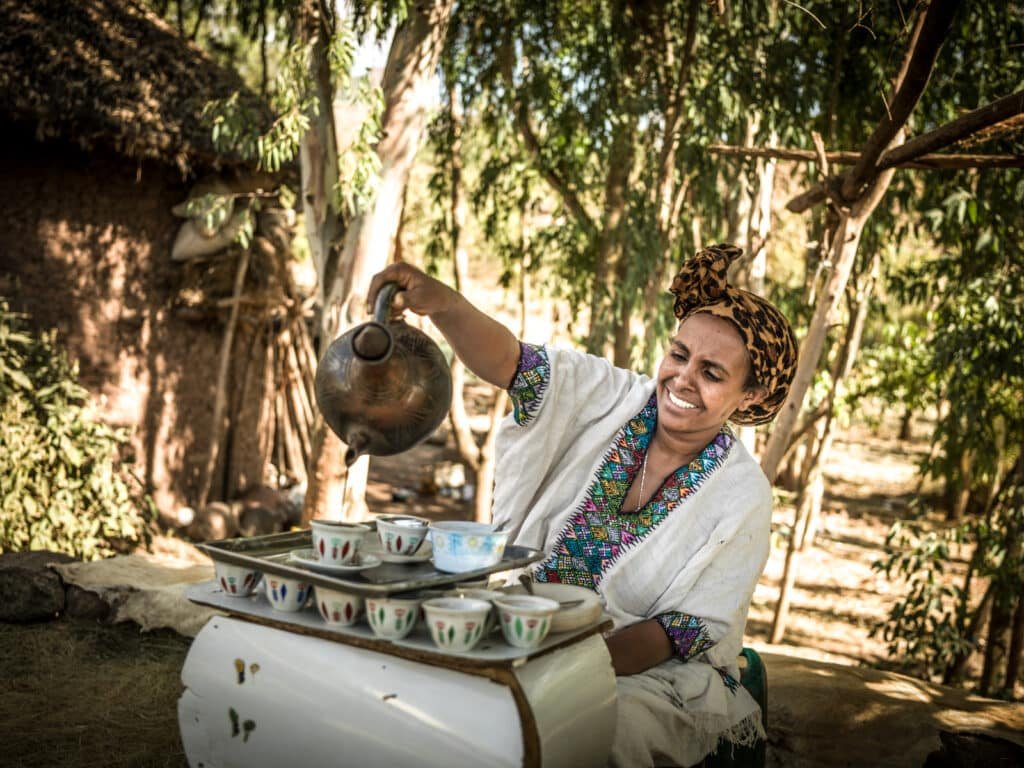
Photography deserves similar care. A beautiful picture of roasting beans can convey material detail, but the people in the room are not museum exhibits. Consent, context and accurate captions matter. The photograph used with this article documents a ceremony in Lalibela in 2017; it does not stand in for every Ethiopian region or imply that the Smithsonian restaurant’s particular event was photographed.
Perhaps the most important act of attention is to recognize that the person preparing the coffee is not merely providing a service. They may be creating the conditions for a social encounter. Respecting that work means noticing its skill and the time it requires, rather than treating the ritual as a colourful prelude to the ‘real’ conversation.
Three cups are not the conclusion
The Ethiopian coffee ceremony is compelling because its material details are so specific: beans, heat, grinding, clay, aroma, cups and shared time. Yet the strongest evidence of its importance lies in what people have done with those details. Oromo women have used gatherings to sustain support across migration. Rural government workers have built solidarity around coffee. A Washington restaurant made the ceremony a bridge between strangers. An Addis Ababa programme demonstrated both the possibilities and the limits of using it for organized dialogue.
These are not interchangeable stories, and none proves that the ceremony always achieves harmony. Together they show why a living tradition should be studied through particular communities rather than praised through a single romantic formula. Coffee is the substance being prepared; relationships are among the things being made. The invitation is meaningful not because every cup is ancient or identical, but because people continue to choose what to do with the time between them.
Sources, status and photograph
Primary institutional and research sources: Smithsonian National Museum of American History, DAS Ethiopian Restaurant jebena and oral-history context; Yedes, Clamons and Osman (2004), ethnography of Oromo women’s buna gatherings; Sarah Howard (2018), Coffee and the State in Rural Ethiopia; Anteneh Mekuria Tesfaye (2011), participatory communication study in Addis Ababa; UNESCO (25 February 2025), nomination-file preparation workshop; H. le Roux (2017), Bunna without borders, diaspora and relational space. The UNESCO item documents nomination preparation, not completed inscription.
Featured image: Niels Van Iperen, Coffee ceremony, Lalibela (8 March 2017), Wikimedia Commons, CC BY-SA 4.0. The photograph depicts a documented ceremony in Lalibela, not any of the specific Smithsonian or ethnographic research events described above.
Continue exploring
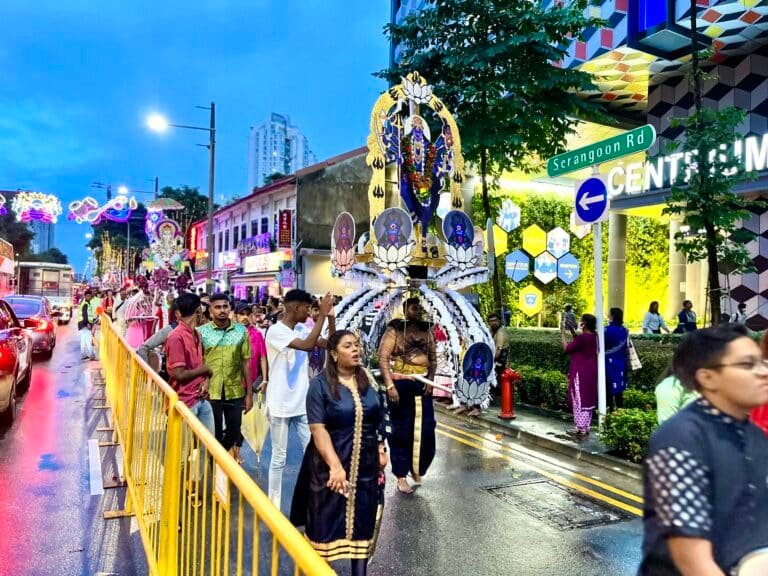
The Burden That Becomes a Promise: Thaipusam’s Journey from Tamil Hills to Singapore Streets
From a 1932 silver chariot stopped by trolley wires to Singapore's 2026 procession, Thaipusam reveals how Tamil devotion and diaspora life reshape one another.

When the New Year Has More Than One Star: Matariki, Puanga and the Art of Remembering
Matariki is not one fixed star count or ceremony. Explore Māori regional traditions, Puanga, hautapu, the lunar calendar and New Zealand's public holiday.
Partially Supported
Why Do People Keep Ashes, Relics and Memorial Objects?
Hair, ashes, bones, clothing, photographs and relics allow the dead to remain materially present. Tradivior will examine why objects carry memory so powerfully and how continuing bonds differ from pathological…

Evidence Supported
Why Do Cultures Set Aside Days to Remember the Dead?
From Pitru Paksha and Qingming to Día de Muertos and All Souls’ Day, cultures repeatedly create calendar time for the dead. Tradivior will compare how recurring remembrance renews kinship, grief…
Picked for your curiosity
Enable JavaScript to build a reading profile and see recommendations.