 tradivior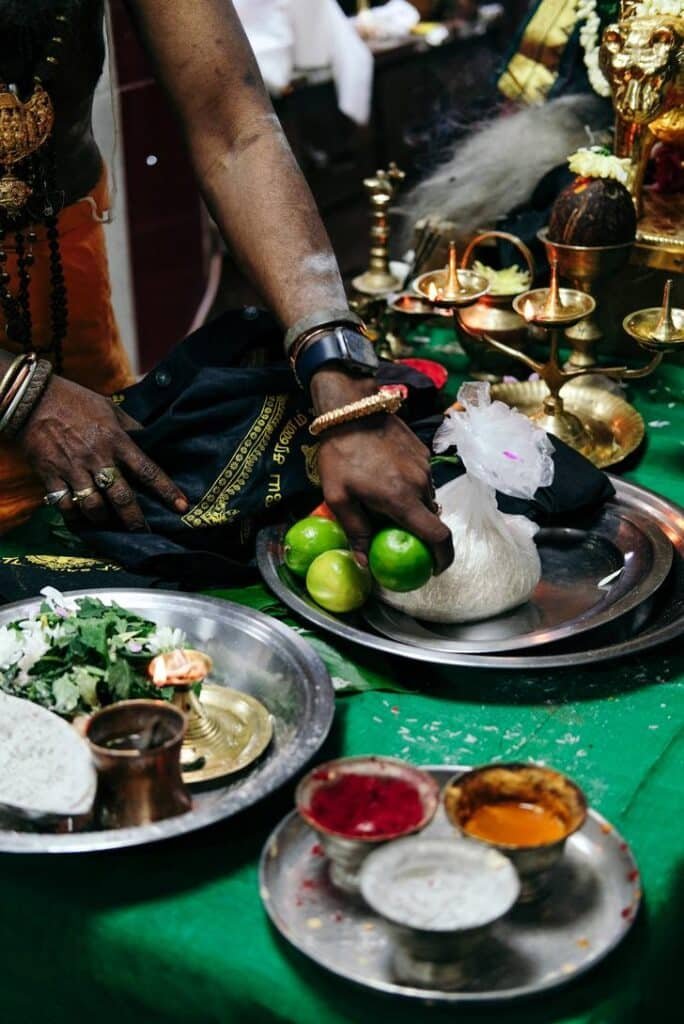
In this investigation
A Hindu puja can look deceptively simple: a lamp is lit, water is offered, flowers are placed, food is presented, incense or fragrance may be used, a bell may sound, and sacred names or verses are recited. Yet this sequence brings together theology, hospitality, aesthetics, sensory attention, memory and social identity in a way that is difficult to reduce to one function.
Modern explanations often do exactly that. Lamps are said to “purify energy,” bells to “activate the brain,” flowers to “release healing vibrations,” camphor to “sterilize the air,” and offerings to have been selected for biochemical reasons. Some of these materials have real physical properties. But real properties do not automatically explain historical ritual purpose.
Tradivior therefore asks two questions separately: what did puja historically mean to the people who performed it, and what measurable effects can a multisensory ritual environment have today?
Puja is a family of practices, not one fixed ritual
There is no single Hindu puja performed identically across India. Domestic worship, temple worship, festival ritual, sectarian practice and regional traditions differ in sequence, language, objects and theology. Some are highly elaborate; others consist of a lamp, a flower and a few words.
The common pattern is relational. The deity is approached through acts of welcome, attention, offering, praise and farewell. In many ritual systems, offerings resemble forms of hospitality: water, food, fragrance, clothing, light and respectful address. The ritual creates a relationship between worshipper and deity through material acts.
Why offer water?
Water is one of the most widespread substances in Hindu ritual because it can signify welcome, purification, cooling, life and sacred presence. In formal puja sequences, water may be offered for washing, sipping, bathing or symbolic refreshment. These meanings are understandable within an older culture of hospitality in which offering water to a guest was both practical and respectful.
Water also carries ritual meaning far beyond hygiene. A substance can be physically cleansing and symbolically purifying at the same time without those being identical concepts. Modern germ theory is not required to explain why water became sacred.
Why flowers?
Flowers are transient, fragrant and visually striking. They communicate beauty, freshness, attention and impermanence. Their value in puja is therefore not mysterious: they are culturally potent gifts that can transform an ordinary space into a marked ritual environment.
Different flowers acquire different associations with particular deities and regional traditions. This makes the ritual vocabulary culturally specific rather than reducible to a universal botanical mechanism.
Why lamps?
Light is one of the most powerful ritual materials humans use. A flame is visible, dynamic, fragile and attention-grabbing. In Hindu worship, light can mark divine presence, knowledge, auspiciousness and the removal of darkness. A lit lamp changes the sensory environment immediately.
Modern cognitive science can help explain why flame is attentionally powerful. Moving high-contrast light draws the eye. In dim settings, it becomes a natural focal point. But this does not mean worshippers historically lit lamps to manipulate visual-attention networks. The historical meanings are devotional and symbolic; the attentional effects are modern explanatory layers.
Why food?
Food offerings transform nourishment into relationship. In many Hindu traditions, food is offered to the deity and later returned as prasada—food understood as blessed through the ritual relationship. The act can turn ordinary eating into participation in sacred reciprocity.
Anthropologically, offerings make devotion material. A thought is private; a gift is observable. Food also links household economy to religion: grain, fruit, sweets or cooked dishes represent effort, abundance and care. Sharing prasada then redistributes that sacred value through a community.
Why fragrance and incense?
Fragrance changes atmosphere rapidly and creates strong associations with place and memory. Incense, flowers, sandalwood and other aromatics can therefore make a ritual setting distinctive and memorable. Smell has unusually direct connections with emotional memory, which helps explain why religious scents can evoke powerful autobiographical responses.
This does not make every claim about ritual smoke healthy. Combustion produces particles and volatile compounds, and indoor air quality depends on fuel, ventilation and intensity. “Sacred” does not mean physiologically harmless.
Why bells?
A bell marks transition. It can announce that ordinary activity has shifted into ritual time, coordinate participants, and capture attention with a sudden salient sound. This function is common across cultures far beyond Hinduism.
Claims that bells emit uniquely therapeutic frequencies require evidence specific to frequency, dose and outcome. The stronger explanation is simpler: sound commands attention, structures timing and becomes sacred through cultural learning.
Puja as multisensory ritual
Puja combines sight, sound, smell, touch, taste and movement. This multisensory organization matters because human memory and attention are context-sensitive. A recurring ritual becomes easier to recognize and remember when many sensory cues converge.
Research on religious cognition and ritual increasingly emphasizes that ritual performance is not merely a set of beliefs in the head. Bodies, objects, movement, sensory cues and shared expectations work together. Recent reviews of ritual cognition describe persistence as arising through combinations of affective reward, social coordination, learned world models and habitual reinforcement.
That framework fits puja well without reducing puja to psychology. The ritual persists because it is meaningful within a religious world and because repeated embodied performance makes that world experientially vivid.
The deity as honoured guest
One of the most useful interpretive models for many forms of puja is hospitality. The deity is invited, welcomed, offered a seat, water, fragrance, light, food and praise. This does not describe every ritual tradition equally, but where it applies it explains the sequence without requiring hidden science.
Hospitality is itself a powerful human institution. It creates relationship through material care. Puja intensifies that logic by directing hospitality toward a divine presence.
Does ritual reduce anxiety?
Psychological studies of ritual show that repeated structured actions can help regulate emotion, especially under uncertainty. The mechanism may include predictability, attentional narrowing and a sense of orderly action. This does not prove that every puja lowers anxiety, but it gives a plausible explanation for why familiar ritual can feel stabilizing.
Ritual can also intensify emotion. Festival puja, crowded temple worship and highly devotional settings may increase arousal rather than reduce it. The function depends on context.
Can puja improve attention?
A structured sequence asks participants to move attention from object to object: flame, image, mantra, flower, food, gesture. Repetition can make these transitions highly practiced. That may reduce distraction during the ritual and create periods of focused engagement.
But it would be an overreach to claim that puja was designed as a cognitive-training protocol. The historically visible aim is worship. Improved attentional control, where it occurs, is better treated as a consequence than an origin story.
Why exact sequence can matter
Ritual sequences become authoritative partly because repetition makes them familiar and transmissible. Exactness can signal seriousness, respect and continuity. It also reduces ambiguity: participants know what comes next.
Current cognitive models of ritual distinguish habit-like reinforcement from more explicit cultural models about why a ritual matters. Puja can involve both. A participant may perform a sequence because it is deeply habitual and simultaneously because each act is embedded in a theological explanation.
The danger of “scientific puja” claims
Many popular accounts begin with a true observation and then make an unsupported leap. Camphor has chemical properties, therefore aarti was invented to disinfect temples. Flowers contain aromatic compounds, therefore offerings were designed as aromatherapy. Bells produce sound waves, therefore temple bells were tuned to alter the brain. Copper has antimicrobial properties, therefore every copper ritual object encoded germ theory.
This style of argument confuses modern mechanism with historical intention. To establish historical intention, evidence must come from texts, material culture, documented practice or credible historical scholarship—not from the fact that a substance happens to have a measurable property.
Could some ritual materials have practical side effects?
Yes. A lamp provides light. Water can wash. Some plant materials can repel insects or emit aromatic compounds. Metal vessels can have distinctive durability or chemical properties. Food redistribution can create social sharing. None of this is controversial.
The important question is whether those side effects were central to the historical ritual logic. Sometimes practical and sacred meanings may genuinely overlap. Other times the practical explanation is a modern reconstruction.
Puja and social learning
Children often learn puja by watching before they can explain it. They observe where objects are placed, when hands are joined, how offerings are made and which words are repeated. This makes ritual a powerful form of non-verbal cultural transmission.
Embodied repetition can therefore preserve identity across generations even when theological understanding varies. A ritual can be socially stable because it is enacted, not merely described.
Puja and memory
The sensory density of puja makes it memorable. Smell, sound, flame, touch and taste all become retrieval cues. A fragrance encountered years later may evoke a temple or childhood household immediately.
This is a plausible cognitive mechanism for continuity. It also helps explain why replacing ritual objects with abstract verbal equivalents may feel emotionally insufficient to practitioners: the ritual is stored in more than words.
Puja, community and prasada
When offerings become prasada and are distributed, the ritual moves from deity to community. Shared food can flatten some distinctions temporarily by giving participants a common sacred substance, though social hierarchy can still shape who prepares, serves or receives food in particular contexts.
Commensality research suggests that eating together can reinforce affiliation. Again, this social effect may help explain persistence without becoming the ritual’s sole meaning.
Temple puja and household puja are not interchangeable
Temple ritual can involve specialists, larger audiences, architectural movement, scheduled offerings and complex liturgical systems. Household puja may be intimate, flexible and integrated into domestic routines. Experimental research that studies a brief individual ritual cannot automatically be generalized to both.
The same caution applies across sects and regions. A generalized account of “Hindu worship” should never erase Vaishnava, Shaiva, Shakta, Smarta, regional and local differences.
Regional and sectarian variation matters
Any claim beginning “Hindus do this because…” needs immediate qualification. Puja differs across Vaishnava, Shaiva, Shakta, Smarta and many local traditions; domestic practice differs from temple liturgy; family customs differ by region, language, caste, lineage and deity. A flower considered appropriate in one context may be avoided in another. A formal sequence taught by a priest may look very different from a brief household act performed before leaving for work.
This variation is evidence against one hidden technological explanation. If the same religious goal can be pursued through different materials, sequences and sensory environments, then the stable core is more likely to lie in devotional structure, symbolic meaning and learned ritual grammar than in one precise biochemical mechanism.
Living tradition does not mean unchanged tradition
Puja is a living practice, which means materials and routines change. Electric lamps may supplement or replace oil lamps. Packaged incense may replace locally prepared aromatics. Urban apartments constrain fire, smoke and water use. Diaspora households adapt to what is legally and practically available. These changes do not necessarily make the ritual less authentic; traditions routinely preserve meaning while altering material form.
This is another reason to avoid claims that one traditional object is physiologically indispensable. If a ritual can remain meaningful when the exact material changes, then the material’s symbolic and relational function may be more important than a claimed hidden health effect.
Modern safety still matters
Respect for ritual does not exempt materials from ordinary safety. Open flames can burn. Dense incense smoke can worsen indoor air quality. Oils and powders can trigger irritation or allergy. Food offerings can spoil. Crowded temple environments can increase infectious exposure during outbreaks. These are practical issues, not arguments against worship.
The evidence-led approach is therefore straightforward: preserve devotional meaning, evaluate physical claims separately, and adapt material practice when genuine health or safety concerns are present.
What changes in diaspora and urban practice?
Modern urban life often compresses puja. Small apartments, fire regulations, work schedules and limited access to traditional materials can change how rituals are performed. Diaspora communities may substitute locally available flowers, use electric lamps, simplify offerings or shift temple attendance to weekends. These adaptations show that ritual continuity does not depend on freezing every material detail in time.
They also provide a useful test for hidden-science claims. If puja remains religiously meaningful when a particular flower, metal vessel or flame is replaced, that weakens the argument that one precise material property is indispensable to the ritual’s purpose. What persists most reliably is the relational grammar of offering, attention and devotion.
For researchers, living adaptation is a reminder that ritual is not a fossil. Any scientific study of puja should specify which community, sequence and materials were actually observed instead of treating “Hindu worship” as one standardized intervention.
What survives scrutiny?
Puja is historically authentic as a broad family of Hindu worship practices, and its ritual materials have well-documented devotional, symbolic and hospitality-related meanings. Modern cognitive science gives plausible explanations for how multisensory ritual can focus attention, strengthen memory, regulate emotion and reinforce identity.
What does not survive scrutiny is the claim that puja objects were selected because ancient practitioners possessed hidden modern knowledge about neural frequencies, oxygen, electromagnetic energy or biomedical mechanisms. Such claims require historical evidence that is usually absent.
The Tradivior Evidence Profile
Historical Authenticity — Strong. Material offerings, lamps, flowers, food, water and formal acts of worship are deeply documented across Hindu traditions, though exact forms vary.
Original-Purpose Evidence — Strong. Devotion, hospitality to the deity, auspiciousness, purification, offering, praise and sacred presence are historically visible purposes.
Scientific Mechanism — Moderate. Multisensory attention, embodied cognition, memory cues, repetition and social reinforcement provide plausible mechanisms for effects on participants.
Experimental Evidence — Limited to Moderate. Ritual and religious-cognition research supports general effects of structured multisensory practice, but direct controlled research on specific puja sequences is limited.
Cross-Cultural Evidence — Moderate. Offerings, sacred light, fragrance and hospitality metaphors recur widely, but Hindu puja has its own historical and theological structures.
Modern Relevance — Strong. Puja remains a living religious practice with devotional, familial and cultural significance; biomedical claims should be treated separately.
The Tradivior Conclusion
Primarily Symbolic/Cultural—with plausible psychological effects. Hindu puja does not need a hidden scientific origin to be intelligible. Its strongest historical explanation is devotional: the worshipper creates relationship with the sacred through offerings, attention, hospitality and repeated embodied action. Modern science helps explain why such a multisensory ritual can become memorable, emotionally powerful and socially durable. It does not prove that lamps, flowers, bells or offerings were designed as biomedical technologies.
Sources and further reading
- Lang M et al. Cognitive computations underlying ritual performance and persistence. Trends in Cognitive Sciences, 2026.
- Hobson NM et al. The Psychology of Rituals: An Integrative Review and Process-Based Framework. Personality and Social Psychology Review, 2018.
- Review literature on embodied cognition and religion, including sensorimotor and social dimensions of religious practice.
- The Neuroscience of Religious and Spiritual Practices: A Systematic Review of Neurotheological Evidence. 2026.
- Primary Hindu ritual texts and specialist historical scholarship should guide interpretation of individual puja traditions and regional variants.
Continue exploring
Partially Supported
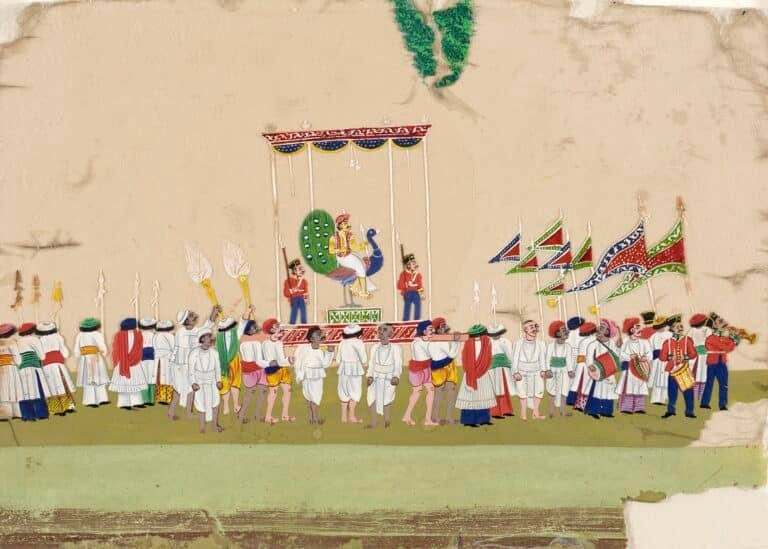
Why Do Religious Processions Take Sacred Things Into the Street?
Religious processions move sacred presence, symbols and communities through public space. They can expand shared identity through coordinated movement and visibility, but the same public occupation can mark boundaries and…
Primarily Symbolic/Cultural
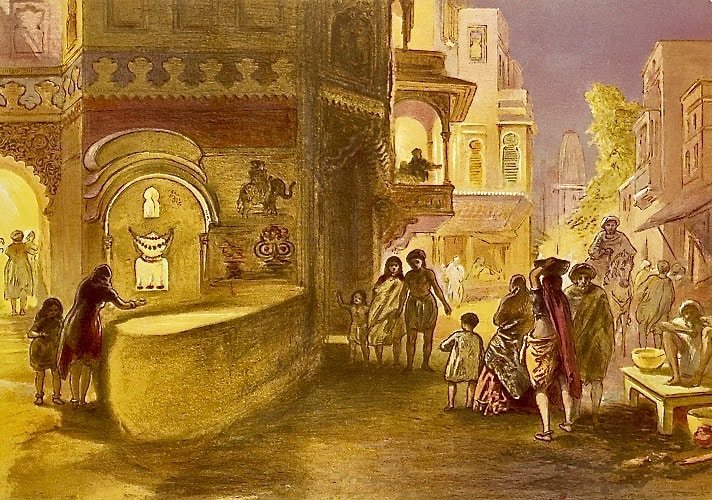
Why Is Diwali Built Around Light?
Diwali’s lamps are historically and religiously meaningful symbols whose interpretations vary across Hindu, Jain, Sikh and regional traditions. Light makes sacred time visible and transforms homes and streets; modern science…
Primarily Symbolic/Cultural
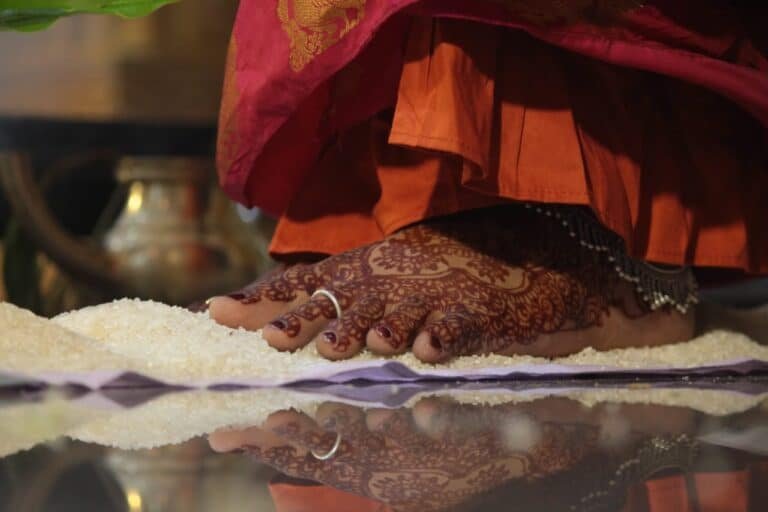
Why Did Indians Circle Sacred Fire at Weddings?
Sacred fire in Hindu weddings is historically a witness, offering medium and divine presence rather than a hidden biomedical technology. Circumambulation and vows make marriage public, memorable and religiously binding;…

Primarily Symbolic/Cultural
Why Do Religions Regulate Meat?
Religions regulate meat because killing animals, blood, purity, sacrifice and communal identity carry unusually high moral weight. Some rules may have ecological or safety consequences, but Jewish, Islamic, Hindu, Jain,…
Picked for your curiosity
Enable JavaScript to build a reading profile and see recommendations.