 tradivior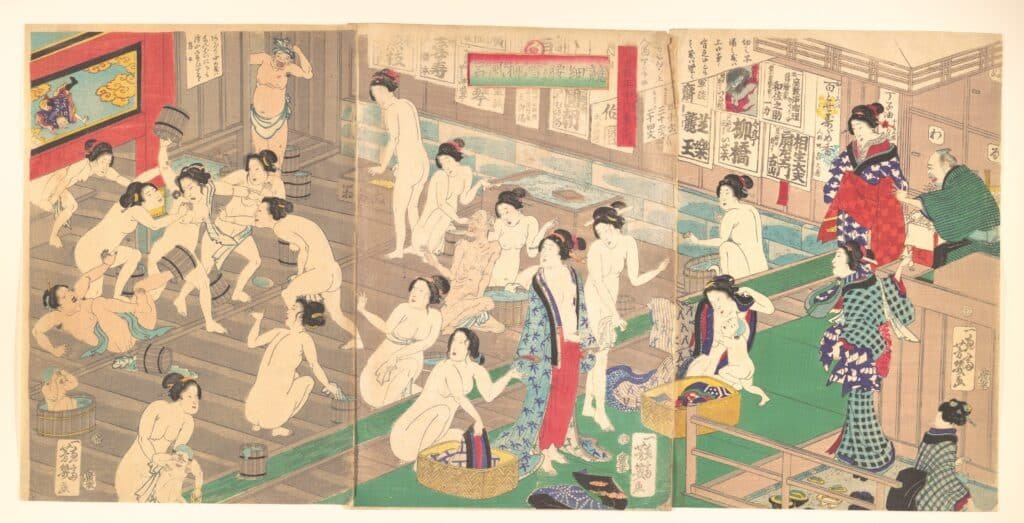
In this investigation
In Japan, a bath can be a wash, a soak, a social space, a hot spring journey and a ritual of transition between the demands of the day and the quiet of evening. That layered meaning was not created at one moment. Japanese bathing accumulated religious, practical, urban and sensory functions over centuries.
Before the daily bathtub
Japanese bathing history begins long before the modern household bath. Practices of purification were associated with Shinto, while Buddhism played an important role in spreading bathing facilities. Temples constructed baths and at times opened them to people beyond the monastic community. Early bathing often involved steam rather than the deep hot-water immersion now strongly associated with Japan.
This religious history should not be compressed into the claim that Japanese people bathe today simply because Shinto requires cleanliness. Cultural practices can outgrow their original settings. Temple bathing, purification, practical washing, pleasure and later commercial bathing all contributed to a much larger institution.
The city made bathing social
Commercial public bathhouses became especially important during the Edo period. Historical accounts place the first public bath in Edo in 1591; bathhouses subsequently spread throughout the city. By 1810, records cited in modern histories count 523 sento in Edo.
These establishments solved a practical problem. Dense urban households did not all possess private bathing facilities, and heating large quantities of water individually was inefficient. A public bath concentrated fuel, water and infrastructure while giving ordinary residents regular access to washing.
But sento were never only plumbing. Japanese research describes public baths as places for both bodily cleanliness and communication. Bathers met neighbours, talked and rested. The architecture therefore supported a social institution as well as a hygienic service.
THE TRADITION
Japanese bathing developed through overlapping traditions: purification, Buddhist temple bathing, natural hot springs, commercial public baths and eventually private household soaking. Onsen and sento belong to the same broad bathing culture but are not the same institution.
Onsen added landscape to the bath
Japan’s volcanic geology created abundant natural hot springs. Onsen connected bathing to particular landscapes and mineral waters, and some became destinations for rest and recuperation. Local springs developed reputations for particular therapeutic properties long before modern clinical trials could test those claims.
This creates an important distinction. Warm-water immersion has physiological effects regardless of whether the water comes from a celebrated spring. Mineral composition may add specific effects in some circumstances, but evidence for one spring or mineral cannot validate every therapeutic reputation attached to onsen culture.
Why wash before entering the bath?
A striking feature of contemporary Japanese bathing etiquette is that the tub is primarily for soaking, not for scrubbing dirt from the body. Bathers wash before entering shared water. In communal settings this is straightforward hygiene and etiquette: the water is a shared environment rather than an individual wash basin.
The separation of washing from soaking also changes the meaning of immersion. Once cleaning has already occurred, sitting in hot water can function as warmth, relaxation and transition rather than merely dirt removal.
What does hot water actually do?
Hot-water immersion is a real physiological exposure. Heat warms the body, dilates peripheral blood vessels, changes circulation and can influence autonomic activity. Reviews of Japanese-style bathing discuss possible effects on sleep, cardiovascular function, pain and subjective wellbeing.
But a plausible mechanism is not proof that every customary bath produces a clinically important benefit. Observational studies of habitual bathing can be influenced by age, health, housing, income and other behaviours. Intervention studies differ in water temperature, immersion depth and duration. Claims should therefore stay proportional to the evidence.
THE SCIENCE
Warm-water immersion has credible thermal and cardiovascular mechanisms and may aid relaxation or sleep in some settings. Those findings help explain why a hot soak can feel restorative; they do not prove that Japanese bathing customs originated from knowledge of modern physiology.
Hotter is not automatically healthier
Japanese bathing research also records hazards. Very hot water can cause large cardiovascular changes. Rapid movement between a cold changing environment and a hot bath can stress the circulatory system, particularly in older or medically vulnerable people. Bath-related accidents and drowning are a recognized safety problem in Japan.
This matters because a tradition can contain both benefit and risk. The relaxing effect of warmth does not make extreme temperature safer, and cultural familiarity does not eliminate physiological limits.
The private bath changed the public bath
After the Second World War, private household bathrooms became increasingly common. Public-bath use declined as the practical need for communal washing diminished. Yet sento did not disappear. Their continued existence reveals what infrastructure alone cannot explain: people may value a shared bath for atmosphere, neighbourhood connection, spacious soaking and continuity with familiar routines.
Modern bathing culture therefore contains a paradox. Technology made public baths less necessary, while the social and experiential meanings of bathing allowed some to survive.
Purity, cleanliness and modern identity
It is tempting to imagine an unbroken national obsession with cleanliness stretching unchanged from ancient purification rites to the present. Historians caution against that picture. Ideas of cleanliness themselves changed, particularly as modern hygiene, public-health administration and nationalism developed. The modern image of Japan as exceptionally clean has its own history.
The better explanation is cumulative: old purification concepts, Buddhist institutions, urban bathhouses, hot-spring traditions, modern hygiene and domestic technology repeatedly reshaped one another.
Japanese bathing separates washing from soaking
One of the clearest differences from many Western bathing habits is procedural. In Japanese homes, sento and onsen, the body is typically washed before entering the shared or household bath. The bathwater is then used primarily for soaking rather than for removing soap and dirt.
This rule has an obvious hygienic function in shared water. It also makes the soak a distinct phase of rest and warming rather than merely a cleaning step.
Sento and onsen are related but not identical institutions
Sento are public bathhouses that historically served neighbourhoods, especially when private baths were uncommon. Onsen are baths supplied by naturally heated spring water that may contain characteristic minerals. Their social functions can overlap, but their water sources and legal classifications differ.
Wellness claims about mineral springs therefore should not be applied automatically to an ordinary heated public bath, and evidence about hot-water immersion should not be attributed to minerals without testing them separately.
The household bath became widespread only recently in historical terms
Modern Japanese homes commonly contain private baths, but neighbourhood sento were once a practical necessity for urban households without their own bathing facilities. Postwar housing and plumbing gradually shifted the balance toward domestic bathing.
The persistence of public baths despite private bathrooms shows that the institution offered more than access to hot water: neighbourhood familiarity, spacious tubs, routine and cultural preference remained valuable.
Immersion changes circulation immediately
Hot-water immersion dilates peripheral blood vessels, raises skin blood flow and can temporarily lower vascular resistance. Hydrostatic pressure from immersion also shifts blood centrally. Heart rate and blood pressure responses depend on temperature, depth, duration and the bather’s health.
These acute cardiovascular effects are real and help explain the sensation of warmth and relaxation. They are not evidence that every hot bath prevents cardiovascular disease.
Observational cardiovascular findings are intriguing, not causal proof
Japanese cohort studies have reported associations between frequent tub bathing and favourable cardiovascular outcomes. Such studies are useful because the behaviour is common enough to observe in large populations.
However, people who bathe frequently may differ from infrequent bathers in income, housing, mobility, health status, sleep, diet and many other ways. Randomized long-term trials assigning thousands of people to decades of hot bathing do not exist. Association therefore should not be promoted as proof that baths extend life.
Heat before sleep may help because body temperature later falls
Warm bathing in the evening can raise skin temperature and promote peripheral heat loss afterward. Sleep research has found that appropriately timed passive body heating can shorten sleep onset for some people.
This provides a plausible modern explanation for the relaxing pre-sleep bath without suggesting that Japanese households historically designed bathing from circadian thermophysiology.
Very hot baths carry a specifically Japanese safety history
Japan has documented sudden deaths associated with bathing, particularly among older adults during cold seasons. Risk can increase when a person moves from a cold dressing room into very hot water, stays immersed too long, drinks alcohol beforehand or has cardiovascular vulnerability.
Research on bath-related deaths is a reminder that a culturally familiar practice can be both pleasurable and physiologically demanding. Moderate water temperature and avoiding abrupt thermal extremes are safer than treating hotter water as more therapeutic.
The winter bathroom creates a thermal-transition problem
Traditional Japanese homes could be poorly heated outside the main living spaces. An older person might undress in a cold room, enter a hot bath and then stand up after prolonged vasodilation. Those rapid changes in temperature and blood pressure can increase fainting or cardiovascular stress.
Modern recommendations to warm changing areas and use less extreme bath temperatures are therefore engineering improvements, not rejection of bathing culture.
Mineral water can have specific effects, but “onsen therapy” is not one treatment
Hot springs differ in acidity, sulfur content, carbon dioxide, salts and other minerals. Dermatology and balneotherapy research has explored benefits for conditions such as psoriasis, atopic dermatitis and musculoskeletal pain, with some positive findings.
The evidence is heterogeneous and often concerns repeated therapeutic courses rather than casual recreational bathing. A sulfur spring, acidic spring and plain hot-water bath should not be assumed to produce identical biological effects.
Onsen water can irritate as well as soothe
Highly acidic, sulfur-rich or very hot water may irritate sensitive skin. People with open wounds, acute dermatitis or particular medical conditions may need to avoid certain springs.
The Japanese practice of posting mineral composition and bathing cautions at many onsen is a practical recognition that natural water is chemically variable.
Shared bathing creates unusually clear etiquette
Washing before entry, keeping towels out of the bath, tying up long hair and avoiding contamination are social rules with direct hygienic effects. Because many bodies share the same water, etiquette becomes part of the technical system.
This is another example of tradition storing practical behaviour in manners rather than scientific explanation.
The bathhouse creates weak social ties that private bathing does not
Neighbourhood sento historically brought people into repeated contact outside work and family. Such low-intensity recurring encounters can create familiarity and local social capital even when conversations are brief.
That social effect is difficult to quantify but helps explain why some communities treat the loss of a local bathhouse as the loss of a neighbourhood institution rather than only a washing facility.
Nudity is culturally regulated rather than socially absent
Shared bathing might appear unusually intimate to outsiders, but Japanese bath etiquette places clear boundaries around gaze, washing and behaviour. Social rules make nudity ordinary within one setting while inappropriate elsewhere.
The practice therefore illustrates how culture changes the meaning of bodily exposure without changing the body itself.
Tattoo restrictions reveal how institutions carry historical memory
Some Japanese baths historically restricted tattooed patrons because large tattoos became associated with organized crime. As tourism and social attitudes change, policies are becoming more varied.
This has little to do with hygiene or hot-water physiology but shows how public-bath etiquette can absorb broader social history.
Bathing is restorative partly because it creates protected time
A person in a bath cannot easily multitask in the same way as someone standing under a quick shower. The ritual forces a pause, often after work and before sleep.
That behavioural structure may contribute to perceived relaxation alongside heat. It is a credible explanation that does not require claims about detoxification or mineral absorption into every organ.
The healthiest modern version preserves the ritual while moderating the thermal dose
For many healthy adults, a comfortably warm bath can be a pleasant routine. Older adults and people with cardiovascular disease should avoid extreme heat, dehydration, abrupt standing and bathing after heavy alcohol use.
This is a strong example of selective inheritance: retain washing-before-soaking, communal etiquette, warmth and rest while applying modern evidence to temperature and safety.
Hydration remains the simplest modern precaution
Hot immersion increases sweating and can lower blood pressure after a person stands. Drinking appropriately, avoiding excessive alcohol and leaving the bath when dizzy are more useful safety rules than chasing an ever-hotter therapeutic dose.
A comfortable bath does not become more authentically Japanese because it is hotter.
What survives scrutiny?
- Japanese bathing has deep historical connections with religious purification and Buddhist bathing institutions.
- Commercial sento became essential urban infrastructure and social spaces during the Edo period.
- Onsen added geographically specific hot-spring traditions and therapeutic reputations.
- Washing before communal soaking has a clear hygienic and social rationale.
- Hot-water immersion produces real thermal and cardiovascular effects and may support relaxation and sleep in suitable circumstances.
- Modern physiology should not be projected backward as the original reason for ancient or medieval bathing practices.
- Very hot baths and abrupt temperature changes can create genuine health risks.
- The persistence of bathing after private bathrooms became common shows that the bath carries social and experiential value beyond hygiene.
The Tradivior Evidence Profile
Historical Authenticity — Strong. Religious bathing, temple baths, sento and onsen are extensively documented across Japanese history.
Original-Purpose Evidence — Strong. Purification, bodily cleaning, public access, social interaction and recuperation are historically visible functions.
Scientific Mechanism — Strong. Hot-water immersion has well-understood thermal, circulatory and autonomic effects, although these do not validate every traditional therapeutic claim.
Experimental Evidence — Moderate. Modern bathing and heat-exposure research supports several short-term effects, but methods and populations vary.
Cross-Cultural Evidence — Strong. Communal and therapeutic bathing occurs widely, while Japan developed a distinctive combination of public baths, hot springs and domestic soaking etiquette.
Modern Relevance — Strong. Bathing remains important for hygiene, relaxation, tourism and community, with temperature and individual health determining safe practice.
The Tradivior Conclusion
Evidence Supported—with historical qualifications. Japanese bathing became more than hygiene because centuries of institutions layered additional purposes onto washing: purification, public infrastructure, neighbourhood sociability, hot-spring recuperation, relaxation and daily transition. Modern physiology supports some benefits of warm-water immersion, but those findings are not evidence that early bathers understood cardiovascular or autonomic mechanisms. Japan’s bathing culture is compelling precisely because practical cleanliness and cultural meaning evolved together.
Continue investigating
Sources & further reading
- A review of Japanese-style bathing: its demerits and merits, Journal of Physiological Anthropology, 2022.
- Wada N. A study on the transformation of lifestyle and the design of public bath: Cultural history of Edo era from the viewpoint of ukiyo-e. Japanese Society for the Science of Design, 2005.
- Fujishima H. A Biographical Survey on Public Baths in Japan: A Review, 2022.
- National Diet Library catalogue: Nakano Eizo, History of Japanese Public Bathhouse “SENTO,” fifth edition, 2024.
- Historical accounts of sento development, Buddhist bathing and Japanese public-bath culture.
Continue exploring
Partially Supported
Why Did Traditional Japanese Diets Emphasize Variety and Small Portions?
Traditional Japanese diets combined rice with vegetables, fish, soy foods, seaweeds, fermented products and many small side dishes. Cohort evidence links Japanese-style dietary patterns with lower cardiovascular mortality, but high…
Historically Practical
Why Did Hammam Bathing Spread Across the Islamic World?
The hammam was not invented from nothing by Islam. Muslim societies inherited older public-bath technologies and transformed them around purification, hygiene, social life and urban needs.
Historically Practical
Why Did Bathing Become a Daily Ritual in India?
Why did bathing become woven into Indian daily life? The answer runs through hygiene, climate, ritual purity and sacred water—and cannot be reduced to ancient germ theory.
Evidence Supported
Why Did Ancient Indians Scrape Their Tongues?
Tongue scraping is an old Indian oral-care practice with a surprisingly straightforward modern rationale. What do systematic reviews actually say about tongue coating, bad breath and the limits of the…
Picked for your curiosity
Enable JavaScript to build a reading profile and see recommendations.