 tradivior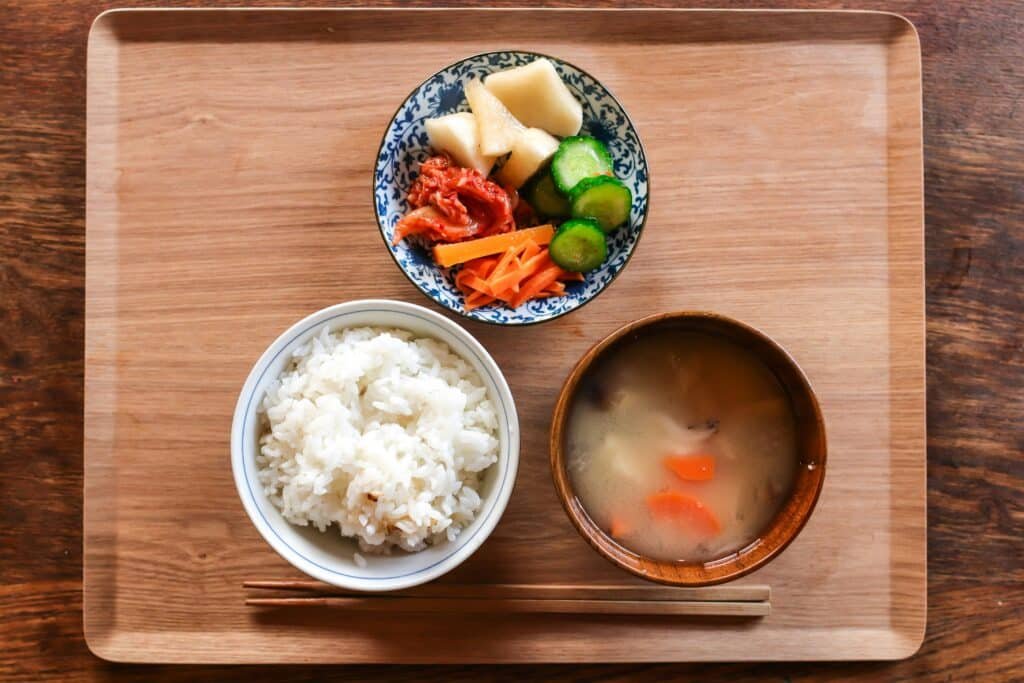
In this investigation
The visual signature of a traditional Japanese meal is not one large centrepiece but a set of smaller components. Rice anchors the meal while soup, vegetables, fish, tofu, pickles, seaweed and other side dishes add colour, texture and flavour. Modern observers often attribute Japanese longevity to this structure.
There is genuine epidemiological support for Japanese-style dietary patterns. Yet longevity is influenced by health care, smoking history, physical activity, socioeconomic conditions and many other factors. The diet itself also contains a major contradiction: many traditional foods are high in sodium.
Rice created the centre of the meal
For much of Japanese history, polished or mixed rice held economic, cultural and symbolic importance. Side dishes were organized around the staple rather than replacing it.
That meal architecture helps explain small portions: variety is distributed across multiple dishes rather than concentrated in one plate.
THE RECORD
The “traditional Japanese diet” is a family of historical patterns shaped by rice agriculture, marine resources, Buddhism, preservation, regional ecology and changing wealth—not one fixed longevity formula.
Fish and marine foods reflect geography
An island nation with extensive coastlines had strong access to fish, shellfish and seaweed. Marine foods contributed protein, iodine and, in fatty fish, long-chain omega-3 fats.
Availability differed regionally and historically, but fish became an important component of many Japanese dietary patterns.
Soy solved several culinary problems
Soybeans became tofu, miso, natto and soy sauce—foods with radically different textures and shelf lives produced through coagulation or fermentation.
These products added plant protein and flavour to meals in which meat intake was historically constrained at different periods by religion, cost and policy.
Fermentation and preservation increased variety
Miso, soy sauce, pickles, dried fish and other preserved foods allowed ingredients to survive beyond immediate harvest or catch. Fermentation also created the savoury depth now associated with Japanese cuisine.
Preservation, however, often came with salt—one of the pattern’s major modern health trade-offs.
Why small dishes can increase variety
A meal built from several side dishes encourages exposure to multiple plant foods and textures even when each serving is modest. This can raise dietary diversity without requiring large portions of every ingredient.
But portion size should not be romanticized. Historical energy intake varied by occupation, class and food availability, and modern restaurant servings do not always mirror household tradition.
THE EVIDENCE
A 2022 systematic review and meta-analysis of prospective cohorts found that higher adherence to a Japanese-style diet was associated with lower cardiovascular, stroke and heart-disease mortality. Higher salt intake moved risk in the opposite direction.
What the cohort evidence found
The meta-analysis included nine studies of Japanese-style dietary patterns involving roughly 469,000 participants. Higher adherence was associated with lower cardiovascular mortality overall, including lower stroke and heart-disease mortality.
Vegetables, fruits, fish, green tea and dairy were among components associated with lower risk, while higher salt intake was associated with increased cardiovascular and stroke mortality.
Observational evidence cannot prove the whole pattern caused the outcome
People who adhere to a traditional dietary pattern may differ in income, activity, smoking, medical care and other behaviours. Statistical adjustment reduces but cannot eliminate all confounding.
This is why the evidence should be called supportive rather than equivalent to a large randomized feeding trial.
Sodium is the contradiction inside the pattern
Miso soup, soy sauce, pickles and salted fish can contribute substantial sodium. Japan historically had high rates of stroke partly associated with high salt intake and blood pressure.
Modern reformulation and public-health campaigns have reduced salt exposure, showing that a tradition can be improved without abandoning its cuisine.
Seaweed supplies iodine—but more is not always better
Seaweeds can be extraordinarily iodine-rich. Adequate iodine is necessary for thyroid hormone production, but very high intake can disrupt thyroid function in susceptible people.
Again, a traditional food can be nutrient-dense without being universally beneficial at unlimited doses.
Green tea is one component, not the explanation for longevity
Green tea supplies polyphenols and is associated in some observational studies with favourable outcomes. But longevity cannot be assigned to one beverage.
The more plausible dietary explanation is pattern-level: high plant-food diversity, fish and soy, modest energy density and comparatively low historical intake of some processed foods.
Traditional Japanese diets changed substantially after World War II
Meat, dairy, oils and Western-style foods increased as incomes rose. Some changes improved nutrition by reducing deficiencies; others introduced more highly processed foods.
Therefore, claims about “the Japanese diet” must specify time period.
The Okinawa example is often oversimplified
Okinawan dietary history differed from mainland Japan, with strong reliance on sweet potatoes in some periods. Modern popular longevity narratives sometimes blend distinct regional diets into one national model.
Regional diversity is another reason not to treat Japan as one timeless nutritional experiment.
Variety can coexist with refined rice
White rice is relatively low in fibre and can produce a substantial glycaemic response. A traditional meal can still be nutritionally strong because the rice is accompanied by vegetables, protein foods, soup and fermented side dishes.
This shows why judging one staple in isolation can misrepresent the whole pattern.
The “Japanese diet” measured in cohorts is a score, not a single historical menu
Large Japanese cohort studies usually create dietary indices from foods such as rice, miso soup, seaweed, pickles, vegetables, fish, soy products and green tea, sometimes adding or subtracting other foods. Different studies use different scoring systems.
This means a statistical Japanese dietary pattern is a research model of recurring habits, not a claim that every Japanese household eats the same way.
Large cohort evidence supports the pattern—but remains observational
The Japan Public Health Center cohort has reported lower all-cause and cardiovascular mortality among adults with higher adherence to a Japanese diet index. Earlier national cohorts and the Ohsaki study found similar associations.
Because these are observational data, healthier participants may also differ in education, smoking, activity, healthcare use or other behaviours. The consistency is meaningful without proving that the diet score alone caused longer life.
A 2022 meta-analysis found lower cardiovascular mortality
A systematic review and meta-analysis of prospective Japanese cohorts found higher adherence to Japanese-style dietary patterns associated with lower cardiovascular, stroke and heart-disease mortality.
The same review also identified the central tension in the pattern: vegetables, fruits, fish, fibre and plant protein looked favourable, while higher salt intake increased cardiovascular and stroke risk.
The healthiest Japanese pattern may be a lower-salt evolution of tradition
Newer Japanese cohort research has tested revised diet indices that retain vegetables, fish, soy, seaweed and other traditional foods while reducing salty foods and adding modern components such as dairy or coffee.
The implication is important: tradition does not need to remain frozen. A food culture can keep its strongest components while correcting a risk factor that modern epidemiology identifies more clearly.
Rice is culturally central but nutritionally ambiguous
White rice provides easily digested carbohydrate and historically supplied reliable energy. But polishing removes fibre and micronutrients, and large portions can contribute a high glycaemic load.
The health effect of rice therefore depends on portion size, activity, what accompanies it and whether the rest of the diet is rich in vegetables, fish, soy and fibre.
Small dishes encourage variety without guaranteeing small energy intake
A meal composed of several small bowls can expose the diner to vegetables, pickles, tofu, fish, soup and rice in one sitting. Variety can improve micronutrient coverage.
But many small dishes can still contain substantial calories or sodium. Presentation style influences portion perception but does not override food composition.
Soy provides protein in several distinct forms
Tofu, natto, miso and other soy foods differ in fermentation, sodium content, texture and nutrient profile. Treating “soy” as one food misses those differences.
Soy protein is high quality for a plant food, and fermented forms can contribute distinctive microorganisms or metabolites. Miso, however, can also add substantial salt.
Natto is nutritionally interesting without being a longevity secret
Natto provides protein and vitamin K2 and contains fermentation-derived compounds that have attracted cardiovascular research. Its strong flavour and texture make it culturally specific rather than universally adopted.
Observational associations with fermented soy do not establish natto as a life-extending medicine, and high vitamin K intake can interact with warfarin management.
Fish offers benefits alongside contamination and sustainability questions
Fish supplies protein and, in many species, long-chain omega-3 fatty acids. Regular fish intake can fit a cardioprotective dietary pattern.
Large predatory fish can accumulate methylmercury, while fishing pressure affects ecosystems. Species choice and frequency therefore matter more than simply “eat more fish.”
Seaweed is nutrient-dense but iodine exposure can become excessive
Seaweed supplies iodine, fibre and minerals, and some varieties contain bioactive polysaccharides. The iodine content varies enormously between species and preparation methods.
Very high habitual intake can disturb thyroid function in susceptible people. A traditional food can therefore be nutritionally valuable without being beneficial in unlimited amounts.
Soup can increase vegetable intake while quietly increasing sodium
Miso soup can carry tofu, seaweed and vegetables in a light meal structure. Its salt content, however, contributes to total sodium exposure.
Lower-sodium miso, smaller portions and greater vegetable content can preserve the dish while adapting it to modern blood-pressure evidence.
Pickles preserve vegetables but concentrate salt
Tsukemono and other pickled vegetables historically extended seasonal food supply and added strong flavour in small portions. Salt was part of the preservation technology.
Once refrigeration becomes widespread, preservation benefit no longer requires the same sodium exposure. Tradition can survive with lower-salt methods.
Green tea is a plausible contributor, not the explanation for national longevity
Green tea contains catechins and other polyphenols and is associated with some favourable health outcomes in observational studies. Randomized trials show effects on selected biomarkers.
But Japanese longevity cannot be reduced to tea. Healthcare, smoking patterns, activity, social structure, income, sanitation and genetics all contribute.
Okinawa is often frozen in an older nutritional moment
Historical Okinawan diets were high in sweet potato and vegetables and relatively low in calories and animal foods. Postwar diets changed substantially, and later generations have not reproduced every historical longevity advantage.
This weakens simplistic claims that one Okinawan ingredient caused exceptional survival. Diet changed alongside activity, occupation, smoking and the broader environment.
The pattern’s strength lies in food diversity and moderate portions
A meal combining vegetables, soy, fish, seaweed and modest portions of staple carbohydrate can achieve high nutrient density without relying on one dominant food.
That structural feature travels well across cultures even if the specific ingredients change.
The most defensible modern Japanese diet is selective tradition
Keep vegetables, soy, fish where appropriate, seaweed in sensible amounts, variety and portion awareness. Reduce excessive salt and do not romanticize refined rice or preserved foods simply because they are traditional.
This is not abandoning the Japanese diet. It is the same process by which living food traditions have always adapted to new constraints.
Sodium reduction is the clearest evidence-based modernization
Japan historically had high salt intake from miso, soy sauce, pickles and preserved fish, alongside high stroke mortality. Public-health efforts to reduce sodium have been an important part of later cardiovascular improvement.
This history is useful because it shows that a traditional diet can contain both protective and harmful elements at the same time.
Modern longevity cannot be credited to diet alone
Japan’s long life expectancy also reflects healthcare access, sanitation, smoking trends, education, income, social policy and medical treatment. Food is one contributor inside a much larger system.
Dietary tradition should therefore be studied as one exposure rather than turned into a national longevity secret.
Westernization changed both protective and harmful exposures
Postwar Japan saw more animal foods and dietary diversity but also more processed foods and sedentary living. Some nutritional deficiencies declined while obesity and metabolic disease became more prominent concerns.
This makes simple nostalgia unreliable. A modern diet should preserve the strongest traditional elements without recreating past limitations or ignoring new risks.
Food culture and public health can evolve together
Reducing salt in miso soup, using smaller amounts of pickles, varying the staple grain and keeping soy, vegetables and fish are examples of selective adaptation.
The healthiest tradition is often the one willing to change when evidence improves.
Japan’s experience is therefore a model of selective tradition: retain variety and plant-rich foods, while actively correcting excessive sodium and other risks identified by modern evidence.
Japan’s low cardiovascular mortality cannot be credited to diet alone
Universal healthcare, high literacy, smoking trends, blood-pressure treatment, sanitation, social structure and other public-health factors all contribute to national mortality patterns. Diet is one exposure inside that larger system.
National longevity therefore should not be used as proof that every common Japanese food is protective.
Sodium reduction is one of the clearest evidence-based modifications
Traditional preservation through miso, soy sauce, pickles and salted fish helped food storage but raised sodium intake. Japan’s long-term public-health efforts to reduce salt have coincided with major declines in stroke mortality.
This is a powerful example of a living tradition improving through modern evidence rather than choosing between authenticity and health.
Westernization created both benefits and new risks
Postwar Japan gained more animal protein, dairy and dietary variety, which improved some nutritional deficiencies. At the same time, processed foods, higher saturated-fat intake and sedentary lifestyles introduced new cardiometabolic risks.
The old diet was not perfect and the new diet is not uniformly worse. Modern healthy eating in Japan is a negotiated mixture of both.
The most credible transferable lesson is high variety with lower salt
Vegetables, soy foods, fish where appropriate, seaweed in sensible amounts and modest portions can form a nutrient-dense pattern. Reducing sodium while preserving those components improves the balance further.
This principle can travel across cultures more reliably than attempting to reproduce every traditional Japanese dish.
What survives scrutiny?
- Traditional Japanese meals often combine a rice staple with multiple small side dishes.
- Fish, vegetables, soy foods, seaweeds, fermented foods and tea contribute to the pattern.
- Prospective cohort evidence associates higher adherence to Japanese-style diets with lower cardiovascular mortality.
- High sodium intake is a genuine adverse feature of some traditional foods.
- Observational associations cannot prove that the whole pattern caused longevity.
- Regional and historical variation is substantial.
- Postwar Japanese diets changed markedly, so “traditional” must be time-specific.
- The healthiest modern interpretation retains variety while reducing excessive sodium and highly processed foods.
The Tradivior Evidence Profile
Historical Authenticity — Strong. Rice-centred meals with fish, vegetables, soy foods and preserved side dishes are well rooted in Japanese food history.
Original-Purpose Evidence — Strong. Geography, agriculture, preservation and religious/economic history explain the pattern better than longevity design.
Scientific Mechanism — Strong. Fish, plant foods, soy, fibre and lower energy density have plausible cardiovascular benefits; excess sodium has clear harms.
Experimental Evidence — Limited. Much evidence is observational rather than based on randomized whole-diet trials.
Cross-Cultural Evidence — Moderate. The precise cuisine is Japanese, while the broader principle of varied plant- and fish-rich eating has parallels elsewhere.
Modern Relevance — Strong. The pattern offers useful principles when adapted to lower sodium and contemporary food environments.
The Tradivior Conclusion
Partially Supported. Traditional Japanese diets were not designed as a modern longevity programme; they emerged from rice agriculture, marine ecology, preservation, Buddhism, trade and economic history. Yet prospective evidence supports health advantages from Japanese-style patterns rich in vegetables, fish, soy and diverse side dishes. The main caution is sodium: some preserved foods that made the traditional system practical also increase blood-pressure risk. The strongest modern lesson is therefore selective inheritance—keep the variety and food structure, reduce the excess salt.
Continue investigating
Sources & further reading
- Tsugane S. “Japanese-Style Diet and Cardiovascular Disease Mortality: A Systematic Review and Meta-Analysis of Prospective Cohort Studies.” 2022. PMID 35631146.
- Willcox DC, Willcox BJ, Todoriki H, Suzuki M. Work on traditional Okinawan dietary patterns and longevity.
- Japanese Ministry of Health and related dietary salt-reduction guidance.
- Cwiertka KJ. Modern Japanese Cuisine: Food, Power and National Identity.
Continue exploring

Partially Supported
Why Do Religions Use Bells and Gongs?
Bells and gongs announce sacred time, mark transitions and command attention across Asia, Europe and beyond. Tradivior will compare their histories and test claims about resonance, brain waves and cleansing…
Evidence Supported
Why Did Traditional Diets Depend on Staple-and-Pulse Combinations?
Grain–pulse pairings such as rice and dal, maize and beans, or bread and lentils recur because they combine affordable staple energy with protein, fibre and complementary amino-acid profiles. The nutritional…
Evidence Supported
Why Did Mediterranean Communities Eat the Way They Did?
The Mediterranean diet emerged from ecology, agriculture, scarcity, religion and cuisine—not from a single ancient health prescription. Modern evidence, including the reanalysed PREDIMED trial and prospective cohorts, supports cardiovascular benefits…

Evidence Supported
Why Did Japanese Bathing Become More Than Hygiene?
Japanese bathing became more than hygiene through centuries of purification, temple baths, public sento, hot springs and domestic soaking. Modern science supports some benefits of warm-water immersion—but also important risks.
Picked for your curiosity
Enable JavaScript to build a reading profile and see recommendations.