 tradivior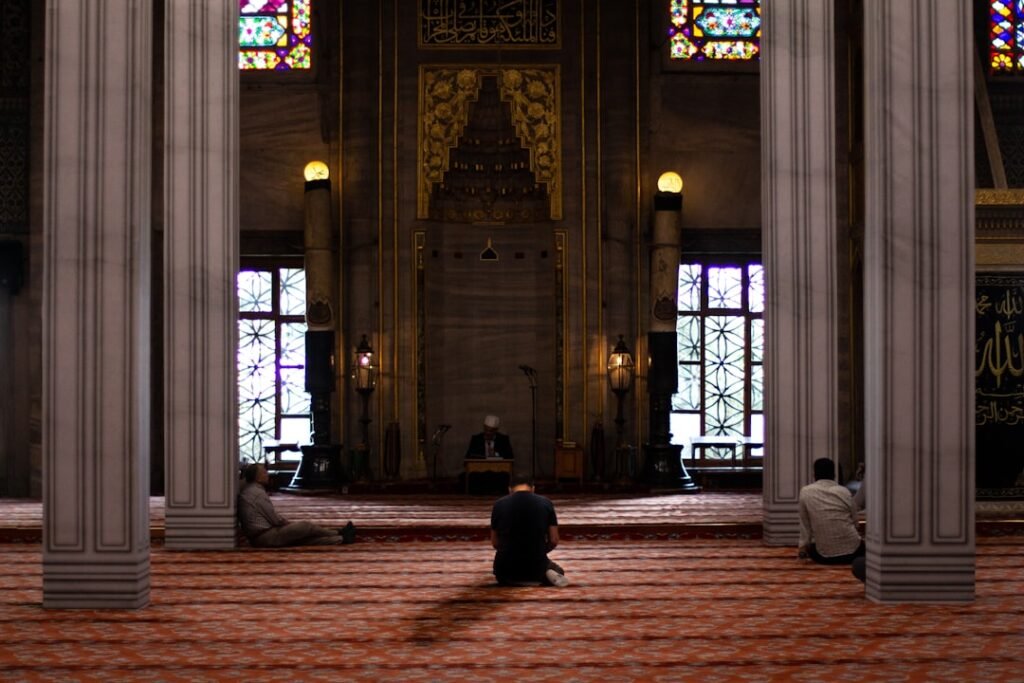
In this investigation
Five times each day, practicing Muslims interrupt ordinary activity to pray. The pattern follows the movement of the sun rather than a mechanical clock: dawn, midday, afternoon, sunset and night. Each prayer combines recitation with standing, bowing, prostration and sitting, oriented toward the qibla.
Modern explanations often frame salat as a hidden exercise routine, a circadian intervention or a stress-reduction technology. Those interpretations start with real observations—salat involves movement, repetition, breathing and fixed timing—but they risk reversing cause and effect. The historical reason Muslims pray is religious obligation and worship, not exercise physiology.
Why fixed times?
Islamic prayer times are tied to observable changes in daylight. Before clocks were precise or universal, the sky itself provided a shared temporal framework. This allowed communities across very different regions to organize worship around recurring astronomical cues.
The five daily prayers do more than divide a day mathematically. They repeatedly pull attention away from work, trade, travel, family concerns and private thought toward worship. In that sense, prayer times create sacred interruptions rather than simply appointments.
Prayer as submission rather than self-optimization
The religious logic of salat is explicit: worship, remembrance, obedience and submission to God. Any modern health effect is secondary to that purpose. This matters because it protects the historical question from retrospective biomedical storytelling.
A person can experience psychological calm during salat without that calm being the reason salat historically developed. A bodily practice can have measurable effects while remaining, in the eyes of practitioners, fundamentally theological.
A ritual that uses the whole body
Salat is neither purely verbal nor purely mental. Standing, bowing, prostrating and sitting make prayer embodied. The sequence gives each prayer a stable motor structure while recitation provides a verbal and auditory one.
Small physiological studies have reported changes in heart-rate variability, EEG activity and stress-related markers during Islamic prayer. For example, one study in healthy Muslim men found increased alpha EEG power and a shift toward parasympathetic indices during salat. Another small study comparing actual salat with mimic movements found different gamma activity when recitation and intention were present.
These findings are interesting but limited. Sample sizes are small, participants are often experienced worshippers, and results do not establish that salat should be prescribed as medical treatment. They do, however, support the straightforward claim that actual prayer is not physiologically identical to mechanically copying the same movements.
The body is not incidental
Prostration is one of the most recognizable parts of Muslim prayer. From a religious perspective, it expresses submission and closeness to God. From a biomechanical perspective, it also moves the hips, knees, ankles, spine and upper limbs through repeated ranges of motion.
It is reasonable to say salat contains light physical activity. It is not reasonable to claim that its movements were designed as a scientifically optimized rehabilitation programme. Reviews discussing salat and health often describe possible musculoskeletal benefits, but the evidence base is not equivalent to that for structured exercise training.
Why repetition matters
A fixed sequence reduces uncertainty. The worshipper knows what comes next. That predictability can make attention easier to organize, particularly after years of practice. Repetition also makes the ritual transmissible: children learn by watching and joining before they can explain every theological detail.
Recent cognitive research on ritual persistence suggests that repeated ritual can be reinforced both by immediate affective and social rewards and by culturally shared beliefs about what the ritual accomplishes. Salat fits this model well: it is habit-like in repetition while remaining explicitly meaningful and intentional.
Does praying five times structure the day?
Yes, at the behavioural level. Fixed recurring practices act as anchors. They can divide work periods, create pauses, and stabilize routine. Behavioural science generally recognizes the power of repeated cues in habit formation.
But it would be inaccurate to claim that the five prayer times were historically selected because early Muslims understood modern chronobiology. The times are religiously grounded in the daily solar cycle. Any circadian consequences are secondary effects.
Prayer time is solar time
The timing of salat shifts through the year and by latitude because it follows dawn, solar position, sunset and nightfall rather than fixed clock hours. This makes prayer responsive to the astronomical day.
That feature creates both elegance and practical complexity. At high latitudes, extreme seasonal daylight can complicate timing, requiring jurisprudential guidance. This is evidence that salat is a living legal and religious system rather than a simple biological schedule.
Could salat influence circadian rhythm?
Potentially, but the direction is not simple. Regular wake and sleep schedules, exposure to dawn light, meal timing and social routines all influence circadian rhythm. Fajr may encourage some worshippers to wake near dawn, while Isha occurs after nightfall.
Yet prayer timing alone cannot be isolated from sleep habits, work schedules, artificial lighting and seasonal variation. Ramadan further complicates the picture because fasting, meals and sleep patterns change together. Studies of Ramadan show that circadian and hormonal patterns can shift, but those effects cannot be attributed to salat alone.
Recitation changes the practice
Salat includes Qur’anic recitation and formulaic phrases. Recitation gives the ritual semantic content, auditory rhythm and memory structure. It also distinguishes genuine prayer from mere movement.
A 2022 systematic review of listening to, reciting or memorizing the Qur’an reported generally favourable findings across anxiety, stress, sleep, quality of life and some physiological measures, but the evidence was heterogeneous and often methodologically limited. The strongest conclusion is not that Qur’anic recitation is a universal medical treatment, but that it can function as a meaningful culturally embedded intervention for some Muslims.
Attention and EEG findings
Small EEG studies have reported changes in alpha and gamma activity during salat. These findings are compatible with focused attention, relaxation or cognitively meaningful recitation. They are not evidence of a unique supernatural brain state.
Neuroscience can show that salat engages the brain differently from rest or mimic movement. It cannot tell us whether prayer is accepted by God, nor can it establish that one observed EEG pattern explains the ritual’s origin.
Can salat reduce stress?
Possibly for many practitioners. Prayer can interrupt rumination, create perceived connection with God, provide familiar language and posture, and remind the worshipper of a larger moral frame. Observational studies among Muslims have linked prayer with life satisfaction and lower stress, while small physiological studies report changes in stress-related measures.
But causation is difficult to establish. People who pray regularly may differ in community support, lifestyle, personality or other religious practices. Salat is also not emotionally identical for everyone. A person experiencing religious guilt or obsessive scrupulosity may not find prayer calming.
Prayer in congregation changes the social dimension
Congregational prayer adds synchronization. People stand in rows, orient in the same direction and move through the same sequence together. Coordinated action can strengthen perceived unity and shared identity.
The mosque also creates social contact around the ritual itself. That can generate practical support, information exchange and belonging. Any health association with communal religious participation may therefore involve social pathways as well as individual prayer.
Why purification comes before prayer
Wudu links bodily preparation to ritual readiness. Washing hands, face and limbs has obvious hygienic potential, but the religious concept of ritual purity cannot simply be translated into germ removal. A person may be ritually prepared without having undergone medical sterilization, and vice versa.
This distinction will matter in a separate Tradivior investigation on purification with water. For salat, the key point is that preparation sharpens the boundary between ordinary time and sacred action.
Why qibla matters
Facing a common direction gives dispersed worshippers a shared sacred geography. Muslims across the world orient toward the Kaaba, creating unity without requiring physical proximity.
Modern claims about magnetic orientation or energy are unnecessary. Direction already has immense religious and social power because it aligns individual bodies toward a common sacred centre.
The temptation to call salat “Islamic yoga”
Comparing salat with yoga because both include posture and breath is misleading. Similar body positions do not make two traditions historically or theologically equivalent. Salat is an act of Islamic worship with specific recitations, timing, direction and legal conditions.
Biomechanics can analyze movement without erasing identity. That is the appropriate level of comparison.
What the health literature can actually support
Reviews describe plausible psychological, cardiovascular, neurological and musculoskeletal effects of salat, but much of the literature is small, observational or exploratory. The evidence is not strong enough to justify claims that salat prevents specific diseases or substitutes for exercise, psychotherapy or medical care.
The scientifically modest claim is stronger because it is credible: salat combines light movement, recitation, repeated attentional focus, social identity and predictable daily timing, all of which can influence human experience.
Work, school and modern scheduling
Fixed-time prayer creates practical negotiations in modern institutions. Work shifts, school timetables, travel, hospitals and airports can make prayer timing easier or harder depending on accommodation. This social dimension matters because the effect of salat on daily routine is partly shaped by whether the surrounding environment supports or obstructs it.
A workplace that allows a brief prayer break may turn salat into a predictable reset point in the day. A workplace that penalizes it may make the same religious obligation a source of stress. The practice itself therefore cannot be separated from the institutional context in which it occurs.
Does frequent standing and prostration count as exercise?
Salat includes repeated transitions between standing, bowing, kneeling and prostration, so it contributes some movement to otherwise sedentary days. However, the energy demand is generally light compared with structured aerobic or resistance exercise. It should not be presented as a replacement for physical-activity guidelines.
For older adults or people with mobility limitations, repeated transitions can also be challenging. Islamic practice includes accommodations for illness and disability, such as praying seated when necessary. That flexibility is important evidence against simplistic claims that one exact posture sequence is medically essential.
Why consistency matters more than novelty
Many wellness interventions depend on novelty and motivation. Salat is different because repetition is built into religious obligation and community norms. That can create exceptional behavioural consistency over years or decades.
From a behavioural-science perspective, consistency itself can matter: repeated pauses, recurring recitation and predictable embodied routines may have cumulative effects even if each individual session is brief. But long-term causal evidence specific to salat remains limited, and those possible benefits should not be exaggerated.
What five daily interruptions do psychologically
Modern work often encourages long uninterrupted periods of task engagement. Salat introduces the opposite rhythm: recurrent interruption. Depending on circumstance, interruption can reduce performance or restore attention. Prayer breaks are distinctive because they are predictable, meaningful and self-initiated rather than accidental.
That predictability may make them easier to integrate cognitively. A worshipper knows that the day contains recurring pauses and can organize activity around them. Over time, the pauses may function as temporal landmarks that divide the day into memorable segments. This is a plausible behavioural consequence of fixed-time worship even though it was not the historical reason the schedule was established.
Why intention matters
Studies comparing actual salat with copied movements are useful because they show that prayer cannot be reduced to biomechanics. Intention, recitation, familiarity and religious meaning change the cognitive task. Two people can perform nearly identical movements while having very different experiences.
This complicates attempts to turn salat into a standardized exercise intervention. Removing the devotional context may remove part of what produces the observed attentional or emotional response. Conversely, attributing every physiological change to spirituality ignores the contribution of posture and breathing. The most realistic model is layered: body, language, intention, belief and social meaning operate together.
What long-term studies still need to test
Most direct physiological studies of salat are small and short-term. Stronger evidence would require larger samples, preregistered protocols, comparisons with matched movement and recitation conditions, and long-term outcomes that distinguish frequent prayer from broader religiosity.
Researchers also need to include women, older adults, people with disabilities and Muslims from different regions rather than assuming one sample represents global practice. Until that evidence exists, salat should be described as a religious practice with plausible secondary health effects—not as a clinically validated therapy.
One final caution is necessary: most salat studies measure immediate changes in already-practicing Muslims. That makes them good for describing what happens during prayer, but much weaker for proving what decades of prayer cause. Long-term health claims therefore need prospective studies that control for sleep, diet, exercise, socioeconomic status, mosque attendance and broader religious commitment.
What survives scrutiny?
The fixed daily structure of salat is historically and religiously central to Islam. It clearly organizes daily time, repeatedly redirects attention and joins verbal devotion to embodied movement. Small physiological and EEG studies support measurable short-term changes during prayer, and Qur’anic recitation research suggests possible mental-health benefits in some Muslim populations.
What does not survive is the claim that the five prayer times were selected because early Muslims understood circadian hormones, or that salat postures were designed as a scientifically optimized exercise therapy. Those are modern retrofits without historical evidence.
The Tradivior Evidence Profile
Historical Authenticity — Strong. Five daily salat prayers, their bodily sequence and solar timing are central and extensively documented Islamic practices.
Original-Purpose Evidence — Strong. Worship, remembrance, obedience and submission are explicit religious purposes.
Scientific Mechanism — Moderate. Repetition, posture, light physical activity, recitation, social synchronization and time anchoring provide plausible mechanisms for measurable effects.
Experimental Evidence — Limited to Moderate. Small studies report EEG, autonomic and stress-related changes, but the evidence base remains too limited for strong clinical claims.
Cross-Cultural Evidence — Moderate. Fixed-time prayer occurs in other religions, but salat has a distinct Islamic structure.
Modern Relevance — Strong. Salat remains a living global practice that structures time, identity and worship for Muslims.
The Tradivior Conclusion
Historically Practical—with measurable secondary effects. Muslims pray at fixed times because salat is a religious obligation organized around the solar day, not because early Islam secretly encoded modern chronobiology or exercise science. Modern evidence makes it plausible that repeated prayer can influence attention, autonomic state, stress and daily routine. Those effects are real enough to investigate but should remain secondary to the historical religious explanation.
Sources and further reading
- Chamsi-Pasha M, Chamsi-Pasha H. A review of the literature on the health benefits of Salat (Islamic prayer). Medical Journal of Malaysia, 2021.
- Doufesh H et al. Research on salat, alpha EEG activity and autonomic nervous-system measures.
- Study of gamma EEG activity during actual versus mimic salat, 2016.
- Systematic review of listening to, reciting and memorizing the Qur’an and physical or mental health, 2022.
- Systematic analysis of objective physiological changes during prayer, 2021.
- Primary Islamic sources and specialist scholarship remain essential for the historical and theological interpretation of salat.
Continue exploring

Why Did People Divide the Day Into Sacred Hours?
Canonical hours, prayer watches, sandhya, salat times and other traditions punctuate the day with religious obligations. Tradivior will ask how astronomy, social order and daily rhythm turned clock time into…

Why Do Human Bodies Follow Daily Light-Dark Cycles?
Traditional schedules often followed dawn, daylight and darkness because artificial lighting was limited, not necessarily because people knew circadian biology. Tradivior will connect historical time use with modern evidence on…
Partially Supported
Why Do Religious Processions Take Sacred Things Into the Street?
Religious processions move sacred presence, symbols and communities through public space. They can expand shared identity through coordinated movement and visibility, but the same public occupation can mark boundaries and…

Primarily Symbolic/Cultural
Why Do Religions Regulate Meat?
Religions regulate meat because killing animals, blood, purity, sacrifice and communal identity carry unusually high moral weight. Some rules may have ecological or safety consequences, but Jewish, Islamic, Hindu, Jain,…
Picked for your curiosity
Enable JavaScript to build a reading profile and see recommendations.