 tradivior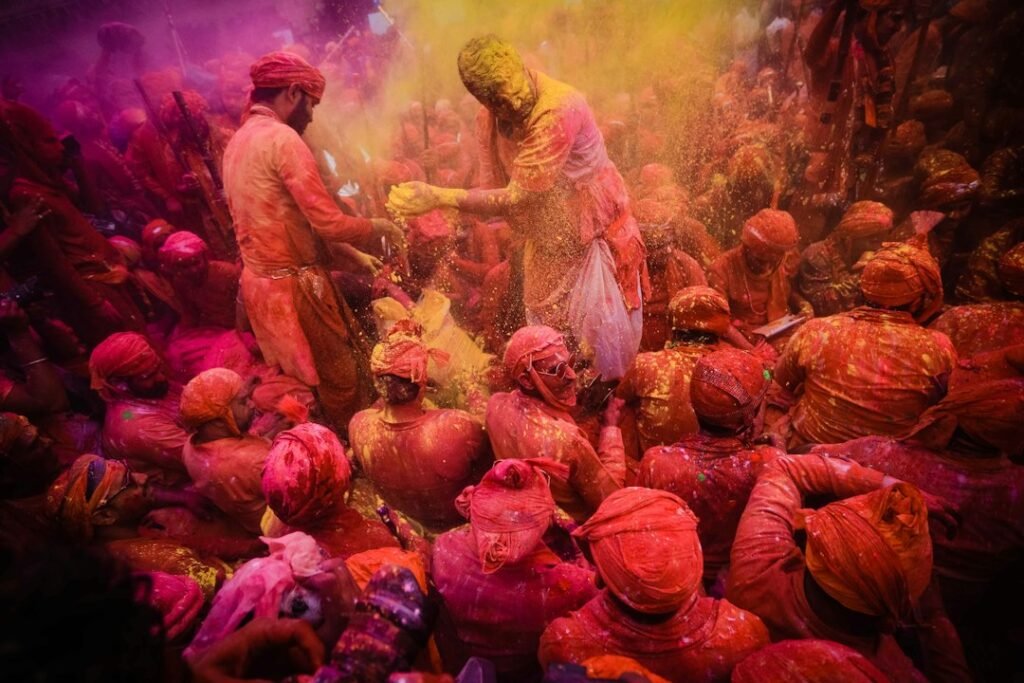
In this investigation
Colour looks immediate, almost biological: red is red, white is white, black is black. Yet the meanings attached to those colours can change dramatically across cultures. White can signal purity in one setting and mourning in another. Red can mark danger, marriage, political power, blood, luck or sacred energy. Saffron can identify renunciation, nationalism or religious devotion depending on context.
This makes ritual colour one of the clearest examples of how biology and culture interact. Human visual systems share broad similarities, and modern research finds recurring emotional associations with lightness, saturation and hue. But societies build symbolic systems on top of those perceptual tendencies. Material availability, religion, political history, status and ritual practice can all transform what a colour means.
Humans do not see colour as pure culture or pure biology
Colour perception depends on the physical spectrum of light, the eye’s photoreceptors and neural processing. These biological systems place real constraints on how humans distinguish colours.
But naming and interpreting colour is cultural. Languages divide the visible spectrum into categories in different ways, and societies attach different concepts to those categories. The classic work of Brent Berlin and Paul Kay, followed by the World Color Survey, showed both cross-linguistic regularities and important variation in how languages organize basic colour terms.
THE CORE DISTINCTION
Humans share a visual system, but colour meanings are not simply built into wavelength. Ritual symbolism is learned, transmitted and historically layered.
Some colour-emotion associations really do recur widely
A large systematic review published in 2025 examined 132 peer-reviewed studies involving more than 42,000 participants across 64 countries. It found recurring associations between colour categories and emotional dimensions.
Light colours were generally associated with more positive affect and dark colours with more negative affect. Red tended to be associated with high-arousal positive and negative emotions. Yellow and orange were often linked with positive high-arousal emotions, while blue and green were more often linked with lower-arousal positive states.
These regularities matter, but the review also emphasized that association is not the same thing as direct emotional causation. Knowing that people associate red with arousal does not prove that placing red cloth in a ritual will reliably produce the same physiological state in every participant.
Cross-cultural similarity exists alongside cultural difference
A major study involving 4,598 participants from 30 nations found substantial similarity in colour-emotion associations across countries. Yet nation, language and geographic proximity still predicted meaningful differences.
This is exactly what ritual colour would lead us to expect. Some associations may draw on broadly shared perceptual or environmental experience, while cultural history modifies and sometimes reverses them.
Red is one of the clearest examples of multiple meanings
Red is visually salient and closely associated with blood, fire, ripe fruit and bodily arousal. Across cultures it often attracts strong emotional meaning.
But that meaning is not fixed. Red can signal danger, prohibition and aggression in modern Western settings. In Chinese culture, red is strongly associated with happiness, celebration and weddings. In many Indian traditions, red is connected with marriage, fertility, auspiciousness and goddess imagery.
A 2026 Chinese study found implicit associations between red and happiness as well as red and weddings. That demonstrates how cultural learning can become deeply embedded enough to appear in rapid psychological responses.
Indian wedding red is historical and social, not merely biological
Red clothing, sindoor, alta and other red materials can appear in South Asian marriage and fertility contexts. It is tempting to explain all of this through one biological theory—blood, sexuality or arousal—but that would be too simple.
Ritual traditions accumulate associations over centuries. Red becomes meaningful because religious imagery, family practice, textiles, marriage customs and repeated public use reinforce one another.
White can signify purity and mourning at the same time
In many Western Christian settings, white is associated with purity, baptism, weddings and resurrection. Yet in South Asia and parts of East Asia, white has also been strongly associated with mourning and death.
There is no contradiction once context is considered. White can represent removal of decoration, simplicity, renunciation, absence of ordinary colour or transition away from worldly life. A colour does not need one universal emotional meaning to function coherently inside a ritual system.
Black mourning in Europe is historically learned rather than biologically inevitable
Black became strongly associated with mourning in many European societies, especially among elites and later wider populations. Material history mattered: producing deep, stable black dyes could be expensive, and formal mourning dress became embedded in court and social etiquette.
The association between darkness and negative affect may have helped the symbolism feel intuitive, but social history determined how black became institutionalized as proper mourning attire.
Saffron shows how material, religious and political meanings accumulate
Saffron, ochre and related orange-yellow tones carry strong religious associations in South Asia. Hindu renunciants may wear saffron or ochre robes, while Buddhist monastic robes across regions range through yellow, orange, ochre, brown and maroon depending on textile traditions and available dyes.
The colour can signify renunciation, sacred identity, monastic discipline or religious belonging. In modern politics, saffron has also acquired strong ideological associations. The colour did not change physically; the social meanings layered onto it did.
Purple became royal partly because it was expensive
One of the clearest examples of material economics shaping symbolism is Tyrian purple in the ancient Mediterranean. The dye was laborious to produce from marine molluscs and became associated with elite status, imperial power and restricted privilege.
Purple did not become royal because humans possess an innate “royalty receptor” for violet wavelengths. Scarcity, production cost and political regulation created the association, which later acquired symbolic life beyond the original dye economy.
Gold and yellow can signal sacredness because materials signal value
Gold is visually distinctive, resistant to corrosion and historically expensive. Its colour therefore becomes associated with wealth, sunlight, divinity and permanence in many ritual arts.
When sacred images are gilded or temples decorated with gold-coloured surfaces, the symbolism draws partly from material value. The colour inherits meaning from the substance.
Blue often links sky, water and transcendence—but not universally
Blue commonly evokes sky and water, and cross-cultural research often finds positive, lower-arousal associations with blue. Religious art can build on those environmental associations.
Yet blue’s sacred meanings differ across traditions. In Indian iconography, deities such as Krishna and Vishnu are frequently represented with blue or blue-black skin, where colour carries theological and artistic significance rather than a simple psychological message of calm.
Colour meanings can emerge from ordinary environmental statistics
Some associations arise because colours repeatedly co-occur with things in the world. Green is connected with vegetation and growth. Red appears in blood, fire, fruit and warning signals. Blue dominates open sky and large bodies of water.
Cross-modal research shows that colour associations are influenced by experience and semantic learning. A 2014 cross-cultural study of colour-odour associations found both regularities and cultural differences, supporting the idea that repeated environmental and linguistic exposure shapes how colours acquire meaning.
Ritual repetition turns association into convention
A bride sees earlier brides in red. A mourner sees generations dressed in white or black. A monk enters an order whose robes already carry centuries of meaning.
Repeated ritual use stabilizes the association. Eventually the colour alone can invoke the ritual category even outside the ceremony.
Context can reverse a colour’s meaning
Red on a wedding garment, red on a traffic signal and red on a financial-loss chart are physically similar stimuli but socially different messages.
Psychological research increasingly emphasizes this context dependence. Colour does not act like a drug with one fixed effect. Meaning depends on object, setting, task and learned association.
THE EVIDENCE LIMIT
Colour-emotion associations are real and measurable, but claims such as “blue always calms,” “red always energizes” or “white universally means purity” are too strong.
Colour psychology is often oversold
Popular colour psychology frequently presents simple rules: red increases appetite, blue improves productivity, green heals, purple inspires creativity. Scientific reviews are much more cautious.
Many studies are small, context-sensitive or difficult to replicate. Association effects are often stronger than direct behavioural effects. A person may reliably connect black with sadness without becoming measurably sad simply because a wall is painted black.
Ritual colour is also a communication technology
Colour is visible quickly and at a distance. It can identify role before speech occurs: priest, monk, bride, widow, soldier, political supporter or initiate.
This makes colour efficient for ritual organization. Participants do not need to explain their status repeatedly; clothing and objects make it legible.
Uniform colours create group identity
Shared clothing colours reduce visible individual difference and emphasize membership. Monastic robes, religious vestments, political colours and ceremonial uniforms all use this principle.
The same mechanism can create solidarity internally and strong boundaries externally.
Colour can regulate hierarchy
Some societies historically restricted particular dyes, fabrics or colours to specific ranks. Sumptuary rules turned appearance into an enforceable social code.
When costly pigments or dyes were difficult to produce, controlling colour could visibly preserve class distinction.
Religious calendars can change colour over time
Christian liturgical traditions, for example, developed colour systems in which vestment colours vary with feast, penitential season or celebration. These systems were historically standardized rather than universally present from the beginning of Christianity.
This demonstrates how ritual colour codes can become more elaborate over time rather than descending unchanged from origins.
Mourning colour communicates social state
Mourning clothing lets others know that a person is undergoing a socially recognized transition. That can change expectations about behaviour, celebration, work and emotional expression.
The colour therefore does social work even if it has no direct physiological effect. It makes private loss publicly legible.
Wedding colour does the opposite kind of signalling
Wedding attire marks a person as entering a new social status. Bright, rare or highly decorated colours make the transition visible and memorable.
Different societies choose different palettes because the key function is not one wavelength; it is ritual distinction.
Colour meanings change when materials change
Synthetic dyes transformed colour availability in the nineteenth century. Shades that were once rare or expensive became cheap.
That technological change can weaken old status associations or allow ritual colours to spread beyond elites.
Photography and screens introduce another shift
Modern ritual colour is increasingly designed for cameras, digital screens and social media. Saturation, lighting and filters alter what participants and remote audiences see.
A colour tradition may therefore remain culturally stable while its visual presentation changes technologically.
Language can preserve distinctions that outsiders miss
English colour words do not map perfectly onto every language’s categories. A term translated as “blue,” “green,” “red” or “white” may cover a somewhat different range or carry additional social meanings.
Researchers should therefore be cautious when comparing ritual colour categories across languages using English labels alone.
Universalism and relativism are both incomplete by themselves
One extreme claims colour symbolism is biologically universal. The other claims all colour meaning is arbitrary cultural invention.
Modern evidence supports a mixed model. Human perception and environmental regularities create some shared tendencies. Language, history, religion and convention then reshape those tendencies into specific symbolic systems.
What survives scrutiny?
- Humans share biological constraints on colour perception, but cultures divide, name and interpret colour differently.
- Large cross-cultural studies find broad regularities in colour-emotion associations alongside meaningful national and linguistic differences.
- Red commonly carries high-arousal meanings, but can signal danger, love, marriage, luck, fertility or power depending on context.
- White can signify purity in some rituals and mourning in others.
- Black mourning in Europe and purple royalty in the Mediterranean were shaped partly by social and material history, not universal psychology alone.
- Saffron, ochre and related colours accumulated religious meanings through repeated historical use.
- Colour can make ritual identity, hierarchy and transition immediately visible.
- Ritual repetition stabilizes learned colour associations across generations.
- Popular “colour psychology” often overstates direct causal effects on mood and behaviour.
- The strongest explanation combines perceptual tendencies with cultural learning, material history and context.
The Tradivior Evidence Profile
Historical Authenticity — Strong. Ritual colour systems are extensively documented in clothing, mourning, weddings, religious art, political symbolism and status regulation across civilizations.
Original-Purpose Evidence — Strong. Identity, status, mourning, celebration, sacred distinction and role recognition are historically visible functions.
Scientific Mechanism — Moderate. Shared visual processing, salience, arousal, environmental statistics and learned association provide plausible mechanisms for recurring colour meanings.
Experimental Evidence — Moderate. Cross-cultural colour-emotion associations are well supported, but direct behavioural and emotional effects of colour are more context-dependent.
Cross-Cultural Evidence — Strong. Colour symbolism appears widely, but the same colours can acquire different or opposite ritual meanings.
Modern Relevance — Strong. Colour remains central to religion, mourning, weddings, politics, branding, identity and public communication.
The Tradivior Conclusion
Partially Supported. Ritual colour is not arbitrary, but neither is there a universal code hidden in human biology. Modern research finds broad cross-cultural regularities in colour-emotion associations, especially around lightness, arousal and salient hues such as red. Yet history, language, materials, religion and repeated ritual use strongly shape what specific colours mean. The same colour can therefore carry opposite meanings without either culture being irrational. Ritual colour survives scrutiny as a powerful communication system built from both shared perception and learned cultural convention.
Continue investigating
- Why Do Mourning Clothes Change Colour Across Cultures?
- Why Do Married Indian Women Wear Sindoor, Mangalsutra and Other Marriage Markers?
- Why Do Hindus Mark the Forehead With Tilak, Bindi or Vibhuti?
Sources and further reading
- Berlin B, Kay P. Basic Color Terms: Their Universality and Evolution. University of California Press; 1969.
- Kay P, Berlin B, Maffi L, Merrifield WR, Cook R. World Color Survey. CSLI Publications; 2010.
- Jonauskaite D, et al. “Universal Patterns in Color-Emotion Associations Are Further Shaped by Linguistic and Geographic Proximity.” Psychological Science. 2020. PMID: 32900287.
- “Do we feel colours? A systematic review of 128 years of psychological research linking colours and emotions.” 2025. PMID: 39806242.
- Schloss KB, et al. “A systematic investigation of conceptual color associations.” 2020. PMID: 31763867.
- Kawai C, et al. “The good, the bad, and the red: implicit color-valence associations across cultures.” Psychological Research. 2023;87(3):704–724. PMID: 35838836.
- “Implicit representations of red color in Chinese culture.” 2026. PMID: 42308905.
- Levitan CA, et al. “Cross-cultural color-odor associations.” 2014. PMID: 25007343.
- Historical scholarship on Tyrian purple, sumptuary regulation, liturgical colour, mourning dress and South Asian ritual colour traditions.
Continue exploring

Partially Supported
Why Is the Ganga Sacred?
The Ganga is river, goddess, pilgrimage route, purifier and national symbol. Tradivior will trace how these layers developed and evaluate modern claims about unusual self-purifying properties without confusing microbial findings…

Evidence Supported
Why Do Cultures Set Aside Days to Remember the Dead?
From Pitru Paksha and Qingming to Día de Muertos and All Souls’ Day, cultures repeatedly create calendar time for the dead. Tradivior will compare how recurring remembrance renews kinship, grief…
Partially Supported
Why Do People Keep Ashes, Relics and Memorial Objects?
Hair, ashes, bones, clothing, photographs and relics allow the dead to remain materially present. Tradivior will examine why objects carry memory so powerfully and how continuing bonds differ from pathological…
Historically Practical
Why Do Cultures Preserve the Dead?
Mummification, embalming, freezing, smoking and desiccation reflect very different beliefs about bodies and afterlives. Tradivior will compare preservation traditions with the chemistry of decomposition and the practical limits of each…
Picked for your curiosity
Enable JavaScript to build a reading profile and see recommendations.