 tradivior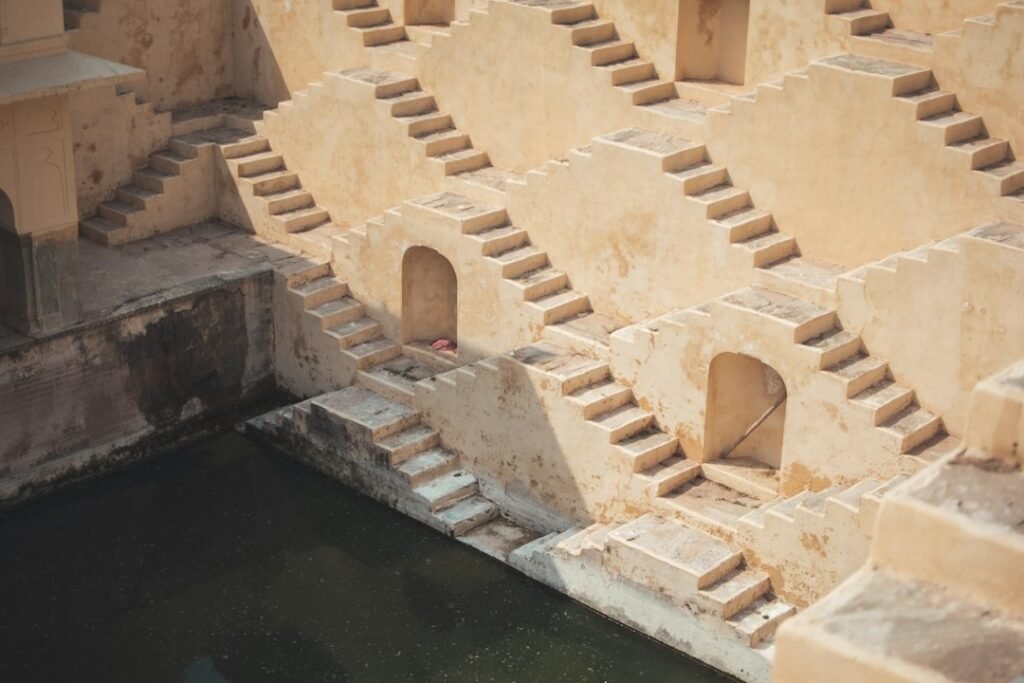
In this investigation
Water sources are easy to damage and difficult to replace. A spring can be polluted by washing or waste. A pond can be silted by grazing and erosion. A forested catchment can dry when vegetation is cleared. Before modern water departments and contamination testing, many communities protected shared water through custom, taboo and ritual.
Some rules made springs sacred. Some forbade cutting trees around tanks. Some restricted washing, bathing or animal access at drinking-water points. Others assigned cleaning duties to particular families or linked annual maintenance to festivals.
These practices can produce real ecological benefits. But they should not automatically be romanticized. Rules concerning purity and access have also excluded lower-status groups, women or outsiders. A water system can be environmentally effective and socially unequal at the same time.
Shared water creates a classic collective-action problem
Everyone benefits from a clean well, spring or tank. But maintenance requires labour and restraint. If each household takes water while leaving cleaning to someone else, the system deteriorates.
Customary rules solve this by turning maintenance into obligation. The rule may be religious, political or social; its practical effect is to coordinate behaviour around a shared resource.
THE SOCIAL TECHNOLOGY
Ritual rules can act like informal regulation: they define who may enter, what activities are forbidden, when cleaning occurs and what sanctions follow violation.
Sacredness can protect catchments as well as water itself
A spring depends on the land that feeds it. Vegetation slows runoff, stabilizes soil and supports infiltration. If a sacred grove surrounds a source, protecting the grove can indirectly protect the water.
Research on Indian sacred groves repeatedly documents their role as micro-watersheds and refuges for springs and streams.
Recent spatial research supports the link between groves and drainage
A 2025 study of 392 sacred groves along India’s Malabar Coast found that grove distribution was closely related to stream and drainage networks. The authors argue that these faith-protected forest patches function much like riparian conservation systems.
The finding is important because it demonstrates a measurable hydrological consequence without requiring us to claim that communities originally protected groves using modern watershed science.
Social fencing can be as powerful as physical fencing
Sacred groves and holy water sources are often protected by taboo rather than walls. People refrain from cutting, hunting, washing or polluting because they fear divine punishment, social condemnation or loss of ritual standing.
Conservation literature sometimes describes this as “social fencing”: community belief creates an exclusion boundary even without formal enforcement.
Ritual sanction can solve the enforcement problem cheaply
Formal enforcement requires inspectors and penalties. Sacred rules move part of enforcement into conscience and community reputation.
A person may avoid contaminating a spring even when nobody is watching because violation is believed to offend a deity or ancestor.
Water purity rules sometimes align with microbiological hygiene
Separating drinking water from bathing, laundry, livestock and waste can reduce contamination. Covered wells, restricted access and clean drawing vessels can also lower exposure to pathogens.
These benefits do not prove communities understood germ theory. A practice can be hygienically useful because generations observed that some forms of handling led to bad taste, smell, illness or visible fouling.
THE EVIDENCE RULE
Modern microbiology can explain why a rule reduces contamination. It cannot by itself establish why the rule was historically created.
Community tanks require periodic collective maintenance
Traditional tanks and ponds accumulate silt, vegetation and debris. Channels clog. Embankments erode.
Linking maintenance to calendrical events, festivals or community obligation helps ensure that repair occurs before monsoon or irrigation demand.
Ritual calendars can schedule practical work
A festival can gather many households at one time. Once assembled, people can clean a tank, repair a channel or clear vegetation.
The ritual creates motivation and coordination that a purely technical instruction may not achieve.
Sacred wells can stabilize rules of access
Wells are vulnerable to overuse and contamination. Communities often regulate when water may be drawn, what vessels may be used and who is responsible for upkeep.
Such rules can preserve order during scarcity—but the same restrictions can also encode social hierarchy.
Purity rules can become exclusionary
In caste-stratified societies, water sources have historically been sites of discrimination. Lower-caste communities could be denied access to wells used by dominant groups.
This is not an ecological benefit. A rule protecting water quality and a rule protecting social hierarchy must be evaluated separately even if both are described using the language of purity.
Women often carried the labour cost of water rules
Where women collect household water, restrictions on access distance, timing or source choice can increase daily labour dramatically.
A conservation system should therefore be judged partly by who bears its costs.
Temple tanks combine ritual, water storage and urban form
Across South India and elsewhere, temple tanks store water within sacred landscapes. They can support ritual bathing, groundwater recharge, water storage and urban drainage.
The combination of religious importance and hydraulic function makes maintenance culturally visible.
Stepwells show that hydraulic infrastructure could become sacred architecture
Indian stepwells demonstrate how water engineering, patronage and religious symbolism could merge. Water access became monumental, shaded and socially important.
Architecture reinforced the idea that water infrastructure deserved care and public investment.
Sacred rivers create a different scale of problem
Declaring a river sacred can strengthen emotional attachment and discourage some forms of disrespect. But large rivers receive pollution from cities, industry, sewage and agriculture beyond the reach of local ritual rules.
Sacred status alone cannot substitute for modern wastewater infrastructure and regulation.
Ritual use can itself create pollution
Offerings, immersion materials, ash, plastics and mass gatherings can burden water bodies when rituals expand in scale or use non-biodegradable materials.
This is another reason not to equate sacredness automatically with conservation.
Traditional rules work best when local communities retain authority
Customary systems depend on shared belief and enforcement. When local institutions weaken, taboos may lose force.
Colonial forest and water administration sometimes displaced community control, while modern development can disconnect people from older maintenance institutions.
Formal law can support or undermine customary protection
Government protection can strengthen sacred landscapes when it recognizes community management. It can also fail if regulation excludes the people whose practices maintained the site.
The strongest contemporary approaches combine ecological science with legitimate local governance.
Water taboos can act as resource-allocation rules
Some customs limit drawing water during drought, restrict irrigation timing or prioritize drinking water over other uses.
These are practical scarcity-management systems even when expressed through ritual language.
Sacredness can increase willingness to protect long-term benefits
Groundwater recharge and catchment protection produce benefits slowly. Individuals may be tempted to cut trees or overdraw water for immediate gain.
A sacred rule can raise the moral cost of short-term exploitation.
But sacred status cannot guarantee equitable governance
A community can protect a spring while denying access to outsiders. Conservation and justice are different dimensions.
Modern management therefore needs to preserve useful ecological rules without preserving discriminatory access.
Climate change increases the value of protected recharge zones
More erratic rainfall increases the importance of infiltration, shade and local storage. Forested sacred catchments may therefore gain new significance as climate-adaptation assets.
The 2025 Malabar study explicitly frames sacred groves near drainage networks as nature-based solutions for local climate adaptation.
Traditional protection can complement modern water testing
Ritual rules are good at shaping behaviour. Modern science is better at detecting pathogens, heavy metals and chemical contamination invisible to the senses.
The two can complement each other: protect the source culturally, test it scientifically.
What survives scrutiny?
- Communities across India and elsewhere have used ritual and customary rules to regulate springs, wells, tanks and sacred water landscapes.
- Protecting vegetation around sources can preserve recharge, reduce erosion and stabilize water flow.
- Sacred groves often function as micro-watersheds and local biodiversity refuges.
- Recent spatial research on the Malabar Coast supports a relationship between sacred groves and stream networks.
- Restrictions on washing, livestock or waste near drinking sources can reduce contamination.
- Ritual calendars can coordinate collective cleaning and maintenance.
- Sacred status does not automatically prevent pollution, especially at river scale or during mass ritual use.
- Purity rules have sometimes encoded caste and gender exclusion without ecological benefit.
- Useful conservation effects should be preserved without reproducing discriminatory access.
- Modern water management is strongest when customary protection is combined with scientific testing, infrastructure and equitable governance.
The Tradivior Evidence Profile
Historical Authenticity — Strong. Ritualized and customary protection of water sources, sacred groves, tanks and springs is widely documented.
Original-Purpose Evidence — Moderate to Strong. Sacredness, purity, collective maintenance and resource regulation are documented motives, though conservation was not always explicitly framed in modern ecological terms.
Scientific Mechanism — Strong. Vegetation protection, access control, sanitation, erosion reduction and infiltration provide clear hydrological and public-health mechanisms.
Experimental Evidence — Moderate. Ecological and spatial studies support watershed and biodiversity benefits, while direct causal tests of specific ritual rules remain limited.
Cross-Cultural Evidence — Strong. Sacred springs, wells, groves and water taboos occur in many societies.
Modern Relevance — Strong. Community protection remains relevant to recharge, sanitation, biodiversity and climate adaptation when combined with equitable access and scientific monitoring.
The Tradivior Conclusion
Partially Supported—with strong practical mechanisms. Ritual rules around water sources can produce real environmental and hygiene benefits by protecting catchments, regulating access and coordinating maintenance. Modern research supports the ecological importance of sacred groves and riparian protection. But conservation was not always the original purpose, and some purity rules enforced social exclusion rather than environmental protection. The tradition survives scrutiny best as community governance expressed through sacred language—valuable when its ecological functions are retained and its inequities are removed.
Continue investigating
- Why Were Sacred Groves Protected in India?
- Why Is the Ganga Sacred?
- Why Do Religions Purify With Water?
Sources and further reading
- Behera HC, Singh D, Kumar KA. “Water, Sacred Culture and Conservation in India: An Anthropological Overview.” 2025.
- Research on sacred groves and riparian conservation on the Malabar Coast of India. Landscape Research. 2025.
- Ormsby AA, Bhagwat SA. “Sacred forests of India: a strong tradition of community-based natural resource management.” Environmental Conservation. 2010.
- FAO documentation on sacred groves in India and their ecological, hydrological and community-management functions.
- Singh S, et al. “Sacred Groves: Myths, Beliefs, and Biodiversity Conservation—A Case Study from Western Himalaya, India.” International Journal of Ecology. 2017.
- Research on sacred-grove management, micro-watersheds, ritual taboos and local water conservation in India.
Continue exploring

Why Is the Ganga Sacred?
The Ganga is river, goddess, pilgrimage route, purifier and national symbol. Tradivior will trace how these layers developed and evaluate modern claims about unusual self-purifying properties without confusing microbial findings…

Why Do People Keep Ashes, Relics and Memorial Objects?
Hair, ashes, bones, clothing, photographs and relics allow the dead to remain materially present. Tradivior will examine why objects carry memory so powerfully and how continuing bonds differ from pathological…

Why Do Cultures Set Aside Days to Remember the Dead?
From Pitru Paksha and Qingming to Día de Muertos and All Souls’ Day, cultures repeatedly create calendar time for the dead. Tradivior will compare how recurring remembrance renews kinship, grief…

Why Do Cultures Preserve the Dead?
Mummification, embalming, freezing, smoking and desiccation reflect very different beliefs about bodies and afterlives. Tradivior will compare preservation traditions with the chemistry of decomposition and the practical limits of each…
Picked for your curiosity
Enable JavaScript to build a reading profile and see recommendations.