 tradivior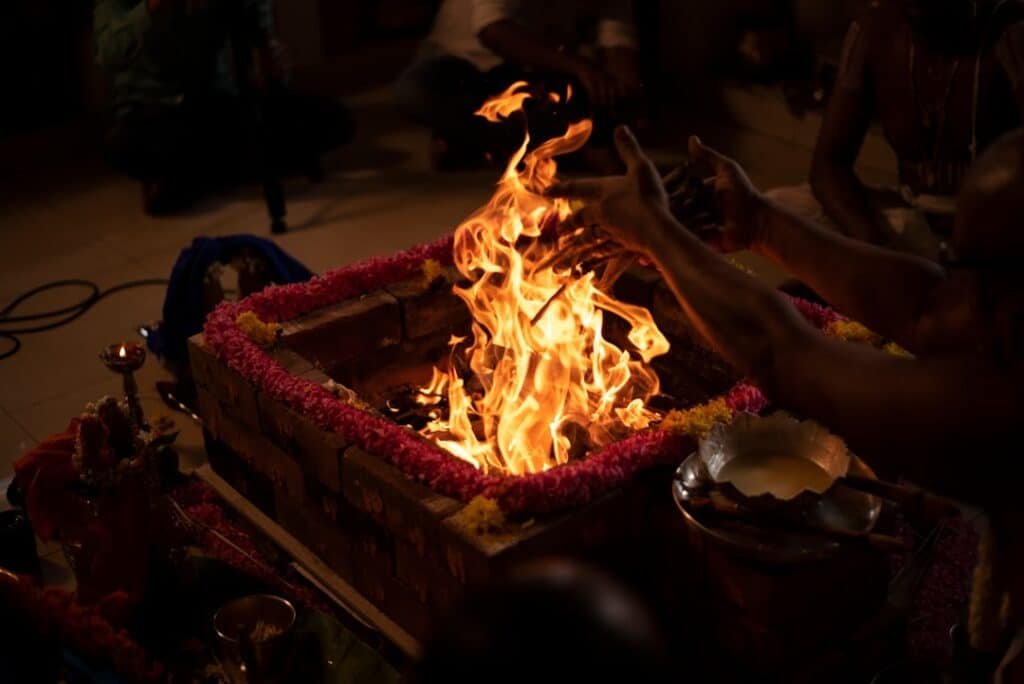
In this investigation
Few things humans learned to control changed life as radically as fire. Fire cooks food, gives warmth, produces light, deters predators, transforms clay and metal, clears vegetation, sterilizes surfaces, destroys bodies and gathers people around a visible centre. It is both useful and dangerous, ordinary and uncontrollable.
Across civilizations, those properties became religious material. Vedic ritual made Agni the messenger who carries offerings to the gods. Zoroastrian practice made fire a central symbol of truth, purity and divine presence. Greek and Roman households maintained sacred hearths. Lamps and flames appear in temples, churches, shrines, funerals, initiations and public ceremonies around the world.
The recurring pattern tempts a simple explanation: humans worshipped fire because it was useful. Utility clearly matters. But religious traditions did not merely thank fire for cooking dinner. They built different theologies around transformation, purity, presence, sacrifice, judgment, continuity and cosmic order. Fire’s physical properties created a uniquely powerful symbolic medium; culture supplied the meaning.
Fire was important to humans long before written religion
Archaeological evidence for early fire use is complex because burnt material can result from natural wildfire as well as human activity. Researchers therefore distinguish opportunistic use, maintenance of naturally acquired fire, habitual use and the ability to produce fire deliberately.
Evidence of burnt material appears at some very early hominin sites, but regular controlled fire becomes much clearer later in the Pleistocene. By the Middle Pleistocene, recognizable hearths appear at many sites and fire had become a recurring focus of human activity.
THE HISTORICAL CAUTION
Human use of fire is far older than surviving written religions. That makes fire’s practical importance relevant to later symbolism, but it does not allow archaeology to tell us exactly what prehistoric people believed about flames.
Cooking made fire part of daily survival
Heat changes food. Cooking softens many plant tissues, denatures proteins, gelatinizes starch, reduces some toxins and can make calories easier to access.
Richard Wrangham’s influential cooking hypothesis proposes that dependence on cooked food had major evolutionary consequences for Homo. The timing remains debated because archaeological evidence for habitual fire is uneven, but there is broad agreement that cooking eventually became a major human technology.
Warmth allowed humans to occupy colder environments
Fire provides a portable microclimate. A hearth allows people to survive cold nights and extend activity into environments that would otherwise demand heavier biological adaptation or shelter.
This practical power is easy to underestimate in modern heated buildings. For much of human history, maintaining fire could be a direct condition of survival.
Light extended the human day
Fire changes darkness from a hard stop into social time. Hearthlight allows conversation, craft, storytelling, ritual and food preparation after sunset.
Anthropological theories of fire and sociality suggest that evening firelight helped create distinctive periods of low-work, high-conversation interaction. The evidence is indirect for deep prehistory, but the mechanism is obvious: light changes what people can do after dark.
The hearth became a natural social centre
A fire radiates heat and light in all directions, encouraging people to gather around it. Food preparation also concentrates activity near the same point.
This makes the hearth more than a tool. It becomes a spatial organizer. Where the fire is placed can determine where people sit, work, talk and sleep.
Fire is visually unlike most other useful technologies
A stone tool is inert. Fire moves, consumes, changes colour, produces sound and transforms whatever enters it. It is visibly active without being alive.
That ambiguity makes fire unusually available for symbolic thought. It looks like a process rather than an object.
Transformation is the central physical property behind many sacred meanings
Fire turns wood into ash, clay into pottery, ore into metal and raw food into cooked food. It destroys one form while producing another.
Religions repeatedly use this visible transformation to symbolize purification, sacrifice, death, rebirth and transmission.
Vedic religion made Agni both fire and divine mediator
The Rigveda opens with a hymn to Agni, one of the most prominent Vedic deities. Agni is not merely the physical flame. He is priest, messenger and receiver of offerings.
In sacrificial ritual, offerings placed into fire are transmitted to the gods. The physical process of combustion becomes a religious process of communication.
Sacrifice makes fire a boundary-crossing technology
An offering placed on the ground remains visible. An offering placed in fire disappears into flame, smoke and ash.
That disappearance provides an intuitive material model for transfer from the human world to an unseen divine realm. The offering is visibly changed rather than merely abandoned.
Vedic ritual also turned fire into social continuity
Domestic and sacrificial fires could be maintained as part of household and ritual identity. Fire was linked to marriage, offerings, life-cycle rites and priestly performance.
Continuity of flame could therefore symbolize continuity of household, lineage and obligation.
The Hindu wedding fire is a witness, not a scientific instrument
In many Hindu wedding traditions, the couple circumambulates sacred fire and makes vows in its presence. The fire functions as divine witness and ritual centre.
Modern explanations sometimes claim that walking around fire sterilizes the air or produces therapeutic gases. Those ideas are unnecessary to explain the rite historically. The strongest evidence is religious and social: Agni witnesses and mediates the union.
Zoroastrianism gives fire a different theological role
Zoroastrian traditions also place fire at the centre of ritual life, but it would be misleading to describe the religion as simple “fire worship.” Fire functions as a symbol and medium of purity, truth and divine order.
Encyclopaedia Iranica notes that fire and water are central ritual elements, and that the domestic hearth historically served as a religious focus before the development of formal fire temples.
Zoroastrian sacred fire is associated with truth and judgment
In Zoroastrian thought, fire is connected with aša—truth, order and righteousness. Eschatological traditions also use fire and molten metal as images of final judgment.
The symbolic logic differs from Vedic sacrifice. Similar material—fire—supports a different theology.
THE CROSS-CULTURAL LESSON
Fire’s physical properties recur everywhere. The meanings do not. Shared material affordances can generate repeated sacred use without implying one universal theology or one historical origin.
Greek and Roman religion made the hearth a political symbol
In ancient Greek households, Hestia represented the hearth, domestic order and continuity. Public hearths also carried civic meaning.
Roman Vesta played a related but distinct role. The sacred fire of Vesta was maintained by the Vestal Virgins and symbolized the continuity and security of Rome itself.
An eternal flame turns continuity into something visible
A fire that must not go out creates a simple but powerful ritual problem. Every generation has to maintain what the previous generation maintained.
The flame therefore becomes a physical chain through time.
Household hearths can define belonging
In many traditions, establishing a new household historically involved establishing a new hearth. The fire marks the place where food is cooked, family gathers and domestic rites occur.
“Hearth and home” remains a powerful phrase because the association between fire and household identity persisted long after central heating replaced open flames.
Fire purifies—but it also pollutes
Heat can kill many pathogens. Burning can destroy contaminated objects. Cremation can rapidly transform a corpse.
These real physical effects help explain why purification metaphors feel plausible. But smoke itself contains harmful particles, and burning can spread toxic compounds. Fire is not universally cleansing in a biomedical sense.
Modern microbiology should not be projected backward casually
A ritual fire may incidentally reduce microbes on an object or heat a space. That does not show that ancient practitioners understood pathogens or designed the rite as sterilization.
Historical purpose must come from historical evidence, not from a modern mechanism discovered afterward.
Smoke has antimicrobial chemistry—but exposure is not automatically healthy
Burning certain plant materials releases volatile compounds that can inhibit microbes under laboratory conditions. Traditional fumigation practices may therefore have real biological effects.
At the same time, smoke from biomass combustion is a major source of fine particulate matter and can harm respiratory health. A ritual can have antimicrobial chemistry and still create inhalation risk.
Incense and sacred smoke use fire to carry scent into space
Combustion makes aromatic resins, woods and herbs volatile. Their scent fills a room and marks the environment as ritually different.
This gives fire another religious function: it transforms solid plant material into an invisible sensory atmosphere.
Flame is easy to use as an attention anchor
A flame is bright, dynamic and visually contained. It naturally draws the eye. Lamps and candles therefore work well in prayer, vigil and meditation.
The attentional effect is psychologically plausible without requiring claims that flame emits a unique spiritual frequency.
Candlelight changes emotional atmosphere
Low light reduces visual detail and can focus attention on faces, icons or the flame itself. Flicker adds movement while leaving the broader environment subdued.
This sensory design helps explain why flame remains powerful in ceremonies even after electric lighting becomes available.
Fire is one of the few ritual materials that consumes the offering
Water washes an object. Earth buries it. Fire visibly destroys it.
That irreversible transformation makes fire especially suited to sacrifice, oath, disposal and rites marking a point of no return.
Cremation turns bodily transformation into ritual
In Hindu cremation traditions, fire rapidly transforms the corpse and plays a central role in funerary transition. Other cultures have also used cremation for religious, practical or political reasons.
Fire’s destructive capacity becomes symbolically linked to release, separation or purification, depending on the tradition.
The physical hygiene of cremation is not enough to explain it
Burning a corpse can reduce many biological hazards, but burial and other funerary systems can also be managed safely.
The persistence of cremation therefore cannot be reduced to sanitation. Theology, cosmology and ritual obligation matter.
Fire is a powerful boundary between ordinary and sacred time
Lighting a lamp can begin worship. Extinguishing candles can close a vigil. Bonfires can mark seasonal festivals.
The simple act of ignition creates a visible threshold: before the flame and after the flame.
Seasonal fires can dramatize cosmic cycles
Fire festivals appear around solstices, harvests, spring transitions and new-year periods in many regions. Their meanings vary: cleansing, protection, fertility, renewal, warding off danger or celebrating light.
The repeated association between fire and seasonal transition is understandable because burning visibly destroys old material while producing light and heat.
Bonfires also create collective synchrony
A large communal fire gathers people into one visible event. Singing, dancing and procession become spatially organized around the flame.
The social mechanism can reinforce belonging independently of theological belief.
Landscape burning shows that sacred fire can overlap ecological management
Indigenous and traditional societies in many regions have used controlled burning to manage vegetation, improve hunting, encourage particular plants, reduce fuel loads or maintain open landscapes.
Some of these burning practices are embedded in ritual or cosmology. Others are primarily practical. They should not all be merged into one sacred-fire tradition.
Controlled burning can reduce severe wildfire risk under some conditions
Modern fire ecology recognizes that frequent low-intensity burning can reduce accumulated fuels in certain fire-adapted ecosystems. Cultural burning is now being reconsidered in Australia, North America and elsewhere.
But prescribed fire requires ecological knowledge, weather planning and safety. “Traditional burning” is not automatically safe in every landscape.
Fire can be both ecological tool and ecological catastrophe
The same process that renews some grasslands can destroy forests or peatlands under different conditions.
Fire’s sacred status never guarantees ecological wisdom. Outcomes depend on ecosystem, timing, intensity and frequency.
Metallurgy deepened fire’s association with transformation
Smelting turns ore into metal. Forging changes hardness and shape. Pottery kilns permanently transform clay.
Communities working with pyrotechnology repeatedly witnessed materials becoming something new through heat. That likely strengthened fire’s symbolic association with hidden power and transformation.
Smiths often acquire unusual ritual status
In several societies, metalworkers occupy socially distinctive roles. Their craft appears almost magical to observers unfamiliar with the chemistry: stone-like ore enters a furnace and metal emerges.
Fire is central to that transformation, connecting technology with myth and specialist status.
Fire can symbolize truth because it exposes and tests
Heat reveals material properties. Metals melt, organic matter burns, impurities separate.
Religious traditions can convert this physical testing into moral metaphor: truth survives fire, impurity is burned away, judgment reveals what is hidden.
Ordeals by fire turn metaphor into dangerous practice
Some legal and religious systems historically used fire or heated objects in ordeals intended to reveal innocence or divine judgment.
There is no scientific basis for assuming fire selectively harms the guilty. The practice shows how a powerful symbol can become a harmful decision mechanism.
Fire mythology often encodes the problem of obtaining control
Myths from different cultures describe fire as stolen, gifted, hidden, guarded or acquired from divine beings.
Such stories make sense because fire control is transformative and technically difficult. The myth dramatizes a genuine civilizational threshold without serving as literal history.
Prometheus is not the only fire-acquisition myth
Greek Prometheus is famous for stealing fire for humans, but comparable motifs appear elsewhere. Fire is often treated as something humanity did not originally possess.
The recurrence suggests that societies recognized fire as a special technology separating human life from ordinary nature.
Sacred fire can legitimize authority
Priests who maintain ritual fires control access to an important sacred medium. States that maintain public flames can symbolize political continuity.
Fire therefore becomes institutional power as well as religious symbol.
Keeping a flame alive requires continuous labour
An “eternal” fire is not self-sustaining. Someone must feed, guard and protect it.
The labour required creates ritual office, discipline and institutional continuity.
Extinguishing sacred fire can symbolize rupture
If continuity of flame represents continuity of household or community, extinction becomes symbolically serious.
Relighting may therefore require ritual rather than a casual match.
Modern memorial flames inherit ancient symbolic grammar
Eternal flames at tombs, war memorials and civic monuments are often secular rather than explicitly religious.
Yet the symbolism is familiar: light continues, memory continues, the dead are not forgotten.
The Olympic flame is a modern tradition using ancient imagery
The modern Olympic torch relay is not a continuous survival from ancient Greece. It was created in the twentieth century while deliberately drawing on classical imagery of flame, continuity and ceremony.
This demonstrates how easily fire can be reused to manufacture a sense of antiquity and shared identity.
Fire’s warmth encourages intimacy while its danger enforces distance
People move close enough to receive heat but far enough to avoid burns. A fire therefore structures bodily space naturally.
This may contribute to its ritual effectiveness: it creates a centre that attracts without being touched casually.
Flame is present but impossible to possess
A person can hold a lamp but cannot hold the flame itself. Fire has visible form without stable substance.
That quality makes it particularly suitable for representing spirit, presence and transformation.
Religious meaning does not require fire to have consciousness
Modern scientific description treats combustion as rapid oxidation releasing heat and light. That does not erase religious symbolism.
A physical mechanism and a cultural meaning answer different questions.
Nor does religious symbolism prove hidden scientific knowledge
The fact that fire kills some pathogens does not prove purification rites were designed from microbiology. The fact that cooking improves digestibility does not explain Vedic Agni. The fact that controlled burns manage fuel does not explain Zoroastrian fire temples.
Retrospective scientific explanations become misleading when they flatten distinct traditions into one utilitarian story.
Fire’s sacredness is best explained by affordances
An affordance is what a material allows people to do. Fire affords heat, light, cooking, destruction, transformation, gathering, signalling and disposal.
Those properties make fire unusually rich symbolic material. Different cultures select different affordances and turn them into theology.
This explains recurrence without assuming a single origin
Vedic, Zoroastrian, Greek and many other sacred-fire traditions need not descend from one primordial fire cult.
Humans everywhere encounter the same striking physical phenomenon. Independent religious elaboration is therefore entirely plausible.
What survives scrutiny?
- Controlled fire is one of humanity’s oldest and most consequential technologies.
- Fire provides cooking, warmth, light, protection, material transformation and social gathering.
- Vedic Agni functions as deity, priestly mediator and carrier of sacrificial offerings.
- Zoroastrian fire is central to ritual and symbolizes purity, truth and divine order rather than being a simple object of worship.
- Greek and Roman hearth traditions linked sacred fire with household and civic continuity.
- Fire’s ability to transform matter makes it especially suited to symbolism of sacrifice, purification, judgment and rebirth.
- Heat can kill pathogens and smoke can contain antimicrobial compounds, but ritual fire should not be retroactively explained as germ theory.
- Biomass smoke can harm respiratory health, so “sacred smoke” is not automatically medically beneficial.
- Cultural burning can produce real ecological benefits in some fire-adapted landscapes, but sacredness does not guarantee safe fire management.
- Fire’s sacred roles recur cross-culturally because the same physical affordances are available everywhere, while theological meanings remain culturally specific.
- No single ecological, medical or evolutionary mechanism explains all sacred-fire traditions.
The Tradivior Evidence Profile
Historical Authenticity — Strong. Sacred fire is extensively documented in Vedic, Zoroastrian, Greek, Roman and many other ritual traditions.
Original-Purpose Evidence — Strong. Sacrifice, divine mediation, purity, truth, household continuity, civic protection and memorialization are explicitly documented purposes, differing by tradition.
Scientific Mechanism — Strong. Cooking, heat, light, combustion, sterilization, material transformation and ecological burning are well-understood physical processes that help explain fire’s salience.
Experimental Evidence — Strong for fire’s physical effects; Limited for claims connecting those effects to historical religious origins. Modern science strongly establishes fire’s material consequences but cannot retroactively establish ancient intent.
Cross-Cultural Evidence — Strong. Sacred and ceremonial fire appears across many independent civilizations, with substantial variation in theology and practice.
Modern Relevance — Strong. Fire remains central to worship, memorials, cremation, festivals, cultural burning and domestic symbolism, while modern health and environmental knowledge clarifies its risks.
The Tradivior Conclusion
Historically Practical and Primarily Symbolic/Cultural—with strong material mechanisms. Fire became sacred in many societies because few natural forces are as useful, dangerous, transformative and visually compelling. Its practical role in cooking, warmth, light and technology made it central to human life, while its ability to consume and transform matter made it an unusually powerful religious medium. But shared physical properties do not imply one hidden universal origin. Vedic Agni, Zoroastrian sacred fire and Mediterranean hearth traditions developed distinct meanings. Fire survives scrutiny as a case where material power and symbolic imagination reinforce each other without being reducible to one another.
Continue investigating
- Why Is Fire Sacred in Hindu Wedding Rituals?
- Why Do Indians Wave Camphor Flame in Aarti?
- Why Did Some Traditional Landscapes Depend on Controlled Burning?
Sources and further reading
- Rigveda, especially opening hymns to Agni and sacrificial fire traditions.
- Encyclopaedia Iranica. “ĀTAŠ” and “Zoroastrian Rituals,” on fire, truth, domestic hearths and fire temples.
- Wrangham R. “Control of Fire in the Paleolithic: Evaluating the Cooking Hypothesis.” Current Anthropology. 2017;58(S16).
- Sandgathe DM. “Identifying and Describing Pattern and Process in the Evolution of Hominin Use of Fire.” Current Anthropology. 2017;58(S16).
- Gowlett JAJ. “The discovery of fire by humans: a long and convoluted process.” Philosophical Transactions of the Royal Society B. 2016.
- Attwell L, Kovarovic K, Kendal J. “Fire in the Plio-Pleistocene: the functions of hominin fire use, and the mechanistic, developmental and evolutionary consequences.” 2015. PMID: 25794155.
- Oxford Research Encyclopedia of Anthropology. “Fire Use.” 2020.
- Classical scholarship on Hestia, Vesta, household hearths and the Roman Vestal cult.
- Modern fire-ecology literature on cultural burning and prescribed fire in fire-adapted landscapes.
Continue exploring

Partially Supported
Why Is the Ganga Sacred?
The Ganga is river, goddess, pilgrimage route, purifier and national symbol. Tradivior will trace how these layers developed and evaluate modern claims about unusual self-purifying properties without confusing microbial findings…
Why Do People Keep Ashes, Relics and Memorial Objects?
Hair, ashes, bones, clothing, photographs and relics allow the dead to remain materially present. Tradivior will examine why objects carry memory so powerfully and how continuing bonds differ from pathological…
Why Do Cultures Set Aside Days to Remember the Dead?
From Pitru Paksha and Qingming to Día de Muertos and All Souls’ Day, cultures repeatedly create calendar time for the dead. Tradivior will compare how recurring remembrance renews kinship, grief…
Why Do Cultures Preserve the Dead?
Mummification, embalming, freezing, smoking and desiccation reflect very different beliefs about bodies and afterlives. Tradivior will compare preservation traditions with the chemistry of decomposition and the practical limits of each…
Picked for your curiosity
Enable JavaScript to build a reading profile and see recommendations.