 tradivior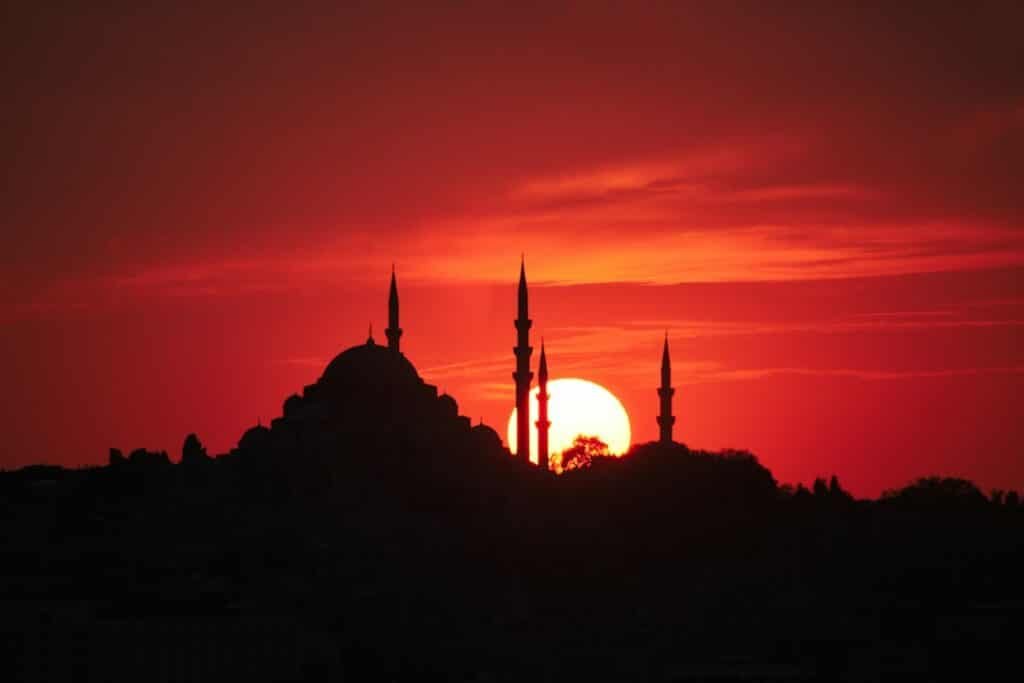
In this investigation
Religions divide the day into sacred hours because time itself can be ritualized. Dawn, noon, sunset and night are not only astronomical transitions; they are moments around which communities can organize prayer, identity and attention.
Christian canonical hours, Islamic salat, Hindu sandhya and other daily prayer traditions all turn recurring points in the day into religious obligations. Their meanings differ, but the social logic is comparable: a belief system becomes part of daily time rather than something reserved for festivals.
Before mechanical clocks, the sky was the clock
For most of history, ordinary people did not organize life around exact minutes. Sunrise, midday, sunset, shadows, stars and local bells provided the practical structure of the day.
Religious schedules naturally used those visible transitions because everyone could recognize them.
Dawn and dusk are powerful thresholds
Dawn is the transition from darkness into activity. Dusk reverses the process. Across cultures, threshold moments attract ritual because they mark change.
In Hindu usage, sandhya literally refers to a junction or transition, and morning and evening sandhya practices developed around these daily boundaries.
Islamic prayer is tied directly to the solar day
The five daily Islamic prayers are distributed across changing solar conditions: before sunrise, after midday, afternoon, just after sunset and night.
This means prayer time moves through the clock calendar across seasons. The system is fundamentally astronomical in its scheduling even though its purpose is religious.
The schedule makes faith recur through ordinary life
Five daily prayers prevent worship from being confined to one weekly or annual event. Work, meals, travel and sleep must negotiate with recurring sacred obligations.
The social effect is profound: religious identity is rehearsed repeatedly through the day.
Christian monasticism developed canonical hours
Christian communities developed structured daily offices that eventually included hours such as Matins or Vigils, Lauds, Prime, Terce, Sext, None, Vespers and Compline.
Different traditions and periods used different arrangements, but the underlying principle was stable: prayer should punctuate the day and night.
Morning and evening became especially important
In the modern Catholic Liturgy of the Hours, Lauds and Vespers are treated as the chief hinges of daily prayer. Liturgical sources connect them explicitly with dawn and evening.
Morning prayer gives the new day a theological beginning; evening prayer interprets the close of the day as a religious transition.
Monasteries made time audible
Bells allowed a community to synchronize prayer without personal clocks. The sound marked time not only for monks but often for surrounding settlements.
This is a key historical point: religious institutions helped standardize social time before modern mechanical scheduling became universal.
Hindu sandhya links prayer to transition
Sandhya practices traditionally cluster around junctions of the day, especially dawn and dusk, and in some traditions midday as well.
These moments may include recitation, water offerings, breath control, mantra and contemplation. Their significance is ritual and theological, not merely chronological.
Daily prayer can discipline attention
A fixed time interrupts whatever else is happening. That interruption forces attention away from ordinary tasks and toward a repeated ritual sequence.
Over months and years, the schedule can turn prayer into a deeply habitual behaviour.
Habit formation helps explain persistence
Behaviour repeated in a stable context becomes easier to initiate automatically. A prayer associated with dawn, a bell or a sunset cue gains a reliable trigger.
This does not explain the religious meaning, but it helps explain why time-linked rituals can become durable.
Communal timing also creates synchronization
If an entire community pauses at roughly the same time, individual prayer becomes collective even when people are physically separated.
Shared timing therefore creates a sense of belonging that does not depend on everyone occupying one building.
Sacred hours can regulate institutions
Monasteries, madrasas, temples and religious households often schedule meals, work, study and rest around prayer times. The ritual schedule becomes an organizational skeleton for the whole day.
This can increase predictability while also constraining flexibility.
Do sacred hours align with circadian biology?
Sometimes. Dawn and dusk are biologically meaningful light transitions. Morning light strongly influences circadian timing, while evening darkness affects melatonin release.
But the existence of circadian effects does not mean religious schedules were designed from knowledge of the suprachiasmatic nucleus.
Prayer at dawn may coincide with a strong biological cue
Morning outdoor exposure often delivers bright light at a time when the circadian system is responsive. A dawn routine may therefore reinforce regular waking and light exposure.
The relevant mechanism is light, not the prayer itself.
Night prayer can work against sleep physiology
Some traditions deliberately include vigils or prayers during biological night. These practices may be spiritually meaningful precisely because they require sacrifice and wakefulness.
This shows why it is wrong to claim that all sacred timing was secretly optimized for health.
Religious discipline sometimes overrides comfort
Fasting, night vigils and early prayer can impose effort. The difficulty may be part of the point: devotion is made visible through inconvenience.
A practice can therefore be religiously valued even when it conflicts with ordinary sleep or comfort.
Fixed prayer can reduce decision load
If the question “Should I pray now?” is answered by the schedule, less moment-to-moment motivation is required. The routine itself carries the behaviour.
This is one reason institutions use timetables: repeated action becomes easier when the time is predetermined.
Timekeeping technology changed sacred hours
Sundials, water clocks, bells, mechanical clocks and eventually digital apps all increased precision. Islamic prayer times can now be calculated for any latitude. Christian offices can arrive as smartphone notifications.
The technology changed, but the principle of sacred recurrence survived.
Exact clock time is a modern overlay
Historically, many religious hours were relative to sunrise, sunset or variable day length. A “third hour” was not necessarily equivalent to the same modern clock time throughout the year.
Modern timetables can therefore make an older solar rhythm appear more rigidly clock-based than it originally was.
Latitude creates practical problems
At high latitudes, dawn and dusk can become extremely early, late or even absent for periods of the year. Religious communities have therefore developed interpretive rules for prayer timing under unusual astronomical conditions.
This demonstrates that sacred schedules are lived systems, not simply mechanical readings of nature.
Why repeated prayer changes subjective time
Daily prayer divides an otherwise continuous day into meaningful segments. People remember “before prayer,” “after prayer” and “between prayers.”
Ritual therefore creates a cultural map of time layered over astronomical time.
Can sacred hours improve wellbeing?
Regular routines can support predictability, social connection and reflective pauses. Some individuals may experience reduced stress or improved self-regulation.
But benefits depend on context. Sleep disruption, occupational conflict or coercive enforcement can produce costs. There is no universal health effect of fixed religious timing.
The strongest scientific claim is modest
Daily schedules can interact with circadian rhythms, habit formation and social synchronization. Those mechanisms are well supported.
They do not establish that one theological schedule is biologically optimal or that religious founders possessed modern chronobiological knowledge.
What survives scrutiny?
- Religious traditions across cultures divide the day into recurring periods of prayer.
- Sunrise, midday, sunset and night provided practical shared time cues before mechanical clocks.
- Islamic prayer times are explicitly tied to changing solar conditions.
- Christian canonical hours helped structure monastic and communal life.
- Hindu sandhya practices emphasize daily transitional periods.
- Fixed timing strengthens habit and social synchronization.
- Dawn and dusk have real circadian significance, but this does not prove religious schedules were designed from modern biological knowledge.
- Some sacred hours deliberately conflict with ordinary sleep, showing that health optimization is not the universal purpose.
The Tradivior Evidence Profile
Historical Authenticity — Strong. Daily prayer schedules are extensively documented in Christian, Islamic, Hindu, Jewish and other traditions.
Original-Purpose Evidence — Strong. Sanctifying time, fulfilling religious duty, remembrance and communal discipline are explicit purposes.
Scientific Mechanism — Moderate. Habit formation, social synchronization and circadian light effects plausibly interact with timed prayer.
Experimental Evidence — Moderate. Circadian and habit mechanisms are experimentally strong, but the total effects of specific religious schedules are less directly tested.
Cross-Cultural Evidence — Strong. Recurring sacred hours occur across unrelated religious systems.
Modern Relevance — Strong. Prayer schedules continue to organize daily life and are now supported by digital timekeeping.
The Tradivior Conclusion
People divided the day into sacred hours because recurring time is one of the most effective ways to make religion part of ordinary life. Dawn, noon, sunset and night offered visible shared markers long before precise clocks.
Modern science helps explain why fixed timing can stabilize habits, synchronize groups and sometimes interact with circadian biology. But sacred hours should not be rewritten as ancient chronobiology. Their primary logic is religious: they sanctify recurrence itself.
Sources & further reading
- Rumsey PM. “The Liturgy of the Hours—Are We Biologically Programmed?” New Blackfriars.
- Christian liturgical sources on Lauds, Vespers and the canonical hours.
- Islamic jurisprudential and astronomical literature on the five daily prayer times.
- Scholarship on Hindu sandhya and daily ritual practice.
- National Institute of General Medical Sciences. “Circadian Rhythms.” NIH.
- Blume C, Garbazza C, Spitschan M. “Effects of light on human circadian rhythms, sleep and mood.” Somnologie. 2019.
Continue exploring
Why Do People Keep Ashes, Relics and Memorial Objects?
Hair, ashes, bones, clothing, photographs and relics allow the dead to remain materially present. Tradivior will examine why objects carry memory so powerfully and how continuing bonds differ from pathological…

Why Do Cultures Set Aside Days to Remember the Dead?
From Pitru Paksha and Qingming to Día de Muertos and All Souls’ Day, cultures repeatedly create calendar time for the dead. Tradivior will compare how recurring remembrance renews kinship, grief…
Why Do Cultures Preserve the Dead?
Mummification, embalming, freezing, smoking and desiccation reflect very different beliefs about bodies and afterlives. Tradivior will compare preservation traditions with the chemistry of decomposition and the practical limits of each…
Why Do People Change Names, Clothes or Homes After Marriage?
Marriage often transforms identity through surname changes, new dress, residence, kinship terms or household membership. Tradivior will investigate why marriage needs visible social consequences beyond the ceremony itself.
Picked for your curiosity
Enable JavaScript to build a reading profile and see recommendations.