 tradivior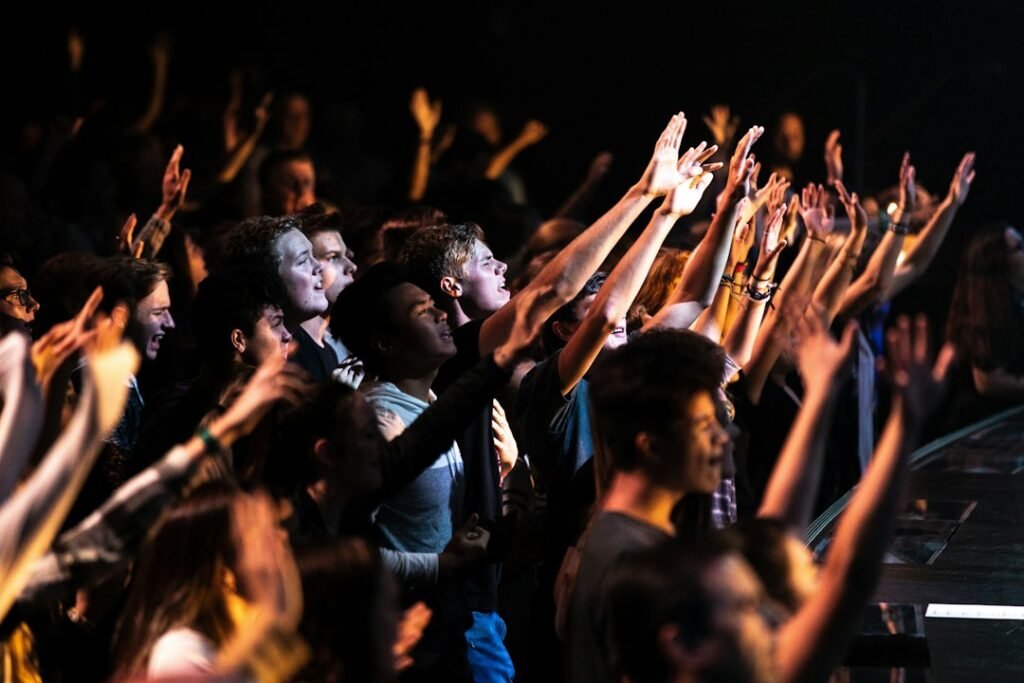
In this investigation
Humans sing in worship because music can coordinate breath, memory, emotion and group action more effectively than ordinary speech. A sung text is easier to repeat together, easier to remember and capable of producing a shared emotional atmosphere.
That does not mean singing has one universal religious mechanism. Hymns, kirtan, psalmody, Quranic recitation, Buddhist chant and Indigenous ceremonial song differ profoundly in theology and musical form.
Melody makes words memorable
Music provides rhythm, pitch pattern and repetition. These extra cues can support verbal memory, especially when texts are transmitted orally.
Religious communities therefore gain a practical advantage from singing: important material can be learned and reproduced across generations.
Group singing synchronizes bodies
When people sing together, breathing, timing and movement become partly coordinated. Studies of choir singing show measurable synchronization in respiratory and cardiovascular patterns, although the effects depend on the music and task.
This coordination does not prove mystical union. It demonstrates that collective vocal behaviour can literally align aspects of bodily timing.
Synchrony can strengthen affiliation
Experimental research on synchronized movement and music suggests that acting in time with others can increase perceived connection and cooperation.
Religious singing can therefore reinforce group identity through a behavioural mechanism as well as through shared doctrine.
Music intensifies emotion
Pitch, harmony, rhythm, loudness and expectation all shape emotional response. A congregation can move from quiet reflection to collective excitement without changing the words.
This makes music unusually effective for rituals that need to regulate group mood.
Call-and-response lowers the barrier to participation
Many traditions use short repeated responses rather than demanding that every participant know a long text. A leader can carry complexity while the group answers with memorable phrases.
The structure combines hierarchy with participation.
Repetition can create absorption
Repeated sung phrases narrow attention and reduce the need to process new verbal information. Over time, participants may experience intense concentration or altered subjective time.
This can be described psychologically without deciding whether the religious interpretation of the experience is true or false.
Architecture changes worship music
Reverberant churches, mosques, temples and caves can sustain chant and make a small number of voices sound larger. Musical styles often adapt to their acoustic environments.
But good acoustics do not prove that sacred music was designed around hidden frequencies.
Why sacred texts are often sung rather than spoken
Singing slows language and gives pronunciation, phrasing and emphasis a stable form. In oral traditions, melody can help preserve textual sequence.
The result is especially valuable when accurate transmission carries religious authority.
Solo and communal singing do different work
A solo singer can display expertise and lead devotion. Congregational singing spreads participation across the group.
Many traditions alternate between the two, balancing specialist knowledge with collective involvement.
Does singing improve health?
Group singing can influence mood, perceived stress, social connection and breathing patterns. Clinical and community studies sometimes report benefits.
Those findings should not be generalized into claims that worship singing treats disease. The strongest evidence concerns psychosocial and physiological state, not cure.
Why music survives doctrinal change
Melodies can persist even when languages, instruments or theology change. Music therefore acts as a carrier of cultural continuity.
People may remember a sacred song long after forgetting a sermon.
What survives scrutiny?
- Singing supports memorization and repeated transmission of sacred texts.
- Group singing synchronizes timing and can strengthen social affiliation.
- Music powerfully regulates emotion and participation.
- Repetition can intensify attention and absorption.
- Architecture shapes how sacred singing sounds.
- Health effects are plausible at the level of stress, mood and social connection, not as universal medical treatment.
The Tradivior Evidence Profile
Historical Authenticity — Strong. Sacred singing is documented across most major religious and ritual traditions.
Original-Purpose Evidence — Strong. Praise, prayer, memorization, communal participation and ritual expression are explicit purposes.
Scientific Mechanism — Strong. Memory cues, respiratory coordination, synchrony and emotion regulation are well-supported mechanisms.
Experimental Evidence — Moderate to Strong. Group singing and synchrony have been studied experimentally, though religious contexts vary.
Cross-Cultural Evidence — Strong. Sacred song is globally recurrent.
Modern Relevance — Strong. Congregational singing remains central to worship and community identity.
The Tradivior Conclusion
Humans sing in worship because music makes belief easier to remember, feel and perform together. It turns doctrine into coordinated action.
The scientific evidence explains why singing is such an effective social technology without reducing sacred music to physiology. Religious communities use real cognitive and social mechanisms in service of meanings that remain theological and cultural.
Sources & further reading
- Vickhoff B et al. “Music structure determines heart rate variability of singers.” Frontiers in Psychology. 2013.
- Wiltermuth SS, Heath C. “Synchrony and cooperation.” Psychological Science. 2009.
- Reviews of music, memory, social bonding and group singing.
Continue exploring

Partially Supported
Why Is the Ganga Sacred?
The Ganga is river, goddess, pilgrimage route, purifier and national symbol. Tradivior will trace how these layers developed and evaluate modern claims about unusual self-purifying properties without confusing microbial findings…

Partially Supported
Why Do People Keep Ashes, Relics and Memorial Objects?
Hair, ashes, bones, clothing, photographs and relics allow the dead to remain materially present. Tradivior will examine why objects carry memory so powerfully and how continuing bonds differ from pathological…

Evidence Supported
Why Do Cultures Set Aside Days to Remember the Dead?
From Pitru Paksha and Qingming to Día de Muertos and All Souls’ Day, cultures repeatedly create calendar time for the dead. Tradivior will compare how recurring remembrance renews kinship, grief…
Historically Practical
Why Do Cultures Preserve the Dead?
Mummification, embalming, freezing, smoking and desiccation reflect very different beliefs about bodies and afterlives. Tradivior will compare preservation traditions with the chemistry of decomposition and the practical limits of each…
Picked for your curiosity
Enable JavaScript to build a reading profile and see recommendations.