 tradivior
In this investigation
On 16 August, five mountains around Kyoto become enormous points of fire. One after another, illuminated characters and shapes appear against the dark slopes. The city describes Gozan Okuribi as a farewell: in a widely held belief, ancestral spirits who have returned to visit their families during Obon are being guided away again. Elsewhere in Japan, people mark the season not with giant hillside fires but with family grave visits, offerings, small lights or dancing that continues deep into the night.
Why should a festival concerned with remembering the dead also be full of music and communal movement? And why can a family in one region observe Obon in July while another waits until August? The answers lead through Buddhist narrative, changing calendars, local ritual histories and a living tradition whose meaning cannot be reduced to a single ancient origin. Obon is not one uniform spectacle. It is a set of relationships—between living and dead, home and migration, temple and neighbourhood—made visible in many different ways.
Kyoto’s farewell fires are a beginning, not the whole story
The Kyoto City Tourism Association’s description of Gozan Okuribi identifies five forms lit on five mountains on the evening of 16 August. The first, Daimonji, is followed by Myo-Ho, Funagata, Hidari Daimonji and Toriigata. Their present sequence is carefully organised, but the city’s account is candid about history: the exact origin of the mountain fires is unknown, with differing explanations for how the practice began.
That uncertainty should not be treated as a defect in the tradition. A ceremony can have a long documented life without an indisputable founding scene. Kyoto’s own material situates its establishment as an annual event after the Muromachi and Edo periods, rather than presenting a precisely witnessed founding year. The public can see the fires; historians can document later practice; participants may understand them as a farewell to ancestors. Those are different kinds of statements, and each deserves its own terms.
Visitors often encounter Gozan Okuribi as an extraordinary night view. For families who understand it devotionally, the flames also mark the close of a visit. The event’s beauty is inseparable from a temporal idea: welcoming someone implies that there will eventually be a goodbye.
A Buddhist story about a son and his mother
The religious vocabulary of Obon is associated with Urabon-e and the Buddhist Ullambana tradition. In a widely circulated narrative, the disciple Maudgalyayana—known in Japan as Mokuren—sees his deceased mother suffering and is instructed to make offerings to the monastic community. The story has been retold and interpreted in different forms across East Asian Buddhist traditions. The Japan National Tourism Organization’s cultural account presents this as a religious origin narrative, not as an independently documented historical event.
The distinction matters. The story expresses a moral concern about care, gratitude and the relationship between living children and deceased parents. Its supernatural elements belong to devotional teaching. A historical investigation can identify the text tradition and its transmission without attempting to measure whether a spirit returned or whether a religious offering altered an afterlife.
In Japan, Buddhist observance developed alongside local household and ancestral practices. It is therefore too simple to describe every lantern, dance or grave visit as a direct enactment of a single scriptural episode. Religious stories can supply meaning while regional communities give that meaning particular objects, music and gestures. The result is continuity with variation, not an identical ritual copied unchanged through centuries.
Why one festival appears in three calendars
Many families observe Obon around 13–16 August, while parts of Tokyo and other areas observe it in July. Some communities follow a lunisolar calendar, producing dates that shift relative to the Gregorian calendar. These are not necessarily rival claims about the ‘real’ Obon; they reflect the historical relationship between the old seventh-month observance, later calendar reform and local choices about timing.
A Japan International Cooperation Agency cultural guide describes the July observance in Tokyo and parts of eastern Japan and the August observance elsewhere, alongside grave visits, household offerings and welcoming lights. Japan’s national tourism organisation likewise notes regional differences. The important point is that a calendar date is a cultural decision made within a changing civil and agricultural world, not a scientific test of the ritual’s authenticity.
The three broad patterns are often described as July Obon, August Obon and lunisolar Obon. Actual local arrangements are more nuanced, so any specific event should be checked against its local calendar rather than inferred from a national summary. For a travelling family, this can mean that the journey home and the family observance occur on dates different from a colleague’s. For historians, the variation preserves evidence of how communities responded to a new calendar while keeping an older seasonal obligation.
At home, remembrance has a physical form
Some Obon observances centre on family graves and household altars rather than public performances. Families may clean graves, prepare offerings, place lanterns or lights and arrange spaces in which ancestors are remembered. A common symbolic explanation is that lights help welcome spirits and later guide them away. These acts can also gather relatives who live far apart and rarely meet at other times of year.
In some households, cucumbers and aubergines are fashioned into small animal-like forms, popularly interpreted as mounts for visiting spirits. The JICA guide documents these objects as part of a living practice. The point is not that every household uses them or that every participant explains them in exactly the same way. A custom can be widespread without being universal, and meanings can vary among families.
It is useful to distinguish an object from an inference about it. A photograph or ethnographic account can establish that a household placed an offering on an altar. The statement that the offering spiritually assists an ancestor belongs to the participant’s religious understanding. Both can be reported respectfully, but they answer different questions.
The dance that makes remembrance public
Bon Odori turns the season outward. In parks, town squares and temple precincts, participants dance to locally familiar music, sometimes in circles around a raised platform. Japan’s tourism organisation describes the dances as a social invitation as well as a cultural performance. In many places, newcomers can follow the steps of neighbours rather than watching from behind a barrier.
It would be a mistake to infer that every Bon dance has exactly the same historical origin or religious function. Some repertoires connect to Buddhist chanting traditions, others to local community histories, and contemporary festivals can emphasise fellowship, heritage or tourism. A public dance can have devotional roots while also becoming a space where children learn local movements and emigrants return to familiar streets.
UNESCO’s 2022 inscription of Japan’s Furyu-odori ritual dances illustrates this diversity. UNESCO describes dances associated with prayers for the repose of the deceased, good harvests, safety and relief from calamities. The inscription concerns a group of distinct ritual dances; it does not mean that every Bon Odori performance everywhere is itself individually UNESCO-listed.
Gujō Hachiman: four nights that refuse to end early
In Gifu Prefecture, Gujō Odori provides a particularly concrete example of a local dance tradition. The Japan National Tourism Organization describes a festival with ten dances, a long summer season and a history linked to community cohesion in the Edo period. Participants do not need to be trained professionals to join the circle. The local tradition is associated with the idea of bringing people together across social divisions.
The local 2026 festival schedule recorded 30 nights of dancing from July to September and four all-night Obon dance nights, 13–16 August. The 13 August 2026 event listing specified dancing from 20:00 until 04:00. These are unusually precise, dated pieces of evidence. They show what the organisers planned for that year; they should not be presented as proof that every historical Gujō festival had exactly the same schedule.
Imagine a returning resident entering a dance already in motion. The ritual’s continuity is not contained in a single written formula. It is enacted through remembered steps, shared timing, music and the willingness of others to make space. In that sense, the town itself becomes an archive that people can participate in.
The danger of turning local variation into a national stereotype
A spectacular photograph of a fire or dance is attractive, but it can mislead if labelled simply ‘how Japan celebrates Obon’. Kyoto’s mountain fires, Gujō’s overnight dancing and a quiet family visit to a grave are not interchangeable. Each has its own local custodians, practical arrangements and social context. Okinawan practices, including Eisa, add further forms and calendrical choices.
Even the tone of remembrance varies. Some gatherings are solemn, some exuberant, and many combine moments of devotion with conversation, travel and ordinary family life. Describing one as the authentic version and the others as diluted would ignore the evidence of long-standing regional differences.
Visitors should also distinguish between public participation and private observance. The JNTO’s festival guidance encourages respectful participation in accessible local dances, but that invitation does not extend to intruding on family altars, graves or restricted ceremonial areas. Cultural curiosity should not override the community’s own boundaries.
What the flames can prove—and what they cannot
There is no empirical experiment that can establish or refute the religious proposition that ancestral spirits visit a household during Obon. That is a belief and a devotional interpretation, not a narrow physical hypothesis for scientific grading. Tradivior’s evidence assessment therefore addresses a different, testable question: Is Obon observed on one identical calendar date and with one uniform set of rituals throughout Japan?
The answer is not supported. Official Japanese cultural and tourism sources document July, August and locally determined lunisolar observances. They also document different public forms, including Gujō Odori and Kyoto’s Gozan Okuribi. This verdict concerns calendar and practice diversity only. It says nothing about whether any participant’s theology is true or false.
The narrower framing is more respectful and more informative. It prevents the article from pretending to adjudicate spiritual reality while still allowing verifiable claims about historical dates, public programmes, and regional differences to be examined critically.
An evidence profile grounded in the actual tradition
Historical record: Buddhist-rooted ancestor observances developed over centuries; specific origin claims for individual customs vary in documentary strength. Kyoto’s own tourism authority says the origin of Gozan Okuribi is uncertain. Textual tradition: the Ullambana/Mokuren narrative explains religious meaning, but is not a contemporary eyewitness account of supernatural events.
Material practice: altars, grave care, lanterns, symbolic offerings and dances are observable, though no single household uses every object. Regional variation: July, August and lunisolar calendars, along with different music and public ceremonies, are independently documented. Living community voice: organisers’ published schedules and local participation guidance demonstrate that the tradition is maintained and adapted by communities rather than existing only as museum history.
Empirical proposition: the claim of one nationally uniform date and ritual pattern fails against these sources. None of these six dimensions is a numerical score for the worth of a belief. They are separate windows into how a tradition is recorded, practised and interpreted.
The modern journey home is part of the ritual’s meaning
For many people, Obon is also a period of travel and reunion. Relatives may return from cities to hometowns, visit graves together, or join a local dance after years away. This practical dimension can be overlooked when festivals are treated only as ancient spectacles. The calendar determines who can travel, where crowds gather and whether the practice remains viable for families whose work and schooling are organised around modern schedules.
UNESCO’s account of Furyu-odori notes that former residents return from cities to participate in dances, and that traditions are also performed by communities away from their original homes. The same movement between home and elsewhere helps explain why local heritage matters in a highly mobile society. What is being preserved is not merely a costume or a sequence of steps but a recurring opportunity to belong.
That observation should not become an invented universal emotional testimony. People participate for different reasons, and not everyone is religious. The documented pattern is that public dances and family visits can connect dispersed communities; the personal significance belongs to the participants themselves.
How Kyoto’s fires remain a living responsibility
Modern Gozan Okuribi is not simply a fire lit for tourists. The Kyoto City Tourism Association provides safety guidance about access to mountains and riverbanks, recognising that a major public ceremony also involves stewardship, crowd management and protection of ceremonial sites. Its 2026 notice identifies the 16 August sequence and explains the religious understanding of farewell.
A Kyoto tourism association account of dedicated wood offerings describes how preservation groups and organisers make participation possible while maintaining the event. The administrative details matter: a tradition continues because people organise, maintain, teach and finance it, not because the past repeats automatically.
That work introduces tensions. Large audiences may appreciate the flames visually without sharing the belief; visitors may need restrictions that residents understand as necessary; younger generations may participate differently. A living tradition is not rendered less authentic because it requires contemporary management. Its continuity depends on such choices. Another Kyoto tradition, Gion Matsuri, likewise shows how neighbourhood organisation sustains a ritual, though its historical origins and religious purposes differ.
A farewell that leaves room for many forms of remembrance
Obon cannot be explained by a single sentence such as ‘Japan welcomes the spirits of the dead’. That is one meaningful description, but it does not explain why Kyoto lights mountains, why Gujō dances through the night, why some families observe in July, or why households choose different forms of care. The historical answer is layered: Buddhist narrative, older local practices, calendar change, community organisation and modern family life all shape the observance.
The most compelling insight may be that remembrance is not necessarily the opposite of celebration. A dance can make an absent person present in memory; a lantern can mark an invitation; a fire can express the moment of farewell. These are interpretations held and enacted by people, not propositions that an outside observer must validate through laboratory evidence.
In Kyoto, the mountain lights go out. In Gujō, the music eventually stops. The dates and gestures differ, but the act of setting aside time for relationships across generations remains the thread connecting the many Obons.
Evidence and further reading
- Kyoto City Tourism Association, Gozan Okuribi history and meaning (2025).
- Kyoto official 2026 event and safety notice.
- Japan National Tourism Organization, Obon customs and variation.
- JICA cultural guide, household offerings and July/August calendars.
- JNTO, Gujō Odori historical and community context.
- Gujō Hachiman local organisers, 2026 schedule.
- UNESCO, Furyu-odori inscription, 2022.
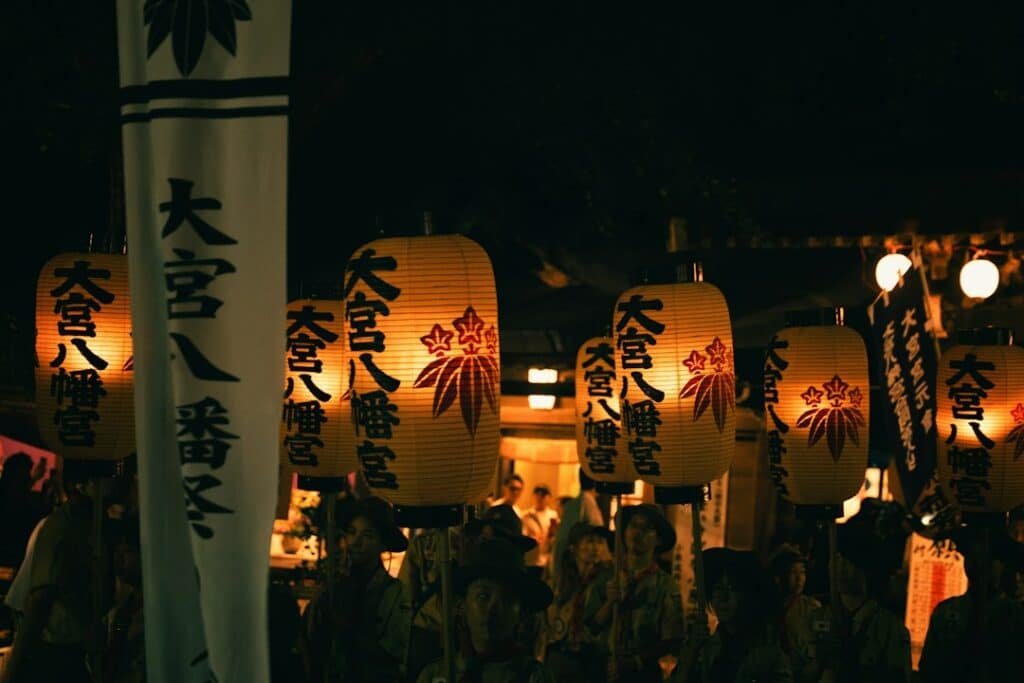
Featured photograph: Japanese lanterns at a night festival, photographed by ayumi kubo and licensed through Unsplash. This is an illustrative festival photograph, not a verified image of a specific Obon rite or the Kyoto mountain fires.
Continue exploring
The Burden That Becomes a Promise: Thaipusam’s Journey from Tamil Hills to Singapore Streets
From a 1932 silver chariot stopped by trolley wires to Singapore's 2026 procession, Thaipusam reveals how Tamil devotion and diaspora life reshape one another.

The People Beneath the Tower: How Catalonia’s Castells Learned to Reach Higher
From eighteenth-century dances to modern safety debates, Catalonia's castells reveal how a living tradition balances collective trust, ambition and risk.

When the New Year Has More Than One Star: Matariki, Puanga and the Art of Remembering
Matariki is not one fixed star count or ceremony. Explore Māori regional traditions, Puanga, hautapu, the lunar calendar and New Zealand's public holiday.
The Altar That Changes Every Year: Día de Muertos and Its Many Histories
A Día de Muertos ofrenda can hold water, marigolds and a loved one's favourite meal. Its meaning is intimate; its history is more layered than an unchanged ancient ritual.
Picked for your curiosity
Enable JavaScript to build a reading profile and see recommendations.