 tradivior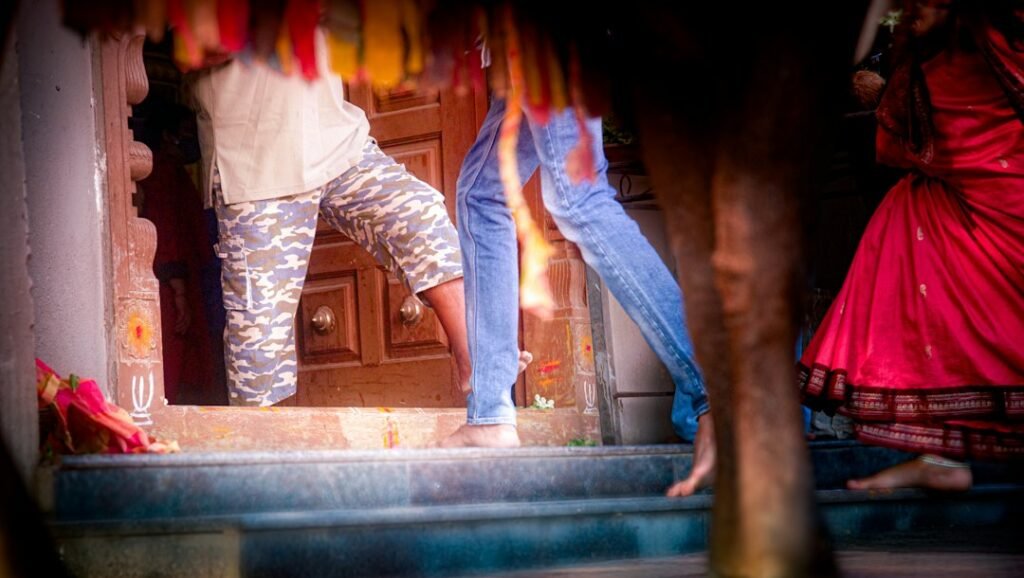
In this investigation
The doorway is one of the most important boundaries in a home. Outside are streets, mud, dust, animals, public toilets, workplaces and weather. Inside are sleeping spaces, food, children, prayer, carpets, mats and the private life of a household. In many cultures, shoes stop at that boundary.
The custom is often explained with a single sentence: shoes are dirty. That is partly true, but incomplete. Shoe removal can protect floors, preserve spaces used for sitting and sleeping, express respect, mark sacredness, distinguish outdoors from indoors, or simply follow an inherited idea of what a properly kept home looks like.
Modern environmental research confirms that shoes can carry microbes, soil particles and chemical contaminants indoors. But the health implication needs care. Finding contamination on a shoe sole does not automatically prove that wearing shoes indoors causes disease in an ordinary household.
Shoes are a technology for the outside world
Footwear exists largely because outdoor ground is abrasive, hot, cold, wet, contaminated or dangerous. A shoe therefore accumulates evidence of where it has been. Soil, dust, plant material, animal waste, road residue and microorganisms can all adhere to soles.
Once homes develop cleaner internal surfaces, the same protective footwear becomes a potential contamination source. A custom of removal can therefore emerge from a simple functional inversion: what protects the foot outside can threaten the cleanliness of the floor inside.
THE BASIC LOGIC
Shoe removal is easiest to understand when the floor is not merely something walked across. If people sit, eat, sleep, pray or play close to it, keeping outdoor footwear away becomes much more valuable.
Floor-based living changes the meaning of cleanliness
In many South Asian, East Asian, Middle Eastern and other households, domestic life historically took place much closer to the floor than in chair-and-bed-centered European interiors. Mats, rugs, low tables, floor seating and bedding create a stronger reason to separate outdoor dirt from indoor surfaces.
A floor used for sitting is functionally closer to furniture. Walking across it in street shoes can therefore feel comparable to placing muddy shoes on a sofa.
Historical descriptions explicitly connect the custom with carpets and floor use
Older descriptions of South Asian domestic manners noted that shoes were commonly removed on entering a house and linked the practice directly to carpet cleanliness and sitting on the floor. Although colonial-era descriptions carry their own biases, they show that practical floor protection was recognized historically rather than invented by modern hygiene marketing.
The same principle remains visible in homes where rugs or prayer surfaces occupy central space. The outdoor/indoor footwear boundary protects a surface that bodies repeatedly contact.
Japan built the footwear boundary into architecture
Japanese domestic architecture makes the transition unusually visible. The entry area known as the genkan creates a physical and symbolic boundary between the outside level and the raised interior. Shoes are removed before stepping up.
Research comparing footwear-removal practices internationally notes that in Japan the whole dwelling is commonly treated as free of outdoor shoes, with the entrance functioning as the decisive boundary. The Japanese verb associated with entering can itself carry the sense of “going up,” reflecting the spatial transition.
Tatami made dirty outdoor footwear especially incompatible with interiors
Tatami developed from elite mats into a much more widespread floor system over centuries. Its woven surface is not well suited to abrasive or dirty street footwear. Removing outdoor shoes therefore protects material as well as cleanliness.
This helps explain why the Japanese custom cannot be reduced to a vague cultural preference for purity. Architecture, flooring technology and daily bodily practice reinforce one another.
Indoor slippers show that the rule is not simply “bare feet are cleaner”
Japanese households often replace outdoor shoes with slippers. Schools have also developed systems of indoor footwear. Historical research on Japanese schools documents a long-standing practice of changing footwear at the entrance and the later institutionalization of dedicated indoor shoes.
The key distinction is therefore not always shoes versus no shoes. It is outdoor footwear versus footwear reserved for a cleaner interior environment.
Sacred spaces extend the same boundary beyond the home
Across Hindu, Buddhist, Sikh, Islamic and other traditions, shoes are removed in many temples, shrines, mosques and sacred spaces. Religious explanations differ, but several themes recur: respect, purity, humility and separation of ordinary outside space from a sanctified interior.
The existence of sacred shoe removal can reinforce domestic customs, but one should not assume that every home rule originated in religion. Practical and sacred boundaries can coexist and strengthen each other.
The threshold itself can become culturally meaningful
Removing shoes is a small ritual of transition. The body pauses, bends, changes footwear and crosses into a different behavioral zone. That repeated action teaches where outside ends and household norms begin.
This is why ignoring the custom can feel disrespectful even when the floor is visibly clean. The visitor has crossed a social boundary incorrectly, not merely introduced dirt.
Hospitality turns a hygiene practice into etiquette
Once a household expects shoe removal, compliance becomes a sign that a guest recognizes the host’s rules. The practical question “are your shoes dirty?” becomes less important than the social question “will you respect this home?”
Custom therefore persists even in modern apartments with clean pavements and washable floors. Etiquette can outlast the original environmental pressure because it has acquired relational meaning.
Climate can push societies toward different solutions
Wet snow, mud and seasonal slush make outdoor footwear especially unsuitable indoors. In some northern societies, shoe removal or changing into indoor footwear is strongly practical even without the same religious or floor-seating history found elsewhere.
This is an example of convergent cultural evolution: similar household rules can arise for different historical reasons.
What does science show about microbes on shoe soles?
A 2016 systematic review found that shoe soles can carry potentially pathogenic microorganisms, including organisms relevant to healthcare-associated infection. Studies documented contamination in healthcare, community and occupational settings.
A later systematic review of floors and environmental ground contamination concluded that shoe soles can act as vectors transferring microorganisms to floor surfaces. The literature supports contamination transfer much more strongly than it supports a simple claim that ordinary household shoe use directly causes infection.
THE EVIDENCE LIMIT
“A pathogen was detected on a shoe” and “this shoe caused a person to become ill” are very different levels of evidence. Transfer is demonstrable; everyday disease risk is harder to quantify.
Shoes can transfer contamination to clean flooring
Experimental and field studies reviewed in the floor-contamination literature show that organisms collected on footwear can be deposited onto flooring. This is unsurprising mechanically: particles adhere to soles and are released through walking.
The relevance increases when people or objects later contact the same floor. Small children, who crawl and then place hands in their mouths, have a different exposure pattern from adults who rarely touch the floor directly.
Chemical contaminants can travel with dust too
Indoor dust contains more than microorganisms. Soil-associated metals, pesticides and other environmental contaminants can enter homes through multiple routes, including open windows, pets, clothing and footwear.
Research in agricultural areas has found pesticides in household floor and doormat dust, with concentrations related to proximity to treated fields. Such studies do not show that shoes are the only route, but they demonstrate why controlling tracked-in dust can matter in particular environments.
School studies give unusually direct evidence for a shoeless intervention
A Finnish study compared schools where outdoor shoes remained in use with schools where shoes were removed at the building entrance. Corridors in shoe-wearing schools had higher concentrations of larger particulate matter and several elements in settled dust.
The study concluded that removing shoes at entry could improve indoor air quality by reducing particle mass. This is stronger evidence for environmental cleanliness than the much broader claim that shoes-off homes are necessarily healthier in every respect.
Indoor air can be affected because floor dust does not always stay on the floor
Walking, cleaning and ordinary activity can resuspend settled particles. Floor contamination therefore does not remain permanently isolated from breathing zones.
Again, the magnitude depends on flooring, ventilation, cleaning, particle type and activity. A hard floor regularly cleaned in a low-contamination environment differs from a heavily trafficked carpet near an industrial site.
Allergens make the question more household-specific
Pollen and outdoor biological material can be tracked inside on shoes and clothing. For a household with severe allergies, reducing tracked material may be more useful than for a household with no susceptible members.
The custom therefore has a plausible modern hygiene benefit without needing to be framed as a universal medical necessity.
Pets, clothing and air can overwhelm the shoe-only story
A no-shoes rule does not create a sterile home. Dogs carry outdoor material on paws and fur. Clothing collects dust. Windows admit particles. People shed microbes continuously.
This is why shoe removal should be understood as one exposure-control measure, not a substitute for cleaning, ventilation or ordinary hygiene.
The microbiome complicates fear-based cleanliness claims
Not all environmental microorganisms are harmful. Humans live among enormous microbial communities, most of which do not cause disease. A house does not become healthier simply by minimizing every possible microbial exposure.
The scientifically defensible claim is narrower: outdoor shoes carry environmental material, and removing them reduces one pathway by which that material enters indoor floors.
Why the rule matters more in some homes than others
A household with crawling infants, floor bedding, prayer mats or expensive carpets has more reason to keep floors clean than one where everyone wears indoor footwear and floor contact is minimal. Homes near agricultural fields, polluted streets or muddy environments also face different exposures.
Tradition can therefore encode a generally sensible default even though its practical value varies by architecture and lifestyle.
The rule can become class-coded
Clean floors, carpets and dedicated entry areas require space and maintenance. In some societies, footwear etiquette can become associated with ideas of refinement, household discipline or social class.
This reminds us that “hygiene” is never purely biological. Standards of cleanliness are also social judgments about what a respectable home should look and feel like.
Why some cultures kept shoes on indoors
There is nothing biologically inevitable about removing footwear. Where chairs and raised beds dominate, floors are less intimate. Where streets are cleaner or shoes are difficult to remove, the practical incentive weakens. Cold interiors may favor footwear indoors.
Different architecture and material culture can therefore produce the opposite etiquette without either population failing to understand cleanliness.
The strongest modern explanation is layered rather than singular
Shoe removal persists because several benefits reinforce one another. It protects flooring. It reduces tracked dirt. It supports floor-based domestic practices. It marks respect for sacred and private space. It creates a visible threshold ritual. And in some settings it reduces measurable particle and contaminant transfer.
No single explanation needs to account for every culture.
What survives scrutiny?
- Shoe-removal customs occur in many regions but do not require one shared origin.
- Floor-based sitting, sleeping, eating and prayer make indoor floor cleanliness unusually important.
- Japanese architecture formalizes the outdoor/indoor boundary through the genkan and long-standing footwear-changing practices.
- Tatami, rugs and other vulnerable or body-contact surfaces create practical reasons to exclude outdoor footwear.
- Sacred-space shoe removal adds meanings of respect, purity and boundary marking that can reinforce domestic practice.
- Shoe soles can carry microorganisms and transfer some of them to floors.
- Environmental dust can also contain chemical contaminants, including pesticides and metals in some settings.
- A school study found lower larger-particle concentrations where outdoor shoes were removed at entry.
- Evidence for contamination transfer is stronger than evidence that ordinary indoor shoe wearing directly causes illness.
- Removing shoes is one exposure-control measure, not a way to sterilize a home.
- The practical value is greatest where floor contact, outdoor contamination or sensitive occupants make tracked material more consequential.
The Tradivior Evidence Profile
Historical Authenticity — Strong. Shoe-removal customs and indoor/outdoor footwear boundaries are well documented across South Asia, East Asia, the Middle East and other regions.
Original-Purpose Evidence — Moderate to Strong. Cleanliness, floor protection, sacred respect and etiquette are historically documented, although exact origins differ by culture.
Scientific Mechanism — Strong. Footwear physically carries soil, microbes and particulate contaminants that can be transferred to indoor flooring.
Experimental Evidence — Moderate. Transfer studies, systematic reviews and school comparisons support reduced indoor contamination, while direct household disease-prevention evidence remains limited.
Cross-Cultural Evidence — Strong. Similar shoe-removal rules appear widely for partially overlapping but culturally distinct reasons.
Modern Relevance — Strong. The practice remains a low-cost way to reduce tracked dirt and some environmental contaminants, particularly in floor-oriented homes or high-exposure settings.
The Tradivior Conclusion
Historically Practical and Evidence Supported. Removing outdoor shoes before entering a home is one of the clearer examples of a tradition whose practical logic survives modern scrutiny. Architecture, floor-based living, carpets, tatami, sacred-space rules and etiquette all contributed in different regions. Modern studies confirm that footwear can carry microbes and particulate contaminants indoors and that shoe-removal policies can reduce some indoor dust loads. What remains unproven is the exaggerated claim that ordinary indoor shoe use necessarily causes disease. The tradition is best understood as a sensible boundary-management practice with genuine cleanliness benefits that later became embedded in hospitality, identity and respect.
Continue investigating
- Why Did People Traditionally Sit on the Floor?
- Why Did Daily Bathing Become So Important in Indian Traditions?
- Why Do Religions Develop Ritual Purity Rules?
Sources and further reading
- Rashid T, VonVille HM, Hasan I, Garey KW. “Shoe soles as a potential vector for pathogen transmission: a systematic review.” Journal of Applied Microbiology. 2016. PMID: 27495010.
- “Mechanisms for floor surfaces or environmental ground contamination to cause human infection: a systematic review.” 2017; PMCID: PMC9507548.
- “The effect of the shoeless course on particle concentrations and dust composition in schools.” Science of the Total Environment. 2020.
- “Pesticides in doormat and floor dust from homes close to treated fields: Spatio-temporal variance and determinants of occurrence and concentrations.” Environmental Pollution. 2022;301:119024.
- Kawauchi K. “A study of footwear removal behavior in residences: Japanese characteristics from an international comparison.” Japan Society of Home Economics; 2002.
- Kuriyama M. “The comparative study of Japanese ‘Foot culture’—The act of shoes wearing and off II.” Journal of Japanese Culture. 2016;70:41–55.
- Research on the historical development of indoor shoes in Japanese schools, Saitama University repository.
- Hirai Y, Uchida Y. “Research on books concerning the development of Tatami and its production and distribution systems.” 2001;27:263–274.
- Historical descriptions of shoe removal, carpet cleanliness and floor-based domestic life in South Asia, including early twentieth-century reference literature.
Continue exploring

Partially Supported
Why Is the Ganga Sacred?
The Ganga is river, goddess, pilgrimage route, purifier and national symbol. Tradivior will trace how these layers developed and evaluate modern claims about unusual self-purifying properties without confusing microbial findings…
Why Do People Keep Ashes, Relics and Memorial Objects?
Hair, ashes, bones, clothing, photographs and relics allow the dead to remain materially present. Tradivior will examine why objects carry memory so powerfully and how continuing bonds differ from pathological…

Why Do Cultures Set Aside Days to Remember the Dead?
From Pitru Paksha and Qingming to Día de Muertos and All Souls’ Day, cultures repeatedly create calendar time for the dead. Tradivior will compare how recurring remembrance renews kinship, grief…
Why Do Cultures Preserve the Dead?
Mummification, embalming, freezing, smoking and desiccation reflect very different beliefs about bodies and afterlives. Tradivior will compare preservation traditions with the chemistry of decomposition and the practical limits of each…
Picked for your curiosity
Enable JavaScript to build a reading profile and see recommendations.