 tradivior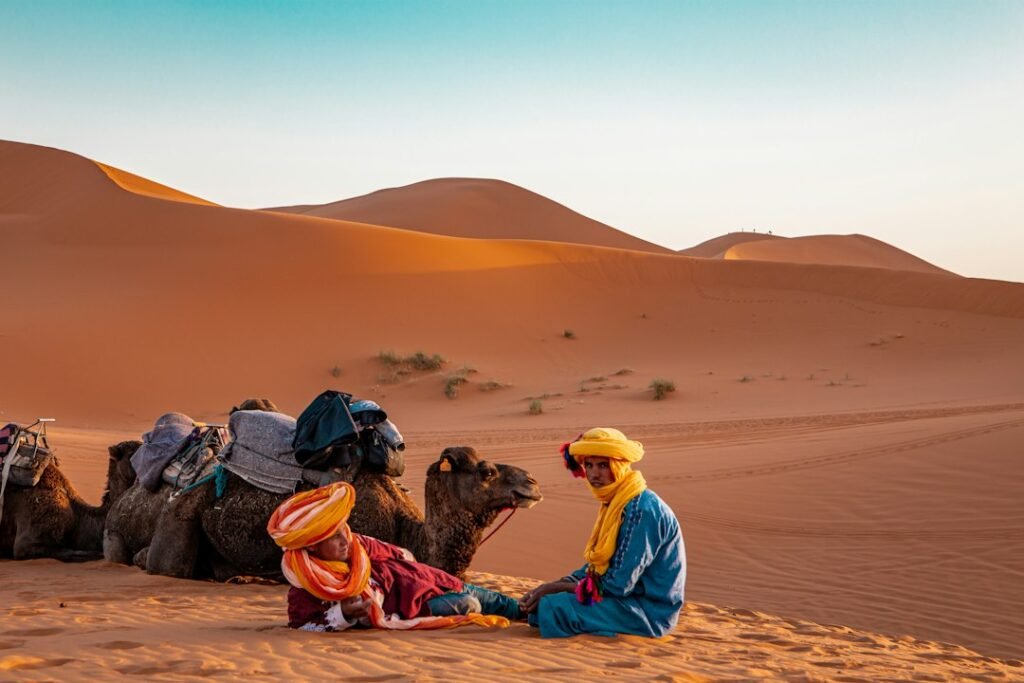
In this investigation
Traditional clothing often looks symbolic from the outside, but much of it began as applied environmental engineering. People needed to work, travel, carry tools, protect skin, conserve heat, release heat, manage sweat and use fibres that actually existed where they lived.
A loose desert robe, a layered wool garment, a wrapped cotton cloth, a fur parka and a wide conical hat solve different physical problems. None is simply “primitive fashion.” Their shapes reflect climate, labour, textile technology, social rules and repeated adaptation over generations.
Clothing sits between the body and the environment
The body continuously produces heat. Clothing changes how that heat moves into the surrounding air through radiation, convection, conduction and evaporation.
In cold environments, garments usually need to slow heat loss. In hot environments, they must reduce harmful heat gain while allowing enough evaporation and airflow to prevent overheating. Labour complicates the problem because physical work produces additional metabolic heat.
THE BASIC PRINCIPLE
Traditional clothing is best understood as a whole system: fibre, weave, layers, looseness, colour, head covering, footwear and work pattern interact with climate.
Loose clothing can create a protective air layer
Tight fabric sits directly against the skin. Loose clothing creates an air space between skin and garment. That layer can reduce direct radiant heat transfer and allow convection within the clothing microclimate.
In hot, dry regions this can be especially useful when garments are airy enough to permit ventilation while also shielding the skin from intense solar radiation.
The Bedouin black-robe experiment overturned an obvious assumption
Black fabric absorbs more solar radiation than white fabric, so it seems obvious that black desert clothing should make the wearer much hotter.
A classic 1980 study of Bedouin robes in the Sinai found something more subtle. Although the black robe absorbed more heat, the additional heat was lost before reaching the skin. Heat gain to the wearer was similar under black and white robes because garment thickness, looseness and convection mattered alongside colour.
The study does not prove that black is always optimal in hot weather. It proves that clothing performance cannot be inferred from colour alone.
Sun protection changes the hot-climate equation
Exposed skin receives direct solar radiation. Covering the body can reduce ultraviolet exposure and limit radiant heat absorbed directly by the skin even when air temperature is high.
This helps explain long sleeves, robes, head coverings and wrapped garments in hot dry climates. Minimal clothing is not always the coolest strategy under intense sun.
Humidity determines how valuable ventilation becomes
Evaporation is one of the body’s most important cooling mechanisms. In dry air, sweat can evaporate efficiently. In humid air, evaporation slows.
Clothing that traps moisture can therefore become especially uncomfortable in humid climates. Open weaves, loose garments and fabrics that permit vapour movement become valuable when the body needs to lose heat through sweat.
Protective clothing research confirms the trade-off
Modern occupational studies show that clothing which blocks evaporation can greatly increase heat strain during heavy work. Reviews of protective garments emphasize that insulation and evaporative resistance both matter.
This modern evidence helps explain why traditional work clothing often remains relatively open and adjustable unless the environment requires strong protection from cold, thorns, sparks or dust.
Cotton became valuable in hot regions for several reasons
Cotton fibres can absorb moisture, are comfortable against skin and can be woven into lightweight fabrics. South Asia became one of the world’s great cotton-producing and textile-manufacturing regions long before industrialization.
Fine cottons made loose draped garments practical in hot climates. But cotton is not universally ideal. Once wet in cold conditions, it can hold moisture and increase conductive and evaporative heat loss.
Wool works differently from cotton
Wool fibres trap insulating air and can absorb substantial moisture vapour while still retaining useful thermal properties. That makes wool valuable in cool, variable and windy climates.
A 2023 controlled study found wool garments maintained higher skin temperatures after exercise in a cool windy environment than cotton, viscose or polyester. Modern measurements therefore support some of the practical advantages long exploited in pastoral and mountain clothing systems.
Fur and hide can outperform woven cloth in extreme cold
Arctic clothing systems built from caribou or other animal skins use the natural structure of hair to trap large volumes of insulating air.
Historical field reports from the Canadian Arctic repeatedly noted that locally made caribou-skin clothing could outperform imported garments under severe cold. Indigenous clothing knowledge includes hide preparation, hair orientation, layering and fit—not simply the use of a warm material.
Layering solves a problem one heavy garment cannot
Several layers trap multiple air spaces and can be adjusted as activity changes. A person can remove insulation during hard work and add it when resting.
This matters because overheating during exertion creates sweat, which becomes dangerous in cold conditions when activity stops.
Garment geometry matters as much as fibre
A fabric sample tested in a laboratory does not tell the whole story. A garment’s fit changes airflow. Open hems, sleeves, vents and wraps can move air through the clothing system.
Modern heat-balance research explicitly treats design, fit and air permeability as separate variables from fabric composition.
Draped clothing offers adjustment without tailoring
Saris, dhotis, lungis, veshtis, turbans and many other wrapped garments can be adjusted to body size, heat, activity and social context without complex cutting or fasteners.
A wrapped cloth can be loosened for ventilation, tightened for work, raised away from mud or rearranged for ritual formality. This flexibility is a technical advantage as well as a cultural style.
Work determines where cloth can safely hang
Farmers, herders, craftspeople and fisher communities need garments that do not interfere with tools, animals or terrain. Long flowing fabric may be suitable in one task and dangerous in another.
Traditional workwear often develops techniques for tucking, wrapping, belting or shortening garments during labour while restoring fuller drape in social or ceremonial settings.
Head coverings do several jobs at once
Turbans, veils, hats and hoods can shade the head, protect hair and skin, reduce dust exposure, provide warmth and communicate social identity.
A turban in a hot dry environment can shield the scalp from intense radiation while also functioning as religious or regional identity. The same object can therefore be practical and symbolic without one explanation cancelling the other.
Footwear evolves around terrain as much as climate
Sand, snow, mud, stone, thorns and agricultural fields create different footwear requirements. Thick soles protect from hot ground and sharp surfaces. Flexible sandals ventilate the feet. Fur-lined boots insulate against snow.
Traditional footwear reflects the surface people actually walk on, not only the air temperature.
Rain changes textile priorities
Monsoon and maritime climates require rapid drying, water shedding or garments that remain workable when wet.
Heavy absorbent textiles can become cumbersome. Communities adapt through shorter garments, protective outer layers, plant fibres, oils, capes or work routines that minimize prolonged saturation.
Colour can matter, but not in isolation
Light colours generally absorb less solar radiation than dark colours, but real garments exchange heat through multiple pathways.
The Bedouin robe study shows why simple advice such as “always wear white in heat” is incomplete. Thickness, airflow, distance from skin and fabric structure can outweigh the direct effect of surface colour.
THE MATERIALS LESSON
Traditional clothing should be evaluated as an ensemble, not one feature at a time. Fibre, weave, layers, fit, colour and movement interact.
Natural fibres were partly a geography problem
People historically wore what local agriculture, herding and trade made available. Cotton thrived in some warm regions. Sheep and goats made wool abundant in pastoral areas. Flax, hemp, bark fibres, silk and animal skins dominated elsewhere.
Traditional clothing therefore reflects ecology and trade as much as deliberate climate optimization.
Trade can change clothing faster than climate changes
Imported cotton, silk, wool and synthetic fibres can replace local materials even when the older fibre was well adapted to local conditions.
Clothing traditions are therefore historical systems, not perfectly optimized evolutionary solutions.
Modesty rules can push clothing away from thermal optimum
Religion and social norms may require covering particular body regions even in hot climates. Communities then adapt within those constraints through loose garments, breathable fabrics, layering and head coverings.
The final clothing system represents compromise between thermal comfort and social acceptability.
Status can also override comfort
Elites may wear heavy, restrictive or highly decorated garments because displaying rank matters more than ease of movement.
Historical court clothing often illustrates this clearly. Clothing does not always optimize physiology; sometimes it deliberately demonstrates that the wearer does not perform manual labour.
Work clothing often values durability over softness
A labourer’s garment may need to resist abrasion, sparks, thorns, dirt or repeated washing. Rougher, heavier fabrics can survive conditions that delicate cloth cannot.
This creates another trade-off: thermal comfort versus mechanical protection.
Traditional clothing can contain hidden ventilation design
Open necks, layered wraps, side slits, loose sleeves and wide hems alter air exchange around the body. These details may appear decorative until viewed as part of the clothing microclimate.
Modern garment engineering measures the same variables with thermal manikins and climate chambers.
Cold-climate clothing manages moisture as carefully as heat
In severe cold, sweating into clothing is dangerous. Wet insulation loses performance and can accelerate cooling when activity stops.
Traditional Arctic systems therefore balance insulation with moisture management and behavioural adjustment. Venting, layer removal and careful drying are part of the system.
Heat adaptation also includes behaviour
Clothing cannot be separated from when people work. Many hot-climate societies shift heavy labour toward morning or evening and reduce activity during peak heat.
A garment that works well with shaded rest and intermittent labour may perform poorly under continuous industrial work in direct sun.
Modern synthetic fabrics alter the old trade-offs
Technical textiles can move moisture, block ultraviolet radiation, stretch, resist abrasion and dry rapidly in ways traditional fibres cannot.
That does not make traditional clothing obsolete. It means the original solutions should be compared with modern alternatives based on actual use rather than nostalgia.
“Natural” does not automatically mean cooler or healthier
Fibre marketing often treats cotton, wool or linen as inherently superior because they are natural. Performance depends on weave, weight, fit, humidity and activity.
A lightweight synthetic mesh can outperform heavy cotton during intense exercise, while wool may outperform some synthetics in cool variable conditions. Context determines the answer.
Traditional clothing persists when symbolic identity becomes more important than original function
Urban heating, air conditioning and modern transport reduce some climatic pressures, yet traditional garments remain important for festivals, worship, weddings and identity.
A garment can therefore survive after its original work or climate function has weakened because its social meaning has become stronger.
Climate change may make old clothing knowledge newly relevant
As extreme heat becomes more common, designers are again studying loose silhouettes, sun shielding, ventilation and low-energy cooling.
Traditional garments do not offer universal templates, but they provide a library of climate-specific design strategies developed before mechanical cooling.
What survives scrutiny?
- Traditional clothing reflects climate, work, local fibres, trade, status and social rules rather than one factor alone.
- Loose garments can reduce direct solar load and create ventilated air spaces in hot climates.
- The Bedouin robe experiment showed that black fabric does not automatically increase heat gain to the wearer when garment design allows absorbed heat to dissipate.
- Clothing insulation and evaporative resistance strongly affect heat strain during work.
- Wool, cotton, fur and other materials have different strengths depending on temperature, moisture and activity.
- Layering and adjustable wraps allow clothing to respond to changing activity and weather.
- Traditional Arctic skin clothing demonstrates sophisticated insulation and moisture-management knowledge.
- Draped clothing can provide practical adjustability without complex tailoring.
- Modesty, hierarchy and identity can push garments away from purely thermal optimization.
- The strongest explanation treats traditional dress as a compromise among environment, work, materials and society.
The Tradivior Evidence Profile
Historical Authenticity — Strong. Climate- and labour-specific clothing systems are extensively documented across hot, cold, pastoral, agricultural and Arctic societies.
Original-Purpose Evidence — Strong. Protection, mobility, insulation, ventilation, modesty, work and identity are visible practical and social functions.
Scientific Mechanism — Strong. Heat transfer, insulation, evaporation, airflow, solar radiation and moisture transport provide well-established mechanisms.
Experimental Evidence — Strong. Modern clothing physiology directly measures insulation, evaporative resistance, garment fit and thermal strain.
Cross-Cultural Evidence — Strong. Distinct societies repeatedly developed climate- and work-adapted clothing systems using locally available materials.
Modern Relevance — Strong. Traditional design strategies remain relevant to heat adaptation, outdoor work, cold-weather clothing and low-energy comfort.
The Tradivior Conclusion
Evidence Supported. Traditional clothing often evolved as practical environmental technology. Garment looseness, layering, fibre, weave and coverage can measurably change heat gain, heat loss, evaporation and movement. But clothing systems were never designed by climate alone: religion, gender, status, trade and available materials shaped the final form. The tradition survives scrutiny most strongly when clothing is treated as a whole adaptive system rather than when one feature—black colour, cotton, wool or head covering—is given a universal scientific explanation.
Continue investigating
- Why Do Cultures Give Ritual Meaning to Colour?
- Why Do Sikhs Keep Uncut Hair and Wear the Turban?
- Why Do Religions Cover the Head in Worship?
Sources and further reading
- Shkolnik A, Taylor CR, Finch V, Borut A. “Why do Bedouins wear black robes in hot deserts?” Nature. 1980;283:373–375. doi:10.1038/283373a0.
- Holmér I. “Protective clothing and heat stress.” Ergonomics. 1995;38(1):166–182. PMID: 7875118.
- Havenith G. “Heat balance when wearing protective clothing.” Annals of Occupational Hygiene. 1999. PMID: 10481628.
- “Practical Considerations for Using Personal Cooling Garments for Heat Stress Management in Physically Demanding Occupations: A Systematic Review and Meta-Analysis.” 2024. PMID: 39498663.
- “Clothing impact on post-exercise comfort: skin-clothing physiology in transient environment.” 2023. PMID: 37960939.
- Manning TH, Manning EW. “The Preparation of Skins and Clothing in the Eastern Canadian Arctic.” Polar Record.
- Historical and ethnographic scholarship on South Asian cotton textiles, draped garments, pastoral wool clothing and Arctic Indigenous dress systems.
Continue exploring

Partially Supported
Why Is the Ganga Sacred?
The Ganga is river, goddess, pilgrimage route, purifier and national symbol. Tradivior will trace how these layers developed and evaluate modern claims about unusual self-purifying properties without confusing microbial findings…

Why Do People Keep Ashes, Relics and Memorial Objects?
Hair, ashes, bones, clothing, photographs and relics allow the dead to remain materially present. Tradivior will examine why objects carry memory so powerfully and how continuing bonds differ from pathological…

Why Do Cultures Set Aside Days to Remember the Dead?
From Pitru Paksha and Qingming to Día de Muertos and All Souls’ Day, cultures repeatedly create calendar time for the dead. Tradivior will compare how recurring remembrance renews kinship, grief…

Why Do Cultures Preserve the Dead?
Mummification, embalming, freezing, smoking and desiccation reflect very different beliefs about bodies and afterlives. Tradivior will compare preservation traditions with the chemistry of decomposition and the practical limits of each…
Picked for your curiosity
Enable JavaScript to build a reading profile and see recommendations.