 tradivior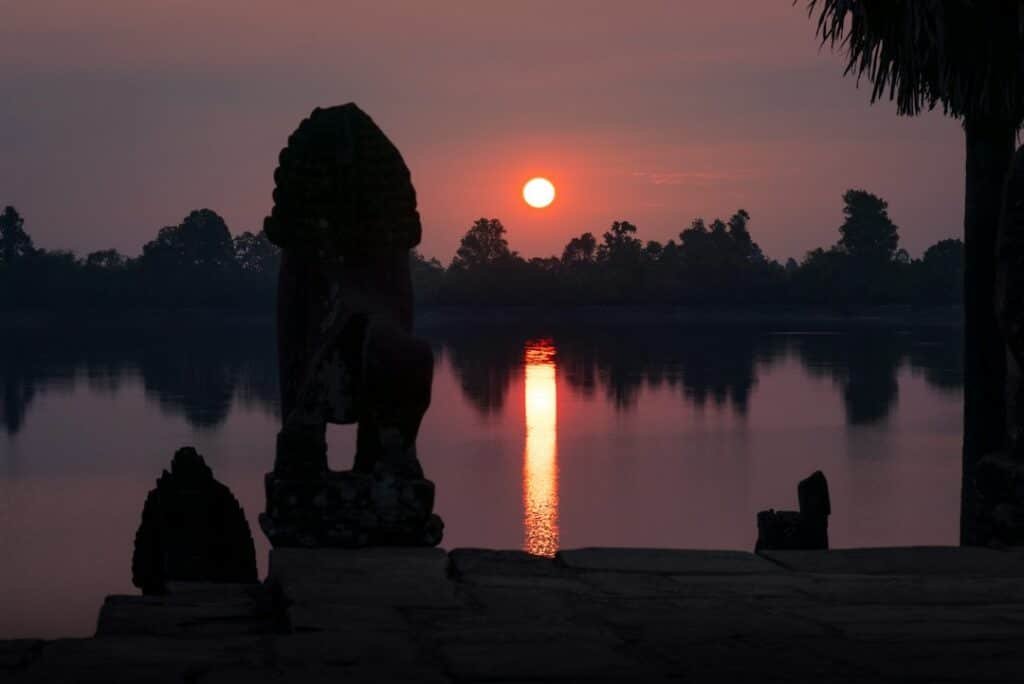
In this investigation
Ancient sacred buildings often face somewhere specific. Temples, tombs, churches, pyramids and ceremonial platforms may align with cardinal directions, sunrise points, mountain horizons, rivers or other landscape features. Sometimes that orientation is clearly intentional. Sometimes it is only approximately consistent. Sometimes modern observers find an alignment first and invent the meaning afterward.
This makes orientation one of the most tempting and dangerous areas of ancient-science interpretation. A building can point toward the rising sun because builders intended a solar calendar, because the entrance needed morning light, because the street grid required it, or simply because the terrain made that direction practical. Good archaeoastronomy has to distinguish those possibilities.
Cardinal directions are unusually easy to establish
North, south, east and west can be determined without modern instruments using repeated observations of the sun, stars or shadows. Ancient builders in several civilizations achieved impressively accurate cardinal layouts.
The pyramids at Giza are among the most famous examples. Their bases are aligned very closely with the cardinal directions, demonstrating skilled observation and surveying rather than accidental placement.
THE METHOD RULE
An alignment is strongest when the structure’s axis, the celestial target, historical context and repeated pattern across comparable sites all support the same interpretation.
East and west carry obvious solar meaning
The sun rises generally in the east and sets generally in the west. Many cultures therefore connected east with beginning, emergence or renewal and west with ending, death or the underworld.
Those meanings can become architectural. Egyptian sacred landscapes, Christian churches and many other traditions use east-west orientation in ways that combine physical observation with symbolic interpretation.
But “faces east” is not the same as “aligned to the equinox”
A common modern error is to treat any roughly eastward building as equinoctial. The true sunrise position changes through the year, and local horizon shape affects where the sun appears.
Archaeoastronomers therefore need accurate azimuth measurements and local horizon data rather than a visual impression that a building “points at sunrise.”
Mesoamerican research shows both real patterns and exaggerated claims
Large studies of Mesoamerican civic and ceremonial buildings have found genuine orientation patterns related largely to sunrises and sunsets on particular dates. These repeated alignments may have supported observational calendars connected with agriculture and ritual scheduling.
At the same time, specialist research warns that many popular claims about equinox alignments are not supported by objective orientation data. This is exactly why repeated regional patterns matter more than a single dramatic photograph.
A calendar alignment becomes stronger when it repeats
If dozens of related buildings cluster around the same few solar azimuths, chance becomes less plausible. A repeated pattern can suggest shared surveying traditions or calendrical conventions.
One building aligned with one sunset is far weaker evidence because the horizon contains many possible astronomical targets.
Observer position has to be defined
Astronomical alignment requires a line of sight. Researchers must know where the observer was expected to stand and what architectural feature defines the sightline.
Without that, it is possible to draw almost any desired line from a large monument toward something interesting on the horizon.
Topography can mimic intentional astronomy
Buildings often respond to slope, bedrock, roads, rivers and existing settlements. A temple facing a mountain may be oriented that way because the mountain is sacred, because the foundation is easiest there, or because the street network already fixed the axis.
Archaeoastronomical interpretation is strongest when terrain constraints have been tested rather than ignored.
Sacred landscape can matter as much as the sky
Some ceremonial centres integrate mountains, water, cardinal directions and celestial cycles in the same spatial system. The relevant question may therefore be broader than “what star does this building point toward?”
Architecture can position a community inside a cosmological landscape where horizon, ruler, ritual and agriculture reinforce one another.
Egyptian monument orientation combined surveying and cosmology
Ancient Egyptian pyramids and temples demonstrate careful orientation practices. Cardinal directions, the solar cycle and particular landscape relationships all carried religious meaning.
Precision does not by itself tell us the exact method. Scholars debate which stars, shadow methods or observations builders used to establish north. The achievement is certain even when the procedure remains contested.
Stonehenge and Newgrange show that solar alignment can be architectural
Prehistoric monuments in Europe include strong solar relationships. Stonehenge’s principal axis relates to solstitial sunrise and sunset directions, while Newgrange famously admits winter-solstice sunlight deep into its passage chamber.
These are stronger cases than vague cardinal resemblance because the architectural effects are repeated, geometrically specific and connected with key annual solar positions.
Light effects can produce misleading certainty
A dramatic beam of sunlight inside a monument is visually persuasive. But if a doorway admits sun on many dates, one striking date may be selected retrospectively.
Researchers therefore ask how narrow the alignment window is and whether the claimed date has independent cultural significance.
Christian eastward orientation became both practical and symbolic
Many medieval churches place the altar toward the east. Christian symbolism associated east with resurrection, light and the expected return of Christ.
Individual churches nevertheless deviate from true east for many reasons, including terrain, street pattern and construction history. Claims that every deviation records a saint’s-day sunrise require case-specific evidence.
Hindu temple orientation belongs to a wider system of spatial order
Indian temple traditions often organize space through cardinal directions, ritual grids and directional deities. Orientation can therefore reflect cosmological order as well as practical site planning.
But surviving temples vary by region, period and local constraints. Vastu texts should not be treated as proof that every historical structure followed one ideal plan exactly.
Directions can encode hierarchy without astronomy
A culture may regard one direction as auspicious, royal, ancestral or dangerous even when no celestial event is being tracked.
Directional symbolism and astronomical observation can overlap, but they are not the same category.
Agricultural calendars create a strong incentive for repeated solar observation
Farmers need approximate knowledge of seasonal change. Horizon observations of sunrise and sunset can mark recurring points in the year without written calendars.
Where ceremonial buildings preserve those observation points, architecture can help connect ritual time with agricultural time.
THE EVIDENCE LIMIT
A plausible astronomical function becomes persuasive only when measurement, chronology, cultural context and repeated pattern agree. Visual resemblance alone is weak evidence.
Stellar alignments are harder to reconstruct than solar ones
Stars change apparent position slowly over centuries because of precession. A building aligned to a star at construction may no longer point to the same rising position today.
This makes accurate dating essential. Researchers have to reconstruct the ancient sky for the monument’s actual period.
Precession can both clarify and tempt
A reconstructed stellar match can be informative if the target star is culturally documented and the chronology is secure.
But because the sky contains many bright stars across many dates, flexible matching creates a serious risk of confirmation bias.
Statistical testing helps control pattern-seeking
Modern archaeoastronomy increasingly uses explicit selection criteria, regional datasets and statistical or simulation methods to test whether alignments occur more often than chance would predict.
Studies of claimed stone-circle alignments, for example, have shown how rigorous re-surveying can reduce dramatic claims to marginal or unsupported evidence.
Surveying skill should not be confused with impossible technology
Ancient builders could achieve accurate orientation using repeated naked-eye observation, plumb lines, cords, shadows and geometric construction.
High precision is evidence of skilled observation and craft organization, not automatically of lost instruments or extraterrestrial knowledge.
Cardinal alignment can be established from shadows
A vertical gnomon casts a moving shadow through the day. Repeated observations can determine east-west and north-south lines with considerable accuracy.
This provides a simple physical route to orientation without modern compasses.
Night-sky methods can also determine north
Circumpolar stars rotate around the celestial pole. Their repeated positions can provide a stable directional reference.
Which exact stars ancient surveyors used in particular civilizations remains a historical question rather than a universal answer.
Orientation can reinforce political authority
A ruler who builds a city or temple aligned with cosmic directions presents political order as part of cosmic order.
Architecture then does ideological work: the ruler is not merely governing people but positioning society correctly within the universe.
Direction can make ritual repeatable
If worship, procession or sacrifice always faces a defined direction, participants do not renegotiate orientation each time.
Architecture stabilizes the ritual script by embedding direction in the building itself.
Landscape and sky often work together
A sunrise may occur over a mountain, notch or river valley that already has local meaning. In such cases astronomical and landscape interpretation should not be separated artificially.
The sacred target may be the combined event: a celestial body appearing at a particular place in the landscape.
Modern tourism can exaggerate “perfect alignment” stories
Monuments attract visitors when they promise a dramatic celestial spectacle. Simplified stories about equinoxes, solstices and secret knowledge therefore spread easily.
Some are accurate. Others are later myths attached to visually striking buildings. Popularity is not evidence.
A good investigation asks what would falsify the claim
If every possible direction can be explained after the fact, the theory cannot fail and therefore proves little.
Strong archaeoastronomy specifies expected orientations in advance, tests alternatives and accepts null results when patterns do not hold.
Intentional alignment is strongest when multiple evidence types converge
Measurement alone is useful. Measurement plus repeated regional pattern is stronger. Add a relevant historical text, ritual calendar or iconographic association and the interpretation becomes stronger still.
This layered standard prevents both dismissal and overclaiming.
What survives scrutiny?
- Many ancient sacred structures were intentionally oriented to cardinal, solar, stellar or landscape references.
- Cardinal orientation can be established accurately with naked-eye observations and simple surveying methods.
- Giza, Stonehenge, Newgrange and many Mesoamerican sites provide strong examples of intentional directional or celestial relationships.
- Mesoamerican datasets show real astronomical orientation patterns while also disproving some popular equinox claims.
- One dramatic alignment is weaker evidence than repeated patterns across related buildings.
- Observer position, local horizon and site topography must be included in archaeoastronomical analysis.
- Directional symbolism can be important even when no specific celestial event is being tracked.
- Stellar alignments require accurate chronology because precession changes star positions over centuries.
- Ancient surveying precision does not require lost high technology.
- The strongest interpretations combine measurement, cultural context, chronology and repeatability.
The Tradivior Evidence Profile
Historical Authenticity — Strong. Intentional orientation is well documented across multiple ancient architectural traditions.
Original-Purpose Evidence — Moderate to Strong. Cardinal order, ritual orientation, calendrics and cosmological meaning are well supported in some traditions but remain uncertain in others.
Scientific Mechanism — Strong. Solar and stellar positions, shadow geometry, precession and horizon astronomy are well understood and allow ancient alignments to be tested quantitatively.
Experimental Evidence — Moderate. Surveying, statistical analysis and astronomical reconstruction can test claims, though original intention cannot always be recovered.
Cross-Cultural Evidence — Strong. Directional sacred architecture appears across Egypt, Europe, South Asia, Mesoamerica and Christian traditions, with different meanings.
Modern Relevance — Moderate. Archaeoastronomy remains important for understanding ancient planning, while the main modern challenge is methodological discipline against overinterpretation.
The Tradivior Conclusion
Evidence Supported—with case-by-case limits. Ancient builders often did align sacred places with directions, solar events, stars or meaningful landscape features. The strongest cases are supported by accurate measurement, repeated patterns and independent cultural context. But sacred architecture is especially vulnerable to retrospective pattern-finding because almost any monument can be connected to something on the horizon. Archaeoastronomy survives scrutiny when it is statistical, contextual and falsifiable—not when every dramatic sunrise is treated as proof of secret knowledge.
Continue investigating
- Why Did Civilizations Build Solstice and Equinox Monuments?
- Why Did Humans Watch the Moon So Closely?
- Why Do Vastu and Feng Shui Care About Spatial Order?
Sources and further reading
- Šprajc I. “Equinoctial Sun and Astronomical Alignments in Mesoamerican Architecture: Fiction and Fact.” Ancient Mesoamerica. 2023;34(2):281–297.
- Aveni AF, Gibbs SL. “On the Orientation of Precolumbian Buildings in Central Mexico.” American Antiquity. 1976;41(4):510–517.
- Cambridge archaeological scholarship on architecture, astronomy and sacred landscape in ancient Egypt.
- Research on solar alignments at Stonehenge and Newgrange.
- Heggie DC, Norris RP, Appleton PN, Few RW. Study of claimed astronomical alignments at Barbrook stone circles using explicit statistical criteria.
- Smarthistory and architectural scholarship on medieval church orientation and eastward altars.
- Archaeological and textual scholarship on Indian temple orientation and directional spatial systems.
Continue exploring

Why Do People Keep Ashes, Relics and Memorial Objects?
Hair, ashes, bones, clothing, photographs and relics allow the dead to remain materially present. Tradivior will examine why objects carry memory so powerfully and how continuing bonds differ from pathological…

Why Do Cultures Set Aside Days to Remember the Dead?
From Pitru Paksha and Qingming to Día de Muertos and All Souls’ Day, cultures repeatedly create calendar time for the dead. Tradivior will compare how recurring remembrance renews kinship, grief…
Why Do Cultures Preserve the Dead?
Mummification, embalming, freezing, smoking and desiccation reflect very different beliefs about bodies and afterlives. Tradivior will compare preservation traditions with the chemistry of decomposition and the practical limits of each…

Why Do People Change Names, Clothes or Homes After Marriage?
Marriage often transforms identity through surname changes, new dress, residence, kinship terms or household membership. Tradivior will investigate why marriage needs visible social consequences beyond the ceremony itself.
Picked for your curiosity
Enable JavaScript to build a reading profile and see recommendations.