 tradivior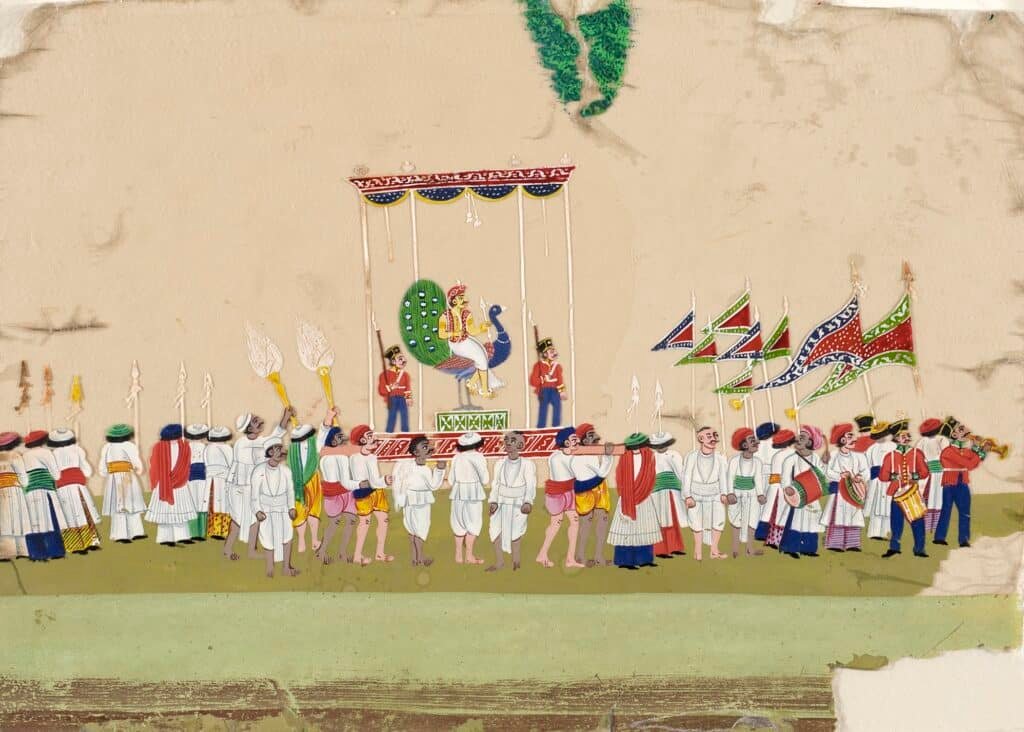
In this investigation
A procession takes what is usually contained inside a sacred place and makes it move. A deity, relic, icon, scripture, canopy, banner or sacred object enters streets where worship intersects with commerce, traffic, neighbours and the state.
This is why processions are among the most socially powerful religious forms. They do not merely gather believers. They redraw public space, making a community visible to itself and to everyone else.
Movement extends sacred geography
Research on processional religion emphasizes that carrying sacred objects beyond a place of worship can create a moving centre of sacred attention in otherwise ordinary streets.
The route itself may become meaningful, linking shrine, neighbourhood, river, cemetery, marketplace or civic centre.
THE RECORD
Processions are historically integral to many religious traditions because public movement combines worship, visibility, territorial memory and collective participation.
Walking together creates synchrony
Marching, chanting, drumming and singing coordinate bodies and attention. Research on ritual synchrony shows that such coordination can increase affiliation and shared identity under some conditions.
The effect is not unique to religion; military parades, protests and sports crowds also use coordinated movement.
THE EVIDENCE
Synchrony and shared attention plausibly strengthen participant identity. The same processes can also sharpen boundaries between groups, so cohesion should not be equated with universal prosociality.
Visibility is a form of recognition
A minority community may use procession to show that it belongs in a city. A majority community may use one to reaffirm historic presence. In either case, the street becomes a stage for identity.
This visibility can feel affirming to participants and threatening to others depending on political context.
Routes can encode memory
Returning along the same route each year can preserve relationships between a community and specific places. Children learn geography through ritual movement.
A route can become a map of sacred history.
Spectacle attracts nonparticipants
Music, costume, flowers and movement draw spectators who may never enter a temple, church or shrine. Processions therefore communicate religion beyond formal worshippers.
The boundary between participant and observer can remain fluid.
Public religion can generate political conflict
Scholarship on urban processions notes that public routes create opportunities for contact and conflict with other faiths and secular activities. Noise, timing, routes and symbolic claims can become politically charged.
This is not an accidental failure of procession. It follows from the form’s basic power: sacred identity is being asserted in shared space.
Crowd risk is physical, not symbolic
Dense processions can create crushing, heat, fire, traffic and emergency-access hazards. Good crowd management, route planning and communication are essential.
Sacred purpose does not alter crowd physics.
Processions redistribute labour
Decorating routes, carrying icons, cooking, music, cleanup and policing require coordinated work. The procession therefore creates temporary institutions around the event.
Participation can strengthen networks because people must solve practical problems together.
The sacred object can become accessible
Bringing an icon, relic or scripture into public space allows elderly, poor or geographically distant devotees along the route to encounter it without entering the central shrine.
This can broaden access while also intensifying public visibility.
Modern states regulate the route
Permits, security, sound restrictions and traffic management place processions within civic law. Negotiation over these rules reveals how religion and secular governance share public space.
Successful regulation requires understanding what ritual elements are flexible and which participants consider sacred.
Pune provides a contemporary example
Recent ethnographic work in old Pune examined Sikh, Jain and Ambedkarite processions sharing neighbourhood streets on the same date. The study showed how timing, bodily presence and sensory practices temporarily transform urban space while communities negotiate coexistence, regulation and belonging.
The example is useful because it shows that processions are not relics of premodern religion. They remain active ways of organizing plural urban space.
A procession changes the meaning of space by moving through it
A shrine normally concentrates sacred attention in one fixed location. A procession does the opposite: it carries icons, relics, scriptures, banners, lamps or other sacred objects into streets used for trade, traffic and everyday life. Recent scholarship describes this as an enlargement of sacred environment. The religious centre becomes mobile, and ordinary space is temporarily reorganized around it.
This helps explain why processions can feel more powerful than simply assembling a crowd outside a place of worship. Movement creates a sequence. Participants leave one point, pass through named neighbourhoods, pause at meaningful places and return. The route itself can become part of the ritual memory.
Routes are arguments about belonging
Public space is shared, which means every procession has a civic dimension even when participants understand it primarily as worship. To carry a sacred object through a market or city centre is to say that this community belongs visibly in that place. Urban historians have shown how public religious ceremonies can communicate solidarity, respectability, continuity and claims to recognition.
This is one reason route disputes become emotionally intense. To an outside administrator, moving a procession one street may look like a minor traffic adjustment. To participants, the original route may encode memory, honour specific shrines or demonstrate a historically important right of passage. Good regulation therefore requires understanding which elements are flexible and which carry sacred or political meaning.
Processions teach geography through the body
Maps represent space abstractly. Processions teach it through movement. A child learns where the temple stands relative to a river, gate, market, memorial or neighbourhood because the body repeatedly travels the route. Songs and stories can attach to particular stops. Over years, the route becomes a walking archive.
This embodied geography can preserve memories that are not obvious in architecture. A demolished gate, relocated shrine or changed neighbourhood may remain present in ritual because the procession still acknowledges it. Sacred landscapes are therefore partly created by repeated movement, not just by permanent buildings.
Synchrony works because bodies solve the same task together
Walking at the same pace, chanting the same phrase, responding to drums, carrying a platform or pausing at the same signal coordinates attention and movement. Research on collective ritual suggests that synchrony and shared emotional experience can strengthen affiliation and cooperation. A procession naturally produces many of these conditions.
But the mechanism should not be overstated. Participation does not automatically make a group harmonious, and highly synchronized crowds can support destructive as well as cooperative goals. The evidence supports a capacity for bonding, not a guarantee of moral improvement. Processions are tools of collective organization; what they organize people around depends on the surrounding culture and politics.
The audience is part of the ritual even when it does not join
Unlike worship inside a closed building, a procession is designed to be encountered by people who did not plan to attend. Shopkeepers pause, commuters reroute, residents watch from balconies and children follow the music. Religious practice becomes public communication.
This visibility can normalize a minority community by making its presence familiar, but it can also heighten tension if spectators experience the event as noise, obstruction or territorial assertion. The same spectacle can therefore be experienced as celebration by participants and intrusion by others. That ambiguity is built into the form rather than being an accidental modern problem.
Carrying the sacred outward can increase access
Moving icons, relics or scriptures through a community can bring sacred encounter to people who cannot easily reach the central shrine. Elderly residents, people with disabilities, those constrained by work or household responsibilities, and residents of distant neighbourhoods may all encounter the procession near home.
This function is particularly important in traditions where seeing the sacred object, receiving a blessing or participating in its passage carries religious value. The procession reverses the normal direction of pilgrimage: instead of everyone travelling toward the sacred centre, the sacred centre temporarily travels toward them.
Processions require temporary institutions
A large procession cannot happen through devotion alone. Someone coordinates musicians, decorations, route permissions, transport, water, food, sanitation, first aid, security and cleanup. Volunteers form teams; donors fund equipment; local businesses adapt; officials manage traffic. The ritual therefore creates a short-lived administrative system.
That work can strengthen community networks because people repeatedly solve practical problems together. It can also expose inequalities over who carries burdens, who receives prestige and who controls decision-making. The procession is therefore both spiritual performance and organizational test.
Public processions can be instruments of power as well as devotion
Historical rulers, churches and religious institutions have often used processions to demonstrate authority. Medieval and Renaissance Rome, for example, used carefully choreographed routes to connect sacred sites and manifest ecclesiastical and civic power. South Asian urban history likewise shows that processional rights became entangled with colonial administration, religious identity and claims over public space.
This political dimension should not be used to dismiss participants’ faith as insincere. Rituals can be sincerely devotional and politically consequential at the same time. The key is to avoid the opposite simplifications: neither “pure religion with no politics” nor “politics disguised as religion” explains every case.
Modern crowd science adds a practical layer ancient ritual could not formalize
Dense gatherings create predictable physical risks: bottlenecks, crushing, heat stress, falls, fire, blocked emergency routes and sudden surges. Sacred intention does not change crowd mechanics. Modern route design, capacity limits, barriers, communication systems and medical planning can therefore make an old ritual materially safer without altering its theology.
This is a strong example of modern relevance that does not require claiming ancient people anticipated contemporary crowd science. The tradition supplies the reason to gather; modern engineering can improve how that gathering is managed.
Processions survive because movement is itself meaningful
A livestream can show a sacred image, but it cannot fully reproduce the physical experience of carrying, walking, waiting, hearing drums approach, seeing a street change or moving beside thousands of others. That embodied quality helps explain why processions remain important even in societies saturated with digital media.
The practice persists not because streets have hidden biochemical power, but because movement makes relationship visible: between shrine and neighbourhood, sacred object and devotee, community and city, present participants and remembered generations. That is a substantial mechanism even though it is social rather than biomedical.
A procession turns a route into a repeated memory
Walking the same streets each year links religious narrative with physical geography. Participants learn where the community gathers, pauses, turns and encounters other neighbourhoods.
The route therefore becomes a map of belonging that can survive even as buildings and populations change.
Spectators are part of the social effect
A procession is designed to be seen. People watching from shops, windows or pavements may not share the faith, yet their presence makes the event public rather than internal.
That visibility can produce recognition, curiosity, inconvenience or conflict depending on context.
Public-space negotiation is part of modern procession life
Permits, sound limits, road closures and police coordination determine how a procession coexists with traffic, commerce and other communities. These administrative systems are modern layers on an old ritual form.
A successful procession now depends on both sacred legitimacy and civic cooperation.
Crowd density can change faster than organizers expect
Small bottlenecks, stopped vehicles or sudden changes in movement can create dangerous pressure in dense crowds. The risk comes from physics rather than individual panic alone.
Route design, monitoring and emergency access should therefore be treated as part of ritual stewardship.
Processions create a moving public rather than a stationary congregation
A temple or church gathers people at one site. A procession carries them through streets, exposing the ritual to residents, shops, traffic and other communities.
That movement changes who encounters the sacred event and makes visibility part of the rite itself.
Route repetition turns streets into memory
Following the same path year after year connects religious identity to specific corners, gates, rivers and neighbourhoods. Participants learn sacred geography through movement.
Route disputes can become intense precisely because changing the path can feel like changing historical recognition.
Crowd identity can improve cooperation and still require engineering
Research on religious mass gatherings shows shared identity can influence how people interpret crowd density and help one another. That social cooperation is valuable.
It cannot replace barriers, route capacity, medical access, heat planning or professional crowd management. Shared meaning does not change crowd physics.
Plural cities make processions a negotiation of coexistence
When different communities share roads, timing, sound and space, processions require civic negotiation. The right to public religious expression intersects with neighbours’ access and safety.
A well-managed procession therefore depends on both ritual knowledge and secular urban planning.
The procession’s social power comes from moving sacred identity through shared space where it can be witnessed, negotiated and remembered.
What survives scrutiny?
- Religious processions are historically widespread forms of public worship.
- They extend sacred symbolism into ordinary public space.
- Walking, chanting and music create coordinated attention and movement.
- Synchrony can strengthen participant affiliation and identity.
- Processions make communities visible to both insiders and outsiders.
- Visibility can foster recognition but also sharpen political and religious boundaries.
- Routes can preserve sacred geography and collective memory.
- Large processions require professional crowd-safety and civic planning.
The Tradivior Evidence Profile
Historical Authenticity — Strong. Processions are documented across Hindu, Christian, Buddhist, Islamic, Sikh, Jain and other traditions.
Original-Purpose Evidence — Strong. Worship, sacred presence, pilgrimage, commemoration and public recognition are direct functions.
Scientific Mechanism — Moderate. Synchrony, shared attention and identity signalling plausibly explain social effects.
Experimental Evidence — Limited. General synchrony research supports mechanisms, while whole public processions are studied mainly through fieldwork.
Cross-Cultural Evidence — Strong. Processional religion appears widely across traditions and regions.
Modern Relevance — Strong. Processions remain important for identity, public religion and civic negotiation.
The Tradivior Conclusion
Partially Supported. Religious processions take sacred things into the street because movement expands sacred geography and makes community visible. Modern research on synchrony and collective identity helps explain why coordinated public movement can strengthen belonging. But the same visibility can mark boundaries and generate conflict. A procession is powerful because it is neither private worship nor ordinary traffic: it temporarily transforms shared space into a public statement of sacred presence.
Continue investigating
Sources & further reading
- Leone M. “Transcendence and Transgression in Religious Processions.” Signs and Society. 2025.
- Whitehouse H, Lanman JA, et al. “Ritual and Religion as Social Technologies of Cooperation.” In: Culture, Mind, and Brain. Cambridge University Press; 2020.
- Swenson E. “The Archaeology of Ritual.” Annual Review of Anthropology. 2015;44:329–345.
- Fisher E. “Public Space, Public Canon: Situating religion at the dawn of modernity in South India.” Modern Asian Studies. 2018;52(5):1486–1541.
- Kong L. “Religious Processions: Urban Politics and Poetics.” Temenos. 2005;41(2):225–249.
- Payne RM. “Religious Parades and Processions in America.” Oxford Research Encyclopedia of Religion. 2017.
- Larios B. “Holy Birthdays and the Sharing of Streets in Two Neighborhoods of Old Pune, Maharashtra.” Religions. 2026;17(6):662.
- Research literature on ritual synchrony, public religion and shared urban space.
Continue exploring
Partially Supported
Why Is the Ganga Sacred?
The Ganga is river, goddess, pilgrimage route, purifier and national symbol. Tradivior will trace how these layers developed and evaluate modern claims about unusual self-purifying properties without confusing microbial findings…
Historically Practical
Why Did the Monsoon Shape Calendars and Rituals in South Asia?
In South Asia, rain determines sowing, travel, disease risk and food security, so the monsoon naturally entered ritual and seasonal calendars. Tradivior will trace how climate uncertainty became social time.
Historically Practical
Why Did People Divide the Day Into Sacred Hours?
Canonical hours, prayer watches, sandhya, salat times and other traditions punctuate the day with religious obligations. Tradivior will ask how astronomy, social order and daily rhythm turned clock time into…
Unsupported Claim
Why Do Indians Choose Muhurta for Auspicious Timing?
Muhurta assigns favourable times to weddings, travel, construction and other acts through calendrical and astrological rules. Tradivior will investigate its textual history and distinguish social coordination from unsupported causal claims…
Picked for your curiosity
Enable JavaScript to build a reading profile and see recommendations.