 tradivior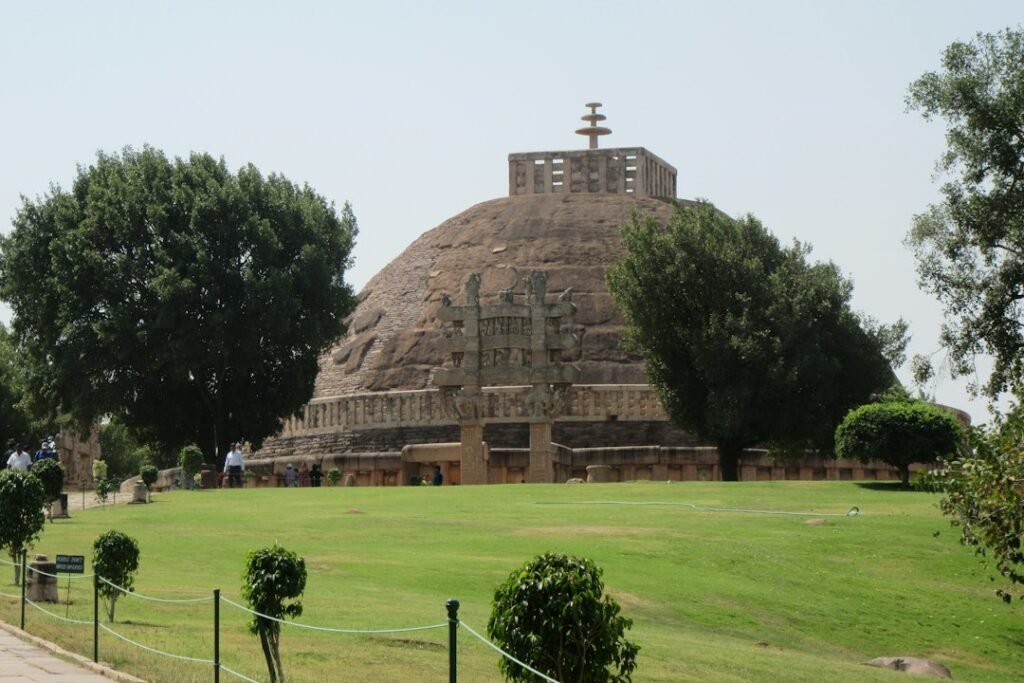
In this investigation
A Buddhist stupa is unusual because its most important interior is not normally entered. The sacred core is enclosed. The devotee approaches from outside, crosses a threshold, turns to the right and walks around the monument. The architecture does not invite occupation of the centre. It organizes movement around it.
This is one of the clearest examples of ritual and architecture becoming inseparable. At sites such as Sanchi, the railing, gateways, processional path and raised terrace do not merely decorate the stupa. They direct the body through a repeated clockwise circuit known as pradakshina or circumambulation.
Modern explanations sometimes turn that circular movement into claims about magnetic fields, energy vortices or advanced ancient neuroscience. The historical evidence does not require those ideas. Circumambulation already makes sense through relic veneration, embodied devotion, spatial hierarchy, repetition and collective ritual.
The stupa began as a mound associated with the dead
The word stupa originally referred to a mound. Burial mounds predate Buddhism in South Asia, and early Buddhist stupas developed from that broader funerary tradition.
After the Buddha’s death, relics associated with his cremated body became central to Buddhist memorial culture. Stupas containing relics turned places of burial into places of devotional presence.
A reliquary creates sacred importance without requiring interior access
If the sacred object is the relic contained inside, worshippers do not need to enter the monument. Instead, they approach, acknowledge and move around it.
This distinguishes the stupa from a hall designed primarily for congregation inside. The enclosed centre intensifies separation between sacred core and human movement.
THE ARCHITECTURAL LOGIC
The stupa is a sacred centre surrounded by a ritual path. The building therefore organizes devotion through movement around an inaccessible core rather than through entry into it.
Early Buddhist texts already connect stupas with remembrance
The Mahāparinibbāna Sutta contains traditions concerning the Buddha’s remains and the erection of stupas. Later Buddhist communities developed extensive reliquary cults around stupas associated with the Buddha, disciples and important teachers.
The monument therefore became a durable physical anchor for memory in a religion whose founder was no longer physically present.
Ashokan patronage helped spread the stupa across South Asia
Tradition credits the Mauryan emperor Ashoka with redistributing relics and sponsoring stupas across his realm. The famous claim that he built 84,000 stupas is legendary in scale, but archaeology and inscriptions confirm major Buddhist patronage during and after the Mauryan period.
Sanchi became one of the most important surviving examples, with an early core associated with Ashokan patronage and major enlargement and embellishment in later centuries.
The Great Stupa at Sanchi makes movement visible in stone
The enlarged Great Stupa at Sanchi is enclosed by a stone railing. Four monumental gateways or toranas orient the visitor at the cardinal directions.
The railing demarcates sacred space and defines the circumambulatory route. The devotee enters through a gateway and moves around the dome rather than toward an internal chamber.
The railing does more than separate sacred from ordinary
A fence can exclude, but at Sanchi it also organizes. It creates a controlled corridor around the stupa and establishes the direction of ritual travel.
This is spatial choreography. Architecture turns a religious expectation into a movement pattern that the body naturally follows.
Clockwise movement keeps the sacred object to the right
In South Asian ritual traditions, respectful circumambulation commonly proceeds clockwise so that the sacred person or object remains on the devotee’s right side.
The same principle appears in Hindu and Jain contexts, showing that Buddhist circumambulation belongs to a wider South Asian ritual language rather than being an isolated architectural invention.
The path converts reverence into bodily repetition
A static act of respect can be completed in seconds. Circumambulation takes time. The devotee repeatedly reorients toward the monument, passes the same gateways and remains physically engaged with the sacred centre.
The duration itself matters. Devotion is extended through effort and repetition.
Walking changes the sequence in which art is encountered
The gateways and railings at major stupas carry dense sculptural programs. A devotee moving around the monument encounters scenes in sequence rather than absorbing the whole structure from one fixed viewpoint.
Architecture therefore controls not only movement but viewing. Narrative becomes distributed across a route.
Early Buddhist art often represented the Buddha indirectly
At sites such as Sanchi, early reliefs frequently represent the Buddha through symbols such as the empty throne, Bodhi tree, wheel or stupa rather than a human figure.
This makes the stupa itself more than a container. It can stand for the Buddha’s presence and teachings within the visual program.
The devotee circles a centre that remains still
The contrast between moving body and unmoving centre became fertile ground for Buddhist symbolism. Later interpretation could connect the stable central axis with enlightenment while the circling devotee remained in motion.
That symbolism is meaningful, but it should not be mistaken for the only reason the architecture developed. Reliquary practice and ritual custom provide strong historical foundations before later cosmological interpretation is added.
The stupa creates a powerful spatial hierarchy
The central relic is inaccessible. The devotee remains at the perimeter. Vertical elements such as the harmika, central mast and umbrella forms rise above the dome.
The arrangement makes sacred importance spatially obvious: the centre is protected, elevated and visually dominant.
A raised circumambulatory terrace intensifies the ritual
Some major stupas include more than one circumambulatory level. At Sanchi, stairs lead to an upper path around the dome.
Ascending and circling change the devotee’s visual relationship to the monument. The ritual becomes a sequence of threshold, elevation and movement.
Rock-cut chaitya halls brought circumambulation indoors
Buddhist architecture did not restrict the practice to outdoor stupas. Rock-cut chaitya halls such as Karle place a stupa at the end of a long interior nave.
Side aisles wrap around the stupa, deliberately allowing devotees to walk behind it and return along the opposite side. Here the entire building is organized around processional circulation.
The chaitya proves that circumambulation was not an accidental path
If people merely happened to walk around stupas because open space existed, there would be little reason to carve side aisles into a rock-cut hall solely to preserve that movement.
Chaitya design provides strong architectural evidence that circumambulation was an intended ritual function.
THE HISTORICAL EVIDENCE
Railings, circumambulatory terraces and purpose-built aisles around stupas provide direct material evidence that ritual movement was designed into Buddhist sacred architecture.
Circumambulation creates repeated orientation
Walking around a fixed object forces continuous spatial updating. The devotee repeatedly tracks the centre while body orientation changes.
Modern cognitive science recognizes that movement and spatial memory are linked. Repeated paths become easier to remember, especially when anchored to a dominant landmark.
A visually dominant centre reduces navigational uncertainty
Unlike a complex maze, circumambulation offers a simple rule: keep the sacred monument beside you and continue around it.
This simplicity lets attention shift from navigation toward prayer, memory, recitation or viewing.
Repetition can support contemplative attention
Walking meditation is easier when the route itself requires little decision-making. A circular path repeatedly returns the practitioner to familiar visual cues.
This can produce attentional steadiness without implying that circles possess a special biological frequency.
Group circumambulation coordinates bodies without requiring perfect synchrony
Multiple devotees can walk the same route at different speeds while still participating in one ritual pattern.
The architecture therefore supports collective practice without requiring everyone to stop, face one direction or perform identical actions at the same moment.
Direction turns movement into moral order
Walking clockwise rather than randomly gives the path a normative structure. Correct movement becomes part of correct ritual behaviour.
Architecture reinforces this rule because gates, railings and stairs make some movements easier and others less natural.
The route can make sacred narratives memorable
Repeated exposure to relief scenes while walking the same path may reinforce memory through combined movement and visual sequence.
This is a plausible cognitive effect, but direct experimental evidence from ancient stupa ritual is naturally unavailable. We can identify the mechanism without pretending to know that ancient designers consciously described it in modern terms.
Circumambulation is cross-religious but not evidence of one universal origin
Hindus circumambulate temples and sacred objects. Jains do likewise. Muslims perform tawaf around the Kaaba. Christian architecture can include ambulatories around shrines and altars.
These similarities reveal a recurring human use of circular movement around sacred centres, but they do not prove that all traditions copied one original ritual or share the same theology.
Why circular movement works so well around a sacred centre
A circle allows repeated approach without penetration. It preserves a protected core while still permitting close physical engagement.
This makes circumambulation especially suitable for relics, tombs or sacred objects that should be approached but not handled.
The stupa can operate without a human image of the Buddha
Early Buddhist sites show that sacred presence did not depend on anthropomorphic sculpture. The relic mound, Bodhi tree, wheel or empty throne could anchor devotion.
Circumambulation made the devotee’s relationship to that presence bodily even when no human statue stood at the centre.
Patronage turned circumambulatory monuments into community projects
Donative inscriptions at Sanchi record contributions from monks, nuns, merchants and laypeople. The monumental complex was not produced only by kings.
This broad patronage suggests that the stupa and its ritual path belonged to a social network of donors, travellers and religious communities.
Trade routes helped sacred sites become movement hubs
Major Buddhist complexes were often located near routes of travel and exchange. Pilgrims, merchants and monastics moved through the same broader landscapes.
At the site itself, large-scale geographic movement contracts into repeated movement around a sacred centre.
Modern claims about “energy fields” go beyond the evidence
Popular explanations sometimes claim that clockwise circumambulation captures electromagnetic energy generated by the stupa or relics. Strong historical or physical evidence for such claims is lacking.
The ritual already has robust historical, spatial and psychological explanations. Adding unsupported physics does not make the tradition more meaningful.
Architecture can shape meditation without secretly being neuroscience
A predictable route, repeated landmark and controlled pace can support attention. Modern environmental psychology makes these mechanisms intelligible.
That does not prove ancient builders designed the path using a scientific model of spatial cognition. Skilled ritual architecture can work effectively without a modern theoretical vocabulary.
The symbolic wheel interpretation is powerful but should be treated carefully
Buddhist teaching uses wheel imagery extensively, including the Wheel of Dharma. Modern interpretations often connect the circular stupa plan, revolving movement and unmoving centre with enlightenment.
Such symbolism is consistent with Buddhist cosmological and doctrinal language, but specific symbolic readings may develop over time. Material function and theological interpretation should be presented together without assuming every later explanation caused the original architecture.
Modern stupas preserve the old movement logic
Contemporary Buddhist stupas around the world still provide circumambulatory paths. The architectural form continues to teach ritual behaviour directly.
A visitor often understands where to walk simply by reading the space, even before receiving detailed instruction.
What survives scrutiny?
- The Buddhist stupa developed from South Asian mound and reliquary traditions.
- Early stupas were associated with relics of the Buddha and later with other revered figures and symbolic presence.
- Stupas are generally approached from outside rather than entered.
- Railings, gateways and terraces at sites such as Sanchi explicitly define circumambulatory paths.
- Rock-cut chaitya halls provide especially strong architectural evidence that walking around the stupa was intentionally designed into worship space.
- Clockwise circumambulation keeps the sacred centre on the devotee’s right and belongs to a wider South Asian ritual pattern.
- Repeated circular walking can support orientation, pacing, memory and contemplative attention through ordinary cognitive mechanisms.
- Group circumambulation coordinates many devotees without requiring complete synchrony.
- Cross-religious examples show that humans repeatedly use circular movement around protected sacred centres, but this does not prove one universal origin.
- Claims that stupas generate special electromagnetic or bioenergetic fields are not supported by strong evidence.
- Later cosmological and doctrinal symbolism adds meaning without necessarily explaining the original architectural development.
The Tradivior Evidence Profile
Historical Authenticity — Strong. Stupas, relic veneration and circumambulatory architecture are extensively documented archaeologically and textually.
Original-Purpose Evidence — Strong. Relic honouring, devotional movement and ritual approach to the stupa are clearly supported by architecture and religious practice.
Scientific Mechanism — Moderate. Repetition, spatial orientation, landmark-based navigation and walking attention provide plausible cognitive mechanisms without requiring exotic physics.
Experimental Evidence — Limited. Modern research supports general effects of walking, repetition and spatial cues, but ancient stupa ritual cannot be experimentally reconstructed in its original context.
Cross-Cultural Evidence — Strong. Circumambulation appears across Buddhist, Hindu, Jain, Islamic and other sacred traditions, though meanings differ.
Modern Relevance — Strong. Circumambulation remains a living Buddhist practice and the architecture continues to organize ritual movement effectively.
The Tradivior Conclusion
Historically Practical and Primarily Symbolic/Cultural. Buddhist stupas were designed for circumambulation because the sacred centre was to be approached, honoured and remembered rather than entered. Railings, gateways, terraces and chaitya aisles turned devotional movement into architecture. Repeated clockwise walking also has ordinary cognitive effects on orientation, pacing and attention, but there is no need to invoke hidden energy fields or lost neuroscience. The practice survives scrutiny as embodied ritual design: the devotee learns the sacred order by moving through it.
Continue investigating
- Why Do Devotees Circumambulate Temples?
- Why Do Sacred Spaces Control Light So Carefully?
- Why Do Sacred Buildings Reach Upward?
Sources and further reading
- Smarthistory. “The Stupa, an Introduction.” Overview of relics, Sanchi, symbolism and circumambulation.
- Smarthistory. “Buddhist Monasteries.” Discussion of stupa, vihara and chaitya architecture, including aisles designed for circumambulation.
- Metropolitan Museum of Art. The Year One: Art of the Ancient World East and West. Discussion of Sanchi’s railing, gateways and circumambulatory worship.
- Metropolitan Museum of Art. The Art of South and Southeast Asia: A Resource for Educators. Discussion of stupa paths, gates, relics and pilgrimage.
- Mahāparinibbāna Sutta, traditions concerning the Buddha’s remains and stupas.
- Archaeological and epigraphic scholarship on Sanchi, Bharhut, Amaravati and early Buddhist patronage.
- Research in spatial cognition and environmental psychology on landmark-based navigation, repeated routes and embodied memory.
Continue exploring
Partially Supported
Why Do Religious Processions Take Sacred Things Into the Street?
Religious processions move sacred presence, symbols and communities through public space. They can expand shared identity through coordinated movement and visibility, but the same public occupation can mark boundaries and…

Primarily Symbolic/Cultural
Why Do Religions Regulate Meat?
Religions regulate meat because killing animals, blood, purity, sacrifice and communal identity carry unusually high moral weight. Some rules may have ecological or safety consequences, but Jewish, Islamic, Hindu, Jain,…
Partially Supported
Why Did Religions Across the World Practice Fasting?
Why did fasting emerge across Judaism, Christianity, Islam, Hinduism, Jainism and Buddhism? The evidence points to multiple religious purposes—not one hidden metabolic origin—while modern science confirms that different fasting protocols…

Evidence Supported
Why Do Festivals Move Through the Lunar Calendar?
Religious festivals move on the Gregorian calendar because many remain anchored to lunar or lunisolar systems. Pure lunar calendars drift through the seasons, while lunisolar calendars insert leap months to…
Picked for your curiosity
Enable JavaScript to build a reading profile and see recommendations.