 tradivior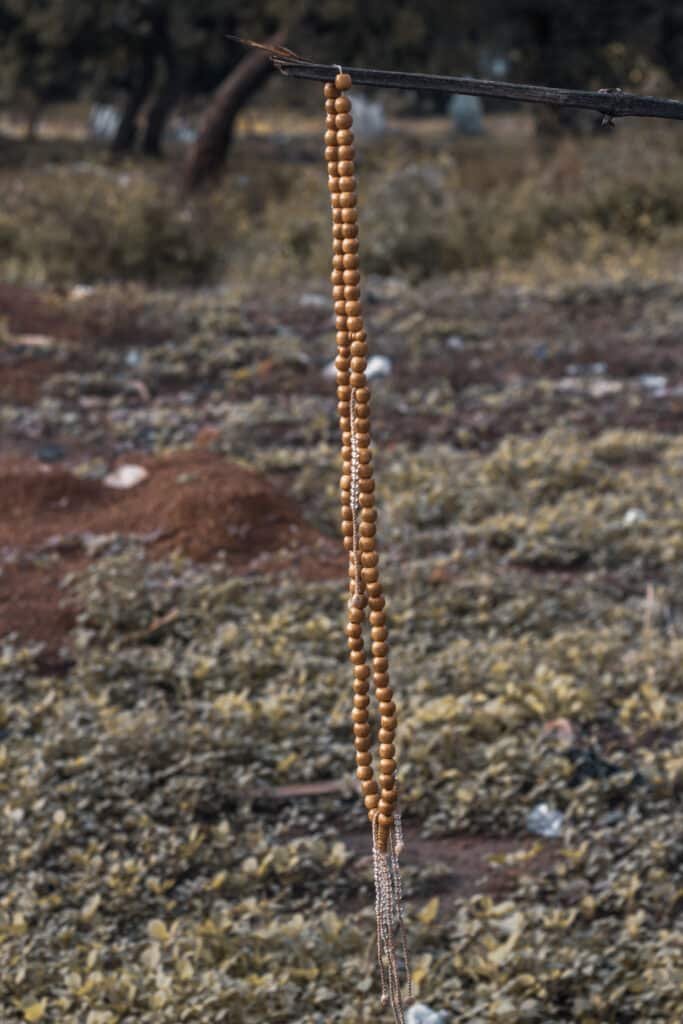
In this investigation
A string of beads passes through the fingers: one bead, one prayer; one bead, one mantra; one bead, one name. Hindu malas, Buddhist malas, Catholic rosaries, Orthodox prayer ropes, Islamic misbahas and other devotional counters look different and carry different theologies, but they solve a strikingly similar practical problem: how to repeat sacred words without using mental arithmetic to remember the count.
That simple function helps explain why prayer beads are so durable. They make repetition tangible. The hands count so attention can remain on the words, image or divine name.
Counting is not incidental
Many devotional traditions prescribe repetition in particular numbers or sequences. Once repetition matters, counting becomes a cognitive burden. Without an external aid, the practitioner must divide attention between prayer and tally.
Beads outsource that tally to touch. Moving one bead at a time turns an abstract number into a physical sequence.
The Hindu mala and japa
In Hindu traditions, malas are closely associated with japa—the repeated recitation of mantra or divine name. A full mala commonly contains 108 beads plus a larger or distinctive guru bead, though counts vary by tradition.
The number 108 has accumulated many symbolic explanations across Hindu and Buddhist traditions. It is risky to insist on one original scientific rationale. The historical importance lies more securely in the mala’s function as a structured counter within devotional repetition.
Buddhist malas
Buddhist traditions adopted and adapted bead-counting for mantra, recitation, aspiration and devotional practice. Numbers, materials and associated meanings vary between schools.
In Tibetan contexts, beads may accompany circumambulation, prostration or mantra recitation, integrating the hand into a larger body-speech-mind practice.
The Christian rosary and prayer rope
Christian traditions developed their own counting devices. The Catholic rosary organizes repeated Hail Marys, Our Fathers and meditations into decades. Eastern Christian prayer ropes use knots to count repeated prayers such as the Jesus Prayer.
The rosary therefore does more than tally. Its structure guides sequence. Larger beads, decades and attached symbols tell the hand when the prayer changes.
Islamic misbaha or tasbih
Muslim prayer beads commonly contain 33 or 99 counting beads and are used for dhikr. Finger-counting also has strong traditional precedent, and some Muslims prefer it, showing that beads are an aid rather than the essence of remembrance.
This distinction is important. The worship is the remembrance and recitation; the beads are a material technology that helps organize it.
Did prayer beads spread from one origin?
The history is too complex for a confident single-origin story. South Asian mala traditions are old, and trade, pilgrimage and religious contact created many opportunities for material practices to travel. Christian and Islamic counting traditions also have their own documented developments.
What can be said safely is that repeated devotion repeatedly creates a counting problem, and tactile counters are an efficient solution. Similar function does not prove independent invention, nor does resemblance prove direct borrowing.
Why touch is useful for counting
The fingers are excellent at sequential movement. Moving bead by bead requires little visual attention and can continue with the eyes closed. This makes beads suitable for repetitive prayer where gaze may be directed elsewhere or withdrawn entirely.
Tactile counting also reduces working-memory demand. Instead of remembering “I am on repetition 37,” the practitioner needs only to advance to the next bead.
Beads create rhythm
The hand establishes a pace. Each bead creates a small motor boundary between repetitions. Over time, recitation and finger movement can become tightly coupled.
This rhythmic coupling may help stabilize attention by reducing irregular pauses and uncertainty about progress.
Why completion matters
A string has a beginning and an end. Completing one circuit gives the practitioner a concrete sense that a devotional unit is finished. That can support motivation in practices involving high repetition.
Behavioural psychology recognizes the value of visible progress markers. Prayer beads provide such markers without requiring a screen, written tally or external observer.
Material itself can become meaningful
Wood, seeds, stone, bone, glass, amber and precious materials can all be used for prayer beads. In many traditions, material carries additional symbolism or lineage associations.
That meaning should not be confused with evidence that a particular bead material emits healing energy. Tactile texture and personal association can affect experience without proving gemstone or seed-based biomedical claims.
Can prayer beads improve attention?
Plausibly. Externalizing the count reduces one source of cognitive load and gives wandering fingers a task linked directly to the prayer. That can help some people sustain repetitive attention.
Direct experimental research comparing bead-assisted and non-bead prayer is limited, so this should remain a cognitive hypothesis rather than a proven universal effect.
Beads and breath
When prayer is paced slowly, bead movement may become loosely coordinated with breathing. This can create a steady rhythm, but there is no universal one-bead-one-breath rule across traditions.
Claims that specific bead counts automatically produce ideal respiratory patterns therefore overstate the evidence.
Why tactile ritual can calm some people
Repetitive hand movement can be soothing, especially when paired with familiar words and predictable sequence. Similar mechanisms help explain why people manipulate worry beads, fidget objects or repetitive crafts.
But prayer beads carry additional religious meaning. Calm, where it occurs, may come from tactile repetition, devotional belief, breathing, memory and perceived sacred relationship acting together.
Prayer beads as portable ritual
A bead string is compact. It turns structured devotion into something that can travel in a pocket, hang from a wrist or be carried on pilgrimage. This portability matters.
Sacred practice no longer depends on a building or book. The object provides an immediate ritual scaffold wherever the practitioner happens to be.
Why worn beads can become identity markers
Objects originally used for counting can also become visible signs of belonging. A rosary, mala or misbaha may communicate religious identity even when not actively used.
This social signalling can strengthen community recognition, though it can also expose wearers to stereotyping or commercial appropriation.
Commercialization changes the object
Modern wellness markets sell malas as fashion accessories, gemstone therapies or generalized mindfulness tools. This can detach the object from specific religious practices and attach new claims to it.
A scientifically cautious account distinguishes tactile and attentional effects from claims that gemstones, sacred numbers or bead materials emit unique therapeutic frequencies.
Why numbers attract pseudoscience
Counts such as 108, 99, 33 or 150 are symbolically rich and often have historical or devotional explanations. Modern writers sometimes reverse-engineer astronomical, anatomical or mathematical coincidences to prove that every number encodes advanced science.
Coincidence is easy to generate when many quantities are available. Historical intention requires historical evidence. A numerical match discovered today does not prove that it motivated an ancient devotional count.
Beads versus digital counters
Digital counters can perform the counting function efficiently, but they alter the sensory experience. Traditional beads provide texture, weight, movement and a physical cycle that does not require a battery or screen.
This comparison helps isolate function. Counting can survive without beads, showing that the material object is useful but not always doctrinally necessary.
Could beads become compulsive?
Any counting ritual can become problematic if a person believes catastrophe will follow from an imperfect count or feels unable to stop. This is especially relevant in scrupulosity and obsessive-compulsive disorder.
Normal devotional repetition should not be pathologized, but function matters more than appearance. The same object can support meaningful prayer in one person and compulsive checking in another.
Prayer beads externalize memory
One of the clearest cognitive advantages of beads is that they move part of the memory task outside the head. The string records progress physically. The practitioner does not need to hold a running numerical total in working memory while simultaneously sustaining prayer or mantra.
This is an example of extended cognition: thinking is supported by an external object. The same principle appears in tally sticks, notebooks, calendars and digital counters. Prayer beads are a religiously embedded version of a very general human strategy.
Why tactile sequence can reduce distraction
A wandering hand can become an anchor. Each bead provides a small tactile event linked to the next repetition. That sensorimotor sequence may help some practitioners notice when attention has drifted and return to the prayer.
Direct experimental evidence remains limited, but the mechanism is plausible because the counting demand is transferred from conscious arithmetic to repetitive finger movement.
Different traditions give the numbers different meanings
The counts attached to bead strings are not interchangeable. Hindu and Buddhist malas commonly use 108, Islamic misbahas often use 33 or 99, Catholic rosaries structure prayer through decades, and Orthodox ropes vary in knot count.
These differences show that there is no single sacred number explaining prayer beads as a category. The common mechanism is counting; the meaning of the number belongs to each tradition.
Why materials acquire secondary symbolism
Once beads are used repeatedly in sacred practice, their material can acquire devotional associations. Rudraksha seeds, tulsi wood, olive wood, glass, amber or stone can become linked to specific lineages or identities.
This does not mean the material is inert culturally. It means symbolic value should not be confused with proof of gemstone therapy, electromagnetic healing or biochemical effects from casual skin contact.
The object can become autobiographical
A bead string used for years can accumulate personal memory. It may be associated with a parent, pilgrimage, teacher, illness or period of intense devotion. Over time, the object can become emotionally charged through biography.
This helps explain why replacing old beads with an identical new set can feel different. The practical counting function is the same, but the learned emotional associations are not.
Why rosary, mala and misbaha should not be collapsed into one spirituality
Comparative similarity can obscure doctrinal difference. A mala used for mantra, a rosary used for Marian prayer and a misbaha used for dhikr may all involve tactile counting, but the words, theology and religious aims differ.
The responsible comparative claim is therefore functional rather than theological: tactile counters support repeated devotion across traditions.
Could the beads themselves calm the nervous system?
Repetitive hand movement can feel soothing, and slow recitation can influence breathing. But there is not enough evidence to claim that bead manipulation uniquely activates a particular autonomic pathway.
If calming occurs, it is more likely to emerge from the combined ritual—touch, repetition, breath, meaning and familiarity—than from a special property of beads as such.
Why prayer beads persist despite digital alternatives
Phone apps and digital counters can track repetitions more precisely, yet many practitioners prefer beads. The reason may lie in sensory simplicity: no screen, no notification, no battery and a tactile object already embedded in tradition.
This persistence suggests that prayer beads are not merely primitive counters waiting to be replaced. Their materiality has become part of the devotional experience.
Research gaps
Prayer beads are widespread enough that surprisingly little direct cognitive research has tested them. Future studies could compare bead-assisted prayer with mental counting, finger counting and digital counters while measuring attention, error rate, perceived absorption and stress.
Such work would clarify which benefits come from external counting and which come from religious meaning. Until then, the cognitive mechanism is plausible but should not be oversold as clinically proven.
Counting tools can shape the pace of devotion
Beads do not merely record how many repetitions have occurred; they can influence tempo. Smooth, evenly spaced beads encourage a regular tactile rhythm, while divider beads or larger markers create pauses and transitions.
This makes the object part of the timing architecture of prayer. The pace is still chosen by the practitioner, but the string provides physical segmentation.
Why ordinary objects become sacred through use
A bead is physically simple, yet repeated devotional use can transform it into a valued personal object. Handling, inheritance and association with prayer give it a biography.
Material-culture research helps explain this transformation without invoking hidden properties: objects become powerful because human relationships, memory and practice accumulate around them.
Why error reduction matters in repetitive prayer
Long sequences are vulnerable to losing count, especially when attention becomes absorbed in the words. Beads reduce this error because each repetition has a physical marker. The practitioner can resume after distraction without reconstructing the total mentally.
This practical advantage becomes more important as repetition counts increase. A device that lowers counting error while demanding little visual attention is well suited to devotional use.
Why prayer beads become inheritance objects
Beads may be passed from teacher to student or parent to child. In such cases, the string carries lineage and memory in addition to counting function. The object becomes evidence of relationship.
This inherited meaning can intensify attachment without implying any transferable physical energy. Social memory is enough to make an ordinary material object feel sacred.
Another useful comparison is with finger counting. If finger counting produces the same attentional benefits as beads, then the critical mechanism is likely externalized tactile sequencing rather than any special property of the bead material itself.
Seen this way, prayer beads are a particularly elegant material technology: simple enough to use almost automatically, structured enough to reduce counting errors, and flexible enough to absorb very different religious meanings.
The object’s success lies in this combination of simplicity and meaning: it counts accurately while becoming inseparable from the devotional habit built around it.
The strongest modern interpretation is therefore functional and material, not mystical.
That is why the beads endure.
Simple, tactile, effective.
What survives scrutiny?
Prayer beads are practical counting technologies embedded in religious practice. They reduce mental tallying, create tactile rhythm, provide progress markers and make repetitive devotion portable.
The evidence does not support claims that particular bead materials or sacred counts possess universal healing frequencies. The strongest explanation is cognitive, devotional and material rather than biomedical.
The Tradivior Evidence Profile
Historical Authenticity — Strong. Prayer beads and counting cords are well documented across multiple religious traditions.
Original-Purpose Evidence — Strong. Counting repeated prayer, mantra or remembrance is the clearest practical purpose.
Scientific Mechanism — Strong. Externalized counting, tactile sequencing, working-memory reduction and rhythmic motor action provide straightforward cognitive mechanisms.
Experimental Evidence — Limited. Direct comparative experiments on prayer beads are sparse despite strong cognitive plausibility.
Cross-Cultural Evidence — Strong. Bead- or knot-based devotional counting appears across Hindu, Buddhist, Christian, Islamic and other traditions.
Modern Relevance — Strong. Prayer beads remain widely used and continue to adapt alongside digital alternatives.
The Tradivior Conclusion
Historically Practical. Prayer beads persist because they solve a real cognitive problem elegantly: they let the hand count while the mind remains with the prayer. Their religious meanings differ across traditions, and their materials can become symbolically important, but no hidden biomedical mechanism is required. The simplest explanation is also the strongest—devotion became tactile because tactile counting works.
Sources and further reading
- Material-culture and religious-studies scholarship on mala, rosary, prayer rope and misbaha traditions.
- Historical scholarship on Christian rosary development and earlier Pater Noster counting traditions.
- Studies of Hindu and Buddhist japa and mantra-counting practices.
- Cognitive literature on external memory aids, working memory and sensorimotor sequencing.
Continue exploring
Why Do People Keep Ashes, Relics and Memorial Objects?
Hair, ashes, bones, clothing, photographs and relics allow the dead to remain materially present. Tradivior will examine why objects carry memory so powerfully and how continuing bonds differ from pathological…
Why Do Cultures Set Aside Days to Remember the Dead?
From Pitru Paksha and Qingming to Día de Muertos and All Souls’ Day, cultures repeatedly create calendar time for the dead. Tradivior will compare how recurring remembrance renews kinship, grief…
Why Do Cultures Preserve the Dead?
Mummification, embalming, freezing, smoking and desiccation reflect very different beliefs about bodies and afterlives. Tradivior will compare preservation traditions with the chemistry of decomposition and the practical limits of each…
Why Do People Change Names, Clothes or Homes After Marriage?
Marriage often transforms identity through surname changes, new dress, residence, kinship terms or household membership. Tradivior will investigate why marriage needs visible social consequences beyond the ceremony itself.
Picked for your curiosity
Enable JavaScript to build a reading profile and see recommendations.