 tradivior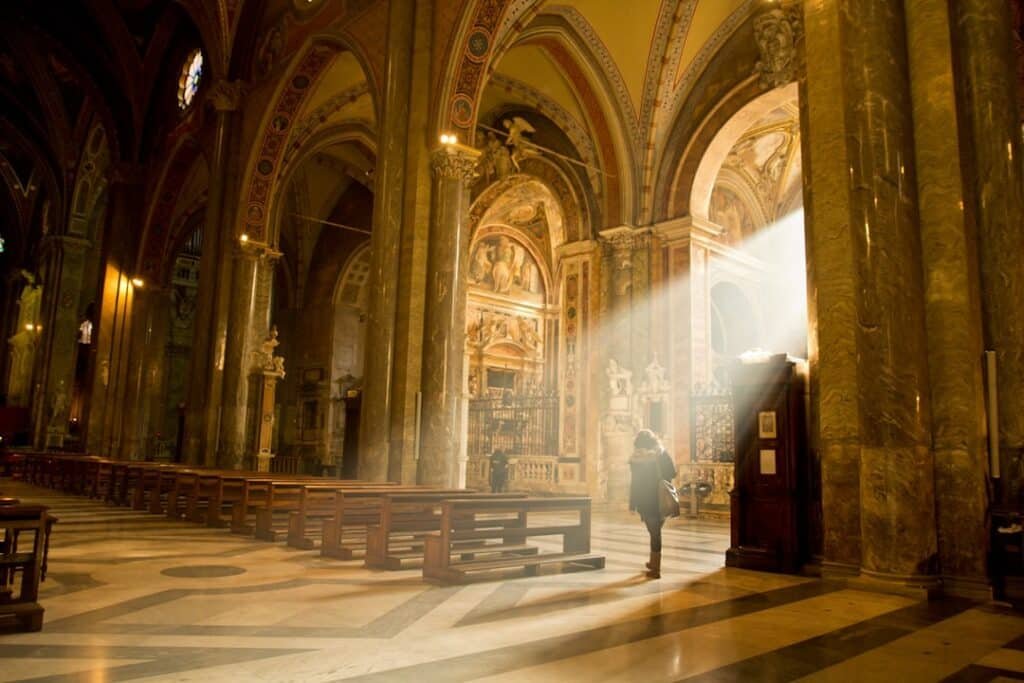
In this investigation
Sacred buildings rarely treat light as neutral. Some flood the worshipper with colour. Others keep the holiest chamber almost dark. Lamps may reveal icons gradually. High windows may separate the visible source of light from the people receiving it. A doorway may lead from bright exterior space into a dim interior and then toward a brighter sanctuary.
These effects can feel mysterious, but their mechanisms are understandable. Light controls what can be seen, how quickly the eyes adapt, which surfaces attract attention and how large or enclosed a room feels. Religious architecture then layers meaning onto those perceptual effects.
The important historical caution is that there is no single sacred-light formula. Hindu temples, Byzantine churches, Gothic cathedrals, mosques, synagogues and shrines use light differently because their rituals, images, climates and theological traditions differ.
Light determines what becomes visually important
Human vision is strongly drawn to contrast. A bright object in a dark room attracts attention. A shaft of daylight on an altar, icon, mihrab or sculpture can make that element visually dominant without any verbal instruction.
This gives architects a powerful tool: control the light and you partly control the sequence of looking.
THE PERCEPTUAL LOGIC
Sacred lighting can direct attention before theology is explained. Brightness, darkness, colour and direction organize perception first; symbolic interpretation then gives that perception religious meaning.
Darkness can make a sacred centre feel protected
Some Hindu temples place the deity in a dark, windowless garbhagriha, literally the “womb chamber.” The contrast with exterior daylight is deliberate and spatially powerful.
The worshipper moves from open, brighter spaces toward a smaller, darker centre where the deity is revealed by lamp light. Darkness therefore increases separation, intimacy and focus.
The garbhagriha is not designed as a congregational hall
Unlike many churches or mosques, the central Hindu shrine is not primarily intended to hold a large congregation. It houses the deity and structures darshan—the visual encounter between devotee and divine image.
Low light makes the moment of illumination more concentrated. The visual experience becomes episodic rather than continuous.
Lamps transform an image by revealing it selectively
Oil lamps create moving, local light. Instead of exposing every surface equally, they make metal, jewellery and polished stone shimmer while leaving other details in shadow.
The result is dynamic. The deity does not appear as a museum object under uniform illumination but as a presence encountered through ritual light.
Byzantine churches used illumination to stage icons and ritual
Research on middle Byzantine churches emphasizes that illumination was both practical and experiential. Windows, lamps and candles had to make worship possible while also shaping how iconographic programs appeared during liturgy.
Gold mosaics respond dramatically to shifting light. Their reflective surfaces can appear to dissolve the solidity of walls, making sacred figures seem less fixed than painted images under flat illumination.
Artificial light mattered because worship continued after sunset
Before electric lighting, churches, temples and mosques depended on daylight, lamps and candles. Night services required deliberate placement of flame sources.
Illumination therefore had an operational function before any symbolism is considered: people needed enough light to move, read, chant and see ritual action.
Gothic architecture turned walls into luminous surfaces
Gothic structural innovations allowed larger windows and thinner wall surfaces. Stained glass transformed incoming sunlight into coloured light that covered floors, columns and people.
Medieval theological interpretation strongly associated light with divine presence. The architecture therefore joined engineering, material craft and religious symbolism.
Abbot Suger made light a theological argument
The rebuilding of Saint-Denis in the twelfth century became especially influential in discussions of Gothic light. Suger described precious materials and luminosity in language connecting physical splendour with spiritual elevation.
Modern scholars debate exactly how directly his theology caused specific architectural innovations, but his writings clearly demonstrate that light and glitter could be interpreted religiously, not merely aesthetically.
Stained glass does more than brighten a church
Stained glass filters, colours and fragments incoming sunlight. It can display narrative images while simultaneously changing the entire chromatic atmosphere of the interior.
The worshipper therefore encounters doctrine through both picture and environment.
Light can make architecture feel less material
When bright windows dominate the upper walls, the structural mass of stone can become perceptually less obvious. Columns and ribs seem to frame fields of light rather than support heavy masonry.
This perceptual dematerialization helps explain why luminous interiors could be interpreted as images of heaven.
Islamic architecture also developed sophisticated light-dark sequences
Islamic sacred architecture varies enormously, but many traditions use courtyards, screens, domes, filtered openings and transitional spaces to regulate daylight.
In some Sufi architectural interpretations, movement from darkness toward light can be explicitly read as a metaphor for inner transformation. In ordinary mosque design, daylight also serves practical needs for prayer, orientation and visual comfort.
Screens allow light without fully opening the wall
Perforated stone or wooden screens such as jali and mashrabiya break sunlight into smaller patterns. They reduce glare, increase privacy and create changing geometric shadows.
The same device can therefore solve climate and privacy problems while creating a visually contemplative effect.
Filtered light is especially useful in hot climates
Direct solar exposure increases heat and glare. Deep overhangs, courtyards, screens and limited openings reduce those problems.
A sacred atmosphere can therefore grow from climate adaptation as much as from symbolic intention.
THE EVIDENCE RULE
A lighting feature can be simultaneously practical and symbolic. Shade may reduce heat; the resulting darkness may later acquire theological meaning. One explanation does not cancel the other.
Light controls adaptation as people move through thresholds
The human visual system adapts to brightness. Moving from sunlight into a dark interior temporarily reduces visual sensitivity until the eyes adjust.
Architectural transitions can use this effect. A bright entrance followed by a dim passage slows perception; emerging into a brighter sanctuary can then feel dramatic.
Slow visual adaptation can make ritual movement more deliberate
When visibility decreases, people often move more carefully. That naturally slows pace and increases awareness of thresholds and obstacles.
This can reinforce ritual seriousness without requiring builders to possess a formal scientific theory of retinal adaptation.
Contrast can isolate sacred objects from surrounding clutter
A small bright flame in darkness is perceptually stronger than the same flame in daylight. A lit icon, altar or relic can become the only visually dominant object in the room.
This helps religious ritual direct collective attention efficiently.
Colour changes emotional atmosphere
Warm firelight, coloured glass and cool daylight produce different visual environments. Human responses to colour depend on context and culture, but light temperature and saturation undeniably affect how materials and faces appear.
Religious interpretation can then attach specific meanings to those perceptual qualities.
Orientation can create time-specific illumination
Buildings aligned toward particular directions receive changing sunlight at different times of day and year. In some monuments, this can create striking moments when a beam reaches a specific interior surface.
Such effects must be evaluated case by case. A compelling alignment is not automatically proof of precise astronomical intent unless historical or archaeological evidence supports it.
Sacred architecture can make time visible
Changing daylight marks morning, noon, evening and season. In religious communities organized around prayer hours, this can link architecture to daily ritual rhythm.
Light therefore becomes a clock without needing a mechanical device.
Candles and lamps create social focus as well as illumination
A group gathered around a limited light source tends to orient toward the illuminated centre. Darkness suppresses competing visual information.
This makes flame especially effective for prayer, mourning, vigil and ritual reading.
Light can distinguish ordinary from restricted space
Sacred buildings often contain zones of different access. Lighting differences can reinforce those boundaries: bright public courtyards, dim transition halls and carefully lit inner sanctuaries.
The worshipper does not need a sign explaining that the spatial hierarchy has changed; the sensory environment communicates it.
Darkness can produce intimacy rather than fear
Low illumination reduces the visible scale of a room because distant boundaries disappear. This can make a large building feel psychologically closer and more enclosed.
That property is useful in contemplative spaces where inward attention is valued.
Bright interiors can produce the opposite effect
Abundant daylight reveals height, volume and decorative detail. It can make a building feel expansive and public.
Traditions therefore select different lighting strategies depending on whether they want intimacy, magnificence, clarity or mystery.
Religious symbolism often develops around universal perceptual facts
Humans everywhere experience darkness as limited visibility and light as revelation. It is unsurprising that religions repeatedly use light as a metaphor for knowledge, divinity, purity or awakening.
That cross-cultural recurrence does not prove one shared origin. Similar embodied experiences can generate similar symbolic associations independently.
Not every dark temple is “mystical engineering”
Limited windows may result from thick masonry, climate, defence, construction technology or structural constraints.
Later worshippers can interpret the resulting darkness spiritually even when the original builder faced practical limitations.
Not every bright cathedral was designed as a psychological experiment
Modern neuroscience can explain how luminance and colour affect attention and perception. Medieval builders did not need that vocabulary to discover effective visual techniques.
Repeated craft practice, theology and aesthetic preference are enough to generate sophisticated environments.
Modern lighting design proves the old effects remain relevant
Contemporary museums, theatres and houses of worship continue to use spot lighting, shadow, colour temperature and daylight control to direct attention and mood.
The tools have changed from stone screens and oil lamps to LEDs and automated blinds, but the perceptual principles remain recognizable.
What survives scrutiny?
- Sacred architecture across cultures deliberately controls daylight and artificial illumination.
- Hindu garbhagrihas often use darkness and local lamp light to intensify focus on the deity.
- Byzantine churches used natural and artificial light to stage liturgy, icons and reflective surfaces.
- Gothic architecture expanded stained glass and luminous interiors through structural innovation.
- Islamic sacred architecture often uses courtyards, screens and transitional spaces to control glare, privacy and atmosphere.
- Light-dark contrast strongly directs visual attention through ordinary perceptual mechanisms.
- Moving between bright and dim spaces changes visual adaptation and can slow or dramatize movement.
- Climate, materials and structural constraints often explain lighting choices alongside religious symbolism.
- Time-specific illumination and solar alignment must be evaluated case by case rather than assumed.
- Religious meanings of light can be historically authentic without proving hidden neuroscience or one universal architectural doctrine.
The Tradivior Evidence Profile
Historical Authenticity — Strong. Controlled natural and artificial illumination is extensively documented in temples, churches, mosques and other sacred architecture.
Original-Purpose Evidence — Strong. Practical illumination, ritual visibility, icon display, climate control and symbolic uses of light are all historically supported.
Scientific Mechanism — Strong. Luminance, contrast, visual adaptation, colour and directional lighting have clear perceptual effects.
Experimental Evidence — Moderate. Modern lighting and environmental-psychology research supports the mechanisms, while historical design intention must be reconstructed cautiously.
Cross-Cultural Evidence — Strong. Sacred traditions repeatedly control light, though the forms and theological meanings vary greatly.
Modern Relevance — Strong. Contemporary worship and architectural design continue to use controlled light to organize attention, atmosphere and ritual focus.
The Tradivior Conclusion
Evidence Supported—with strong symbolic layers. Sacred spaces control light because illumination is one of architecture’s most powerful ways to direct attention, reveal hierarchy, regulate movement and alter perceived atmosphere. Historical evidence shows that religious traditions intentionally used darkness, filtered daylight, lamps and luminous surfaces for both practical and symbolic purposes. Modern perceptual science explains why these strategies work, but does not prove that ancient builders possessed hidden neuroscience. Sacred light survives scrutiny as a genuine meeting point between environmental design and religious meaning.
Continue investigating
- Why Did Churches Develop Naves, Apses and Bell Towers?
- Why Were Buddhist Stupas Designed for Circumambulation?
- Why Do Domes, Vaults and Chambers Change Sacred Sound?
Sources and further reading
- Nesbitt C. “Shaping the sacred: light and the experience of worship in middle Byzantine churches.” Byzantine and Modern Greek Studies. 2016.
- Crow JR. A New Material Interpretation of Twelfth-Century Architecture. Amsterdam University Press / Cambridge Core; 2024–2025.
- Smarthistory. “Sacred Space and Symbolic Form at Lakshmana Temple, Khajuraho.” Discussion of the dark, windowless garbhagriha.
- Metropolitan Museum of Art and medieval art scholarship on Gothic stained glass, verticality and sacred light.
- Research on daylighting and visual comfort in mosque prayer halls and Islamic sacred architecture.
- Environmental psychology and lighting-science literature on luminance contrast, adaptation, colour and attention.
Continue exploring

Why Do People Keep Ashes, Relics and Memorial Objects?
Hair, ashes, bones, clothing, photographs and relics allow the dead to remain materially present. Tradivior will examine why objects carry memory so powerfully and how continuing bonds differ from pathological…

Why Do Cultures Set Aside Days to Remember the Dead?
From Pitru Paksha and Qingming to Día de Muertos and All Souls’ Day, cultures repeatedly create calendar time for the dead. Tradivior will compare how recurring remembrance renews kinship, grief…
Why Do Cultures Preserve the Dead?
Mummification, embalming, freezing, smoking and desiccation reflect very different beliefs about bodies and afterlives. Tradivior will compare preservation traditions with the chemistry of decomposition and the practical limits of each…
Why Do People Change Names, Clothes or Homes After Marriage?
Marriage often transforms identity through surname changes, new dress, residence, kinship terms or household membership. Tradivior will investigate why marriage needs visible social consequences beyond the ceremony itself.
Picked for your curiosity
Enable JavaScript to build a reading profile and see recommendations.